The Indonesia-US Trade Agreement on Reciprocal Tariffs threatens Indonesia's food and national sovereignty
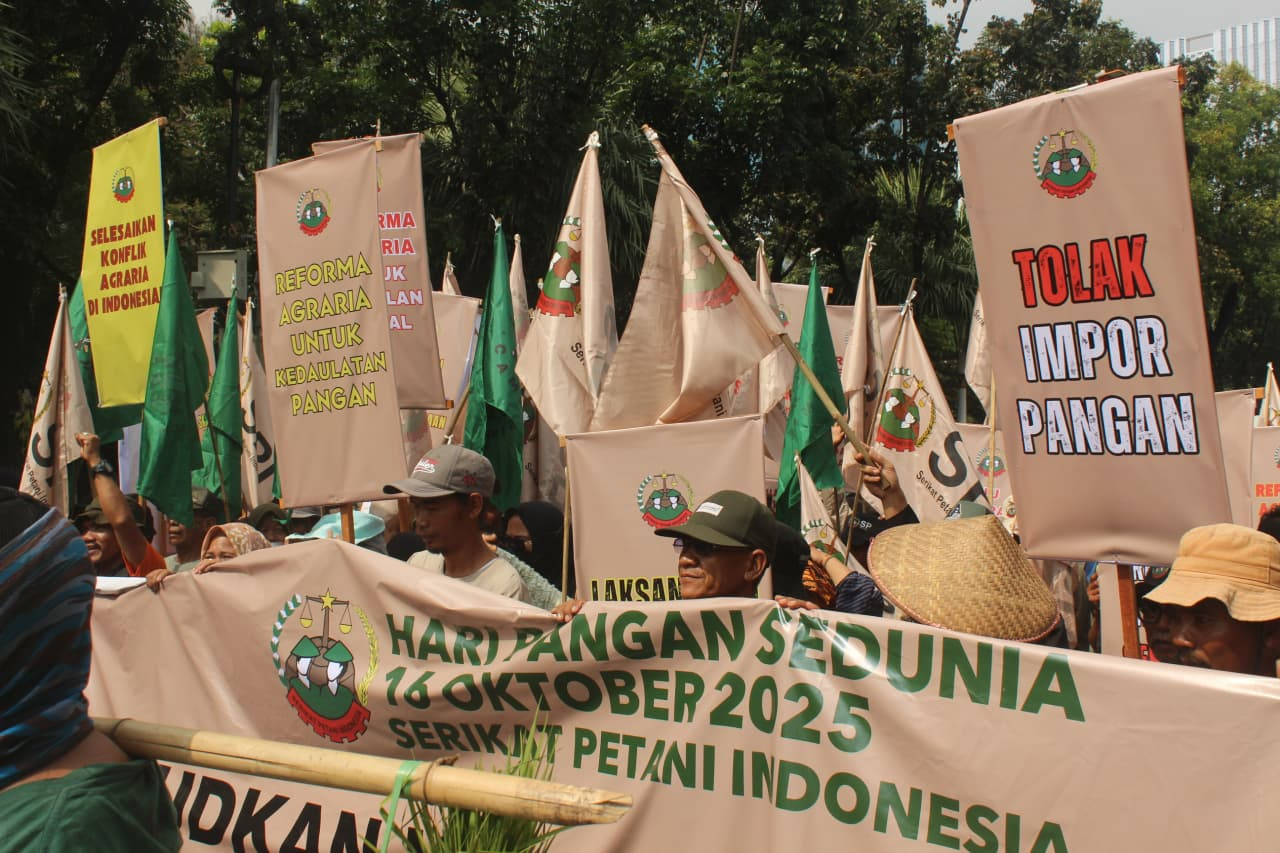
On February 19, 2026, in Washington, D.C., the Indonesia–United States ART was signed during Indonesian President Prabowo Subianto's visit to the United States and his meeting with President Donald Trump. This agreement resulted from a series of negotiations that took place throughout 2025, after the United States government imposed reciprocal tariffs on many Indonesian products, which increased pressure on bilateral trade relations. This was part of Trump's obsession with Make America Great Again (MAGA), but at the expense of the sovereignty of partner countries and their food sovereignty. SPI believes that this agreement has the potential to narrow the scope of national policy in protecting the agriculture and food sectors and has direct and fundamental implications for the direction of national agricultural policy, food sovereignty, and the livelihoods of small farmers, even threatening the sovereignty of the Indonesian state.
The Chairperson of SPI, Henry Saragih, stated that this agreement not only reorganizes the tariff structure but also limits the use of non-tariff instruments such as quotas, commodity balances, certification, sanitary and phytosanitary measures, and import licensing, which have been used as tools to control domestic production and price stability as well as to protect farmers at the national level.
"Agricultural products from the US are exempt from commodity balance policies and various import licensing regimes and are only subject to automatic licensing. Indonesia is also required to recognize the US food control system, accept official certification without additional registration, open access to certain horticultural products, chicken cuts, live livestock, and livestock genetics, and align animal disease regulations with international standards recognized by US authorities. This provision expands recognition of the US regulatory system while disregarding national food trade regulations," Henry explained.
Furthermore, Henry stated that this agreement contains significant imbalances in regulating agricultural commodities between the two countries. "Indonesia is required to liberalize imports of US agricultural commodities worth USD 4.5 billion, including cotton, soybeans, soybean meal, and wheat in volumes of millions of tons per year, as well as guaranteeing an increase in imports of beef, corn, rice, fresh fruit, and other products at a certain minimum level. This commitment has the potential to suppress domestic production, weaken farmers' bargaining position, and disrupt price stability at the producer level, especially for strategic commodities such as soybeans, corn, and rice, which are essential to the livelihoods of many people. Meanwhile, access for Indonesian products to the US market is not tied to an equivalent minimum purchase scheme, but remains subject to reciprocal tariffs and various trade provisions that are subject to change in accordance with US policy. Thus, there is an imbalance in commitment, whereby Indonesia is required to guarantee a certain volume of imports, while Indonesian exports to the United States do not receive similar guarantees," Henry emphasized.
Zainal Arifin Fuad, a member of the International Coordinating Committee (ICC) of La Via Campesina who is also Deputy Chair of SPI's International Affairs Division, said that one of the provisions of the agreement that could potentially harm farmers is the obligation to ratify UPOV 91.
The obligation to ratify the International Convention for the Protection of New Varieties of Plants (UPOV 1991) also raises concerns, as it has the potential to limit farmers' rights to save, exchange, and reproduce seeds from protected varieties. This provision could increase farmers' dependence on licensed commercial seeds and narrow the scope of national seed sovereignty, which has long been a practice in smallholder agriculture," Zainal explained.
Zainal also believes that this agreement includes the alignment of economic and national security policies with other countries based on the interests of the United States. "Indonesia may be encouraged to follow restrictions imposed by the United States on certain countries or entities, even though these restrictions may not necessarily be in line with Indonesia's national interests. This risks narrowing the flexibility of Indonesia's economic diplomacy, reducing the country's ability to pursue an independent foreign policy, and placing national trade policy in the shadow of a global geopolitical configuration determined by major powers," concluded Zainal.
In addition, the substance of this agreement also has the potential to conflict with Law No. 37 of 1999 concerning Foreign Relations and MPR Decree No. IV/MPR/1973, which stipulates that Indonesia's foreign policy must be conducted based on the principles of free and active diplomacy, upholding national sovereignty and equality among nations, and not being bound by the interests or pressures of any foreign power. This contradicts the constitutional mandate and broad outlines of state policy as stipulated by the Majelis Permusyawaratan Rakyat (MPR)/People's Consultative Assembly of the Republic of Indonesia, which places national sovereignty and freedom in determining international stance as fundamental principles in Indonesia's foreign relations.
In closing, Henry emphasized that the government is obliged to conduct a comprehensive, transparent, and participatory evaluation of this agreement in accordance with applicable national regulations. "Based on the 2018 Constitutional Court ruling on the judicial review of Law No. 24 of 2000 on International Agreements submitted by SPI together with a civil society alliance, international agreements that have a broad and fundamental impact on the lives of the people, establishment of new legal norms, as well as matters concerning economic sovereignty, cannot be ratified unilaterally by the President or other executive institutions, but must obtain the approval of the House of Representatives through the mechanism of legislation. Given that the substance of this Indonesia-United States trade agreement concerns quantitative import commitments, restrictions on trade policy space, seed protection, and the harmonization of strategic economic and geopolitical policies, even the political sovereignty of the Indonesian, then it is only fitting that the ratification process be conducted openly, constitutionally, and with parliamentary oversight to ensure accountability and protection of the people's interests," concluded Henry.