

US vows to complete S.Korea trade deal
By Shaun Tandon (AFP)
WASHINGTON — The United States vowed an all-out effort to finalize a free trade agreement with South Korea as the two nations meet Tuesday, despite criticism of President Barack Obama within his own ranks.
President Barack Obama heads on November 11-12 to a Group of 20 summit in South Korea, where he hopes to boost his close alliance with President Lee Myung-Bak by announcing that he will submit the trade pact to the Senate.
"I think we all recognize that this is the best possible timing to make the kind of progress that's necessary," said Kurt Campbell, the assistant secretary of state for East Asia.
"I think we're in a circumstance right now at a strategic level that we cannot afford to fail. I think it's absolutely essential that we are successful on the Korea free trade agreement," Campbell said Monday.
US Trade Representative Ron Kirk plans to meet Tuesday with South Korean Trade Minister Kim Jong-Hoon in San Francisco to work out final details of the pact, first sealed in 2007 under different administrations in both countries.
The strategy carries potential political risks for Obama, whose Democratic Party has increasingly campaigned against free trade as it fights to maintain control of Congress in tough elections next week.
In a joint effort by left-leaning politicians, 21 US lawmakers and 35 South Korean lawmakers last week sent letters to Obama and Lee insisting that the trade deal explicitly lay out standards on health, labor and the environment.
"An FTA that prioritizes corporate interests over those of our constituents is not an agreement but a compromise of our countries' ideals, and it is one we foresee working to defeat," they wrote.
Obama opposed the deal as a candidate. Organized labor, a core Democratic constituency, fears that the deal could strike a fresh blow to a recovering US auto industry by giving an edge to South Korean imports.
The Obama administration has pressed South Korea to give greater access to the US auto industry, which has a minuscule slice of the market in Asia's fourth largest economy.
South Korea has countered that its consumers simply do not like US cars and has refused any substantial revision of the trade pact, which has also been deeply controversial at home.
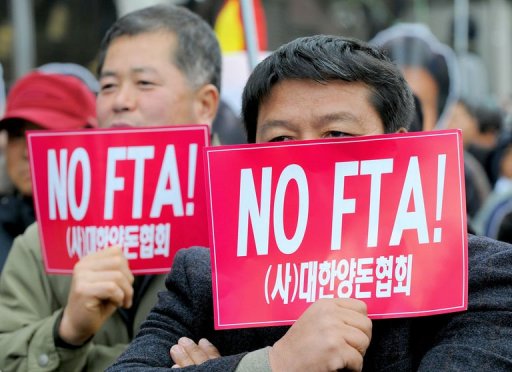
Lee faced a major wave of street protests by South Koreans who voiced safety concerns over US beef.
The Republican Party, which many analysts predict will make gains in the November 2 election, has largely supported pending free trade deals with South Korea, Panama and Colombia, arguing that they will boost business as a whole.
Republican Senator John McCain said that the agreement with South Korea will solidify the two nations' alliance and pointed to Seoul's recent announcement of stronger sanctions against Iran over its nuclear program.
"This decision was not easy or cost-free for Korea's government and companies, and it is another reminder that Congress must pass the Korea-US Free Trade Agreement," McCain said in September.
US advocates for the deal argue that the United States is losing out as South Korea has since reached trade agreements with the European Union and India.
India on Monday also signed a trade agreement with Japan.
Campbell, who was speaking at the Peterson Institute for International Economics, hailed the deal and welcomed a stronger Indian involvement.
"This has gone beyond rhetoric," he said.
"Obviously the Indian government has talked about a 'Look East' strategy, but increasingly you are seeing with its diplomacy and its trade engagement that India is playing a larger and larger role in the region," Campbell said.