

U.S. beef shipments to S. Korea to grow 24 percent in 2011: USDA
By Hwang Doo-hyong
WASHINGTON, Sept. 13 (Yonhap) -- U.S. beef shipments to South Korea are expected to grow dramatically next year due to declining concerns over mad cow disease among consumers in the fourth biggest market for U.S. beef, the U.S. Department of Agriculture (USDA) said Monday.
U.S. beef exports to South Korea will likely soar 24 percent to 136,000 tons next year from 110,000 tons estimated for this year, the department said in a report.
This year's estimate is based on the whopping 130 percent rise to 50,221 tons worth US$225 million in the first half, according to figures from the U.S. Meat Export Federation.
The statistics exceed last year's total shipments of $216 million to South Korea but fall short of the $815 million recorded in 2003, when South Korea banned imports of U.S. beef due to fears over bovine spongiform encephalopathy or mad cow disease in the U.S.
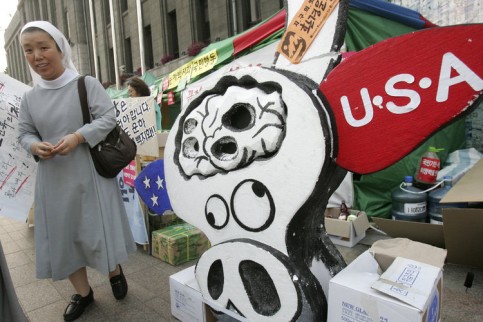
"The re-emergence of U.S. beef in Korea is very gratifying," USMEF President Philip Seng said. "Just a few months ago, we were struggling to gain any traction in the foodservice and retail sectors in Korea. But we have worked very hard through our 'Trust' imaging campaign for U.S. beef and in building relationships with both beef buyers and consumers to regain consumer confidence, and this has created much more interest among the supermarket and restaurant trade."
Seng noted the recent partnership with Lotte Mart, a major Korean supermarket chain, to reintroduce T-bone steaks in Korea. "That's just one of many examples of our progress in this very critical and competitive market."
The surge comes amid some U.S. politicians demanding the restricted shipment of beef be addressed before the ratification of the pending free trade deal with South Korea.
South Korea currently prohibits shipments of beef from cattle older than 30 months due to concerns over mad cow disease.
The U.S. beef industry has called for a cautious approach, fearing a possible backlash in the Korean market, where U.S. beef shipments have grown rapidly since South Korea resumed imports in 2008 after a five-year hiatus.
The Obama administration has not yet made a decision on whether wider access to the Korean beef market should be a precondition for the FTA's ratification.
The Paris-based World Organization for Animal Health, or OIE, has classified the U.S. as "a controlled risk country," meaning the U.S. can export beef with minor limits to certain cuts that may transmit mad cow disease to humans. Japan prohibits shipments of U.S. beef from cattle over 20 months old.
U.S. President Obama in June ordered U.S. Trade Representative Ron Kirk to complete talks with South Korea over autos and beef before he flies to Seoul for a G-20 economic summit meeting in November so that he could present the deal to Congress early next year.
Kirk said last month that he will sideline issues other than autos and beef in negotiations with South Korea to meet Obama's deadline.
Autos and beef have served as major hurdles to the ratification of the Korea FTA.
The U.S. exported 5,878 autos to South Korea last year, while South Korean auto shipments to the U.S. totaled 476,833, according to the statistics by the United Auto Workers.
South Korea's Trade Minister Kim Jong-hoon said recently that negotiations will begin in late September.