


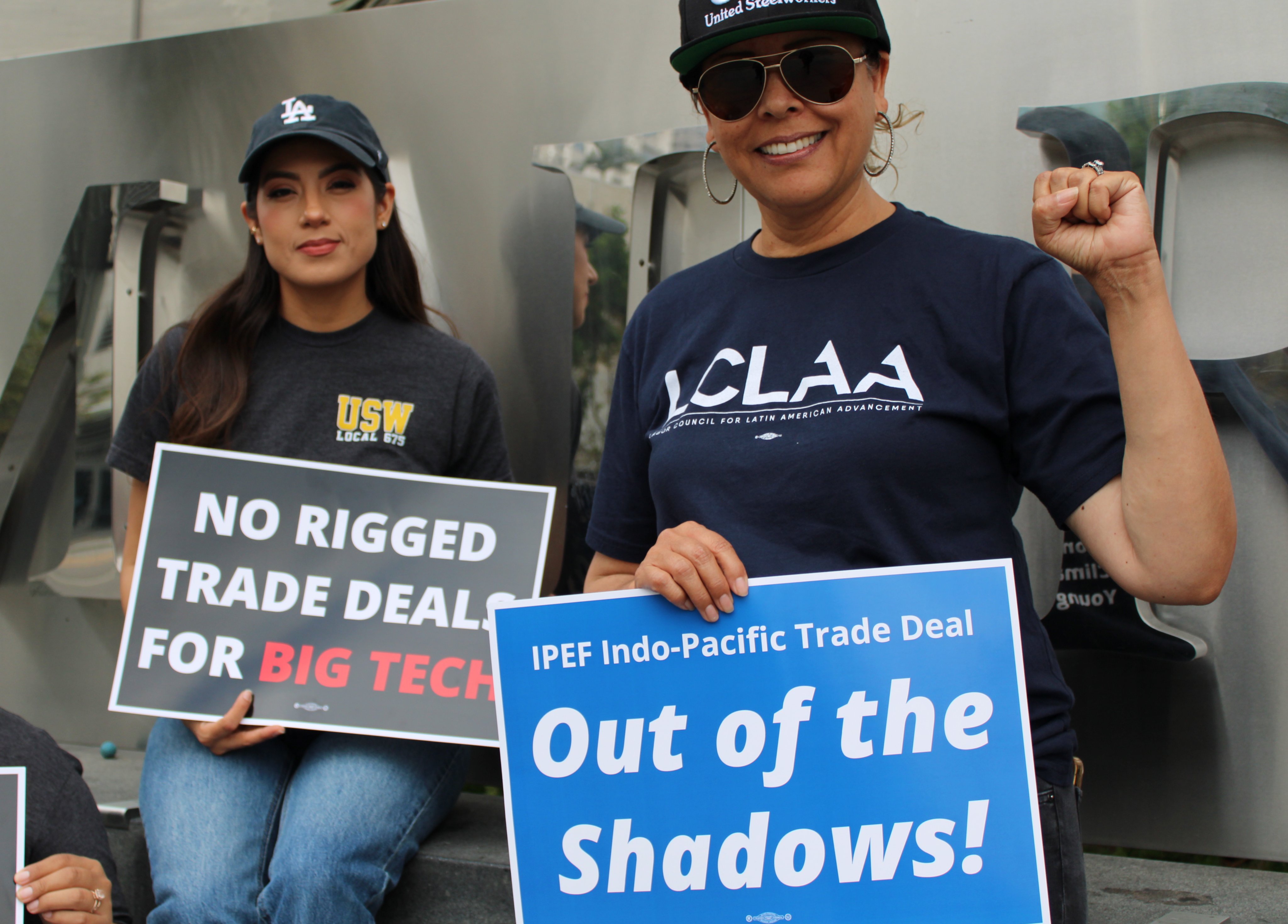
Trump administration must choose between Big Tech and US sovereignty as industry seeks to weaponize trade policy to attack data security, privacy policies in other nations that US has also adopted
Washington, D.C. – Congress and federal agencies and U.S. states have adopted the same sorts
of data security and privacy policies that Big Tech lobbyists are pushing President Trump to attack
as the “illegal trade barriers,” a report released by Rethink Trade and the American Economic
Liberties Project (AELP) revealed.
Last Friday, Trump issued an order warning other countries against regulating “American” Big
Tech firms that explicitly identified “foreign legal regimes limit cross-border data flows” as the
sort of policy against which tariffs, and other sanctions could be imposed.
“Pres. Trump is adamant that U.S. sovereignty and laws should never be internationally
preempted by trade agreements, yet the sorts of data security and privacy policies Big Tech wants
him to target for tariffs have been adopted by Congress, red States and federal agencies,” said
Lori Wallach, director of AELP’s Rethink Trade project. “Big Tech’s demand to weaponize trade
policy to kill other nations’ privacy and other data-related digital policies threatens to boomerang
back again existing U.S. federal and state policies as well as policies Republicans and Democrats
alike are proposing nationwide.”
“This is a moment where it is really important to the reserve the power and reserve the right of
the U.S. Congress to be able to protect our own citizens,” said Senator Chris Murphy (D-Conn.),
who appeared at a virtual event today debuting the report. “We have the ability to regulate the
technology. We have an outstanding question before the Trump administration as to whether
they carry forward the policy of the Biden administration, and we have a public out there that is
hungry for Congress and the President to do the right thing and protect them in a way that has
not happened. As this report will show, it’s a pretty simple question. Should our democracy have
the power over the tech companies, or should the billionaires and the tech companies have
power over our democracy?”
Around the world, governments are discussing and adopting policies that regulate the ways in
which data is collected, transferred, and stored, with the goal of meeting myriad public interest
objectives. After years of other countries adopting personal data protection regimes, most of
which impose limits on the cross-border movement of data, more recently the United States has
begun adopting data security measure that limit data flows and where data can be stored. This
report reveals some of these policies, which are not well known after decades of inaction hereas to date 75% of all countries worldwide have adopted some limits and conditions on the cross-
border transfer of data, usually related to personal privacy.
“Data transfer rules in trade agreements have significant implications for the evolving landscape
of data governance, which means big stakes for national security, personal privacy, taxation, and
how AI is developed and by whom,” said Daniel Rangel, Rethink Trade’s Research Director and
lead author of the report. “While the principle of free flows of information is crucial for modern
societies, trade agreements shaped by Big Tech interests that profit from controlling data often
fail to find the right balance between this principle and countries' right to regulate data.”
Governments also are exploring ways to adequately tax the data economy, which could be
deemed as effectively curbing certain international data transfers. The explosion of AI systems
— trained on massive amounts of data — has raised questions about policies to ensure that
smaller companies have access to this critical resource, rather than it being monopolized by
incumbent tech giants, which would also implicate these rules.
Expansive rules in international trade agreements that impose binding restrictions on
governments’ abilities to regulate cross-border data flows and where data is stored run counter
to these efforts. For the past decade, certain tech interests have advocated for trade agreements
to include strong limits on governments’ abilities to regulate international data transfers and data
location. These terms — often included in “digital trade” or “e-commerce” chapters or
agreements — usually ban government regulation of international data transfers (cross-border
data flows rules) and/or where data may be stored (location of computing facilities rules).
Industry interests seek to lump all such polices together under what they consider the pejorative
label of “data localization.”
Yet, the U.S., Congress, state legislatures, the military, NASA, and White House have all enacted
policies that ban data transfer and regulate where data may be stored. These include:
- Protecting Americans' Data from Foreign Adversaries Act of 2024: In March 2024, the U.S.
- Cybersecurity Requirements for U.S. Cloud Computing Contractors: Since 2015, cloud
- · Executive Order 14117 – Preventing Access to Americans’ Bulk Sensitive Personal Data and
- Montana’s Genetic Information Privacy Act: In 2023, Montana’s lawmakers passed a law that
- 2023 Amendment to California’s Confidentiality of Medical Information Act: California
Each of these U.S. policies fundamentally conflicts with the notion that binding international
rules should prohibit governments from the regulating cross-border data flows or data storage
locations. This briefing paper shows that the exceptions to such prohibitions that have been
included in existing and proposed trade deals would not ensure governments’ abilities to
implement these kinds of policies. The degrees to which countries’ regulation of the data
economy is impeded vary greatly depending on the scope of the trade-deal rules, with the
agreement providing charts and tables breaking down the systems.
Read the executive summary here
Read the full report here.
Rewatch the virtual event here.


