


Center for Strategic and International Studies (CSIS) | 9 March 2026
The new containment doctrine: How the United States is using trade to stop digital regulation
by Duc Minh Nguyet (Moon) Nguyen and Philip Luck
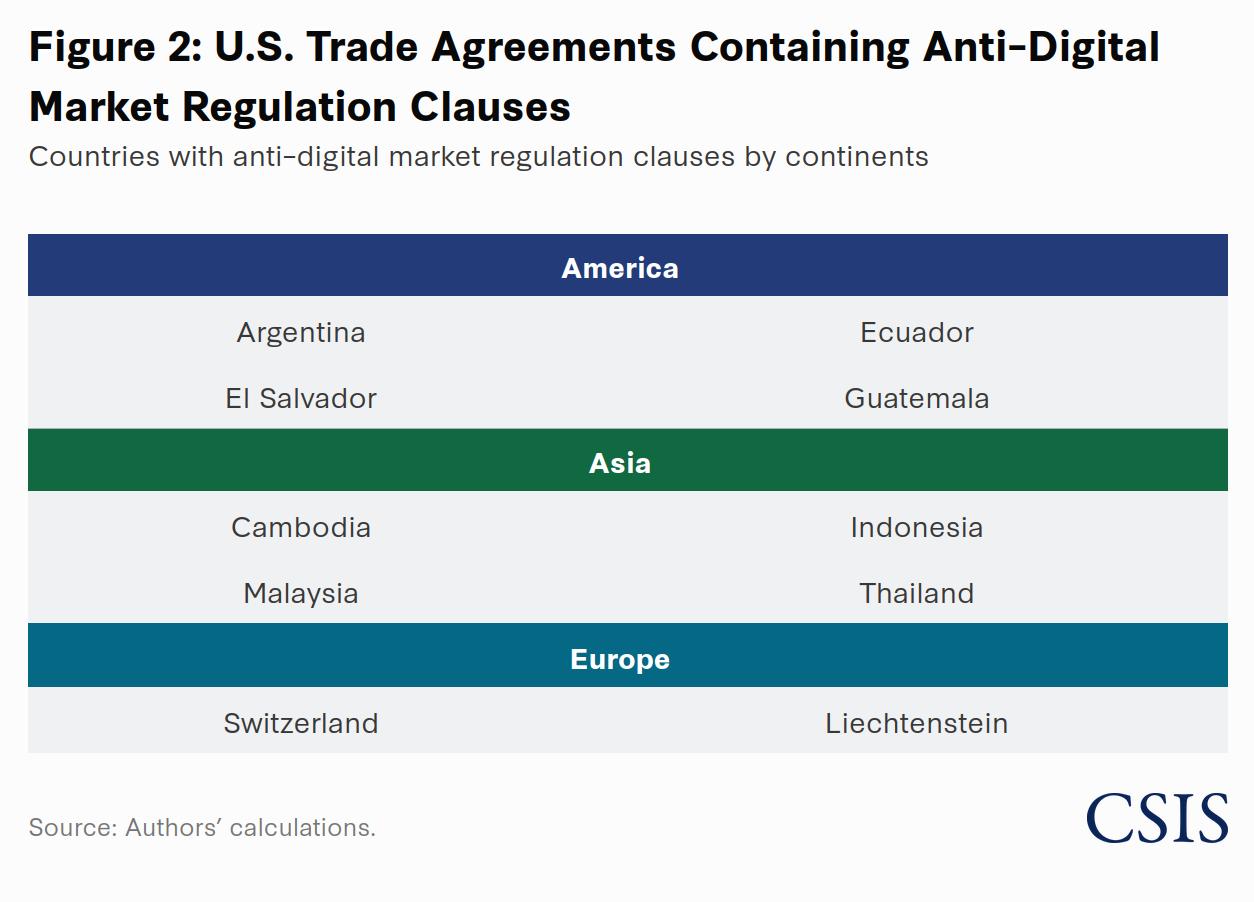
In January 2026, the Department of State imposed visa restrictions on five European officials involved in drafting the EU Digital Markets Act (DMA) and Digital Services Act (DSA), an escalation in the Trump administration’s campaign against digital regulation. These visa actions may be the most direct measures targeting the European Union stemming from frictions over the DMA, but they are by no means the only front in this growing conflict. At the same time it has acted directly against the European Union, the administration has also sought to embed anti–digital regulation clauses into bilateral trade agreements with other partners, including Malaysia, Indonesia, Cambodia, Argentina, Guatemala, and El Salvador, with similar language appearing in framework deals with Ecuador, Thailand, and others.
The strategy marks a shift. Unable to roll back EU regulations at their source, the administration is trying to contain their spread. Using tariff threats as leverage, the United States is transforming what has been a domestic regulatory choice into a negotiable trade concession, seeking to establish precedents that will shape digital governance negotiations for years.
The Trade Deal Campaign
The administration’s campaign extends beyond Brussels. The United States has embedded anti-regulation clauses into bilateral trade agreements and frameworks with at least nine countries across Latin America, Southeast Asia, and Europe. The agreements share nearly identical languages. Specifically, Section 3 of these agreements stated that these countries:
shall not impose digital services taxes, or similar taxes, that discriminate against U.S. companies in law or in fact.
shall facilitate digital trade with the United States, including by refraining from measures that discriminate against U.S. digital services or U.S. products distributed digitally [ensuring the free transfer of data across trusted borders for the conduct of business, and collaborating with the United States to address cybersecurity challenges.]
The clauses do not explicitly mention digital market regulation, but they are clearly aimed at DMA-style frameworks. The DMA requires large platforms to allow interoperability, prohibits self-preferencing in search and app stores, and mandates data portability—rules that the United States argues disproportionately target U.S. firms and undermine their business models. The deliberately broad language in these trade deals—“measures that discriminate”—gives Washington wide latitude to define what counts as a violation.
Timeline of U.S. attacks on the DMA and DSAFigure 1: U.S. Opposition to the European Union’s DMA and DSA Escalated in 2025
Signed agreements with Argentina, El Salvador, Guatemala, Malaysia, Indonesia, and Cambodia contain binding versions of these clauses, though none have entered into force as all countries’ complete internal legal procedures are still ongoing. Frameworks with Ecuador and Thailand include similar language. While nonbinding, these frameworks typically become templates for final agreements. Switzerland and Liechtenstein signed frameworks with narrower language, covering only “harmful digital services taxes” without the broader prohibition on discrimination.
Only Malaysia’s agreement includes a carve-out: “Malaysia has the right to regulate in the public interest.” Whether this provides meaningful policy space or just political cover remains unclear. What matters more is that this reservation is absent from all other agreements—the United States appears to have tightened language in subsequent negotiations.
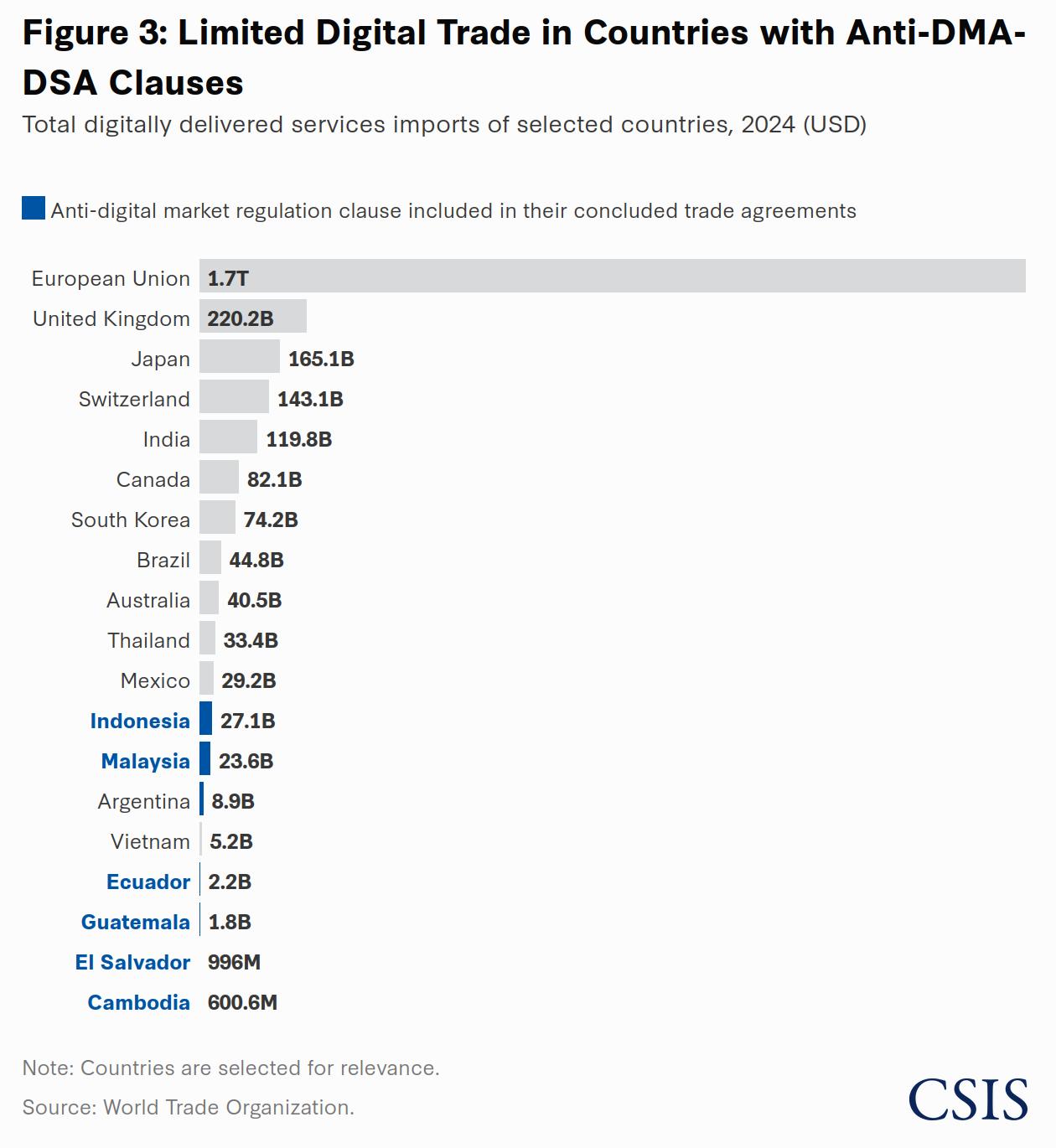
For smaller economies, the calculation is straightforward: accept restrictions on future digital regulation in exchange for immediate tariff relief on agriculture, consumer goods, or other priority sectors. Indonesia, with a GDP of around $1.4 trillion in 2024, is the largest economy to accept such clauses so far. These agreements serve as test cases, demonstrating that the United States can extract regulatory concessions when tariff leverage is high and a country’s digital trade volume is low.
Why This Strategy Now
The Trump administration’s aggressive stance departs sharply from the Biden years. While Biden’s Federal Trade Commission pursued domestic antitrust enforcement against big tech, his trade team took a more measured approach to allied digital regulation, even withdrawing U.S. support for certain World Trade Organization e-commerce proposals to avoid constraining domestic regulatory choices. The Trump administration has so far rejected this deference. It has viewed trade policy as “a critical component to national security” and frames digital regulation as a competitive battleground, showing less concern for sustaining multilateral consensus.
This more aggressive approach has been empowered by the Trump administration’s expansive use of tariffs as leverage. If a trading partner adopts digital rules that Washington interprets as discriminatory, whether targeted taxes, data localization requirements, or platform conduct mandates, the administration can threaten or impose costs outside the digital sector through tariffs on goods. In August 2025, Trump threatened “additional tariffs” on countries with “digital taxes, legislation or regulations,” explicitly portraying such measures as designed to harm U.S. technology companies. It should be noted that even with the loss of the International Emergency Economic Powers Act (IEEPA) as a policy tool, digital trade objectives can still be pursued through credible threats of tariffs or investigations under Section 301 or Section 232 of U.S. trade law.
The urgency demonstrated by the Trump administration likely stems from the perceived acceleration of the Brussels Effect. The EU Digital Markets Act has become a template for many others. Brazil introduced comprehensive digital markets legislation in September 2025. South Korea advanced platform fairness rules. India, Japan, and the United Kingdom are all considering similar frameworks. When the world’s second-largest economic bloc establishes platform rules that predominantly bind U.S. companies and other major economies follow, the U.S. executive branch has strong incentives to respond. The methods range from negotiating carve-outs to threatening retaliation to deter adoption.
Where the Strategy Works—and Where It Does Not
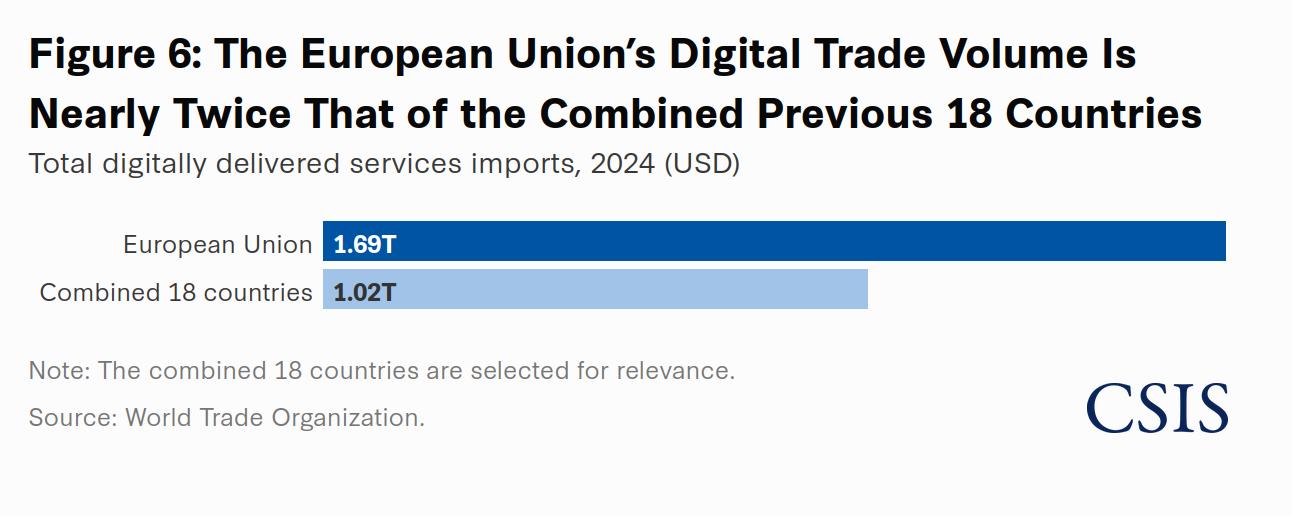
Success with small economies does not mean the Brussels Effect is contained. Digital trade volume matters. Argentina, El Salvador, Guatemala, Malaysia, Indonesia, and Cambodia’s combined digital markets are negligible compared to Brazil’s, South Korea’s, or the European Union’s. As the administration targets larger markets with more developed regulatory proposals, the strategy faces stiffer resistance.
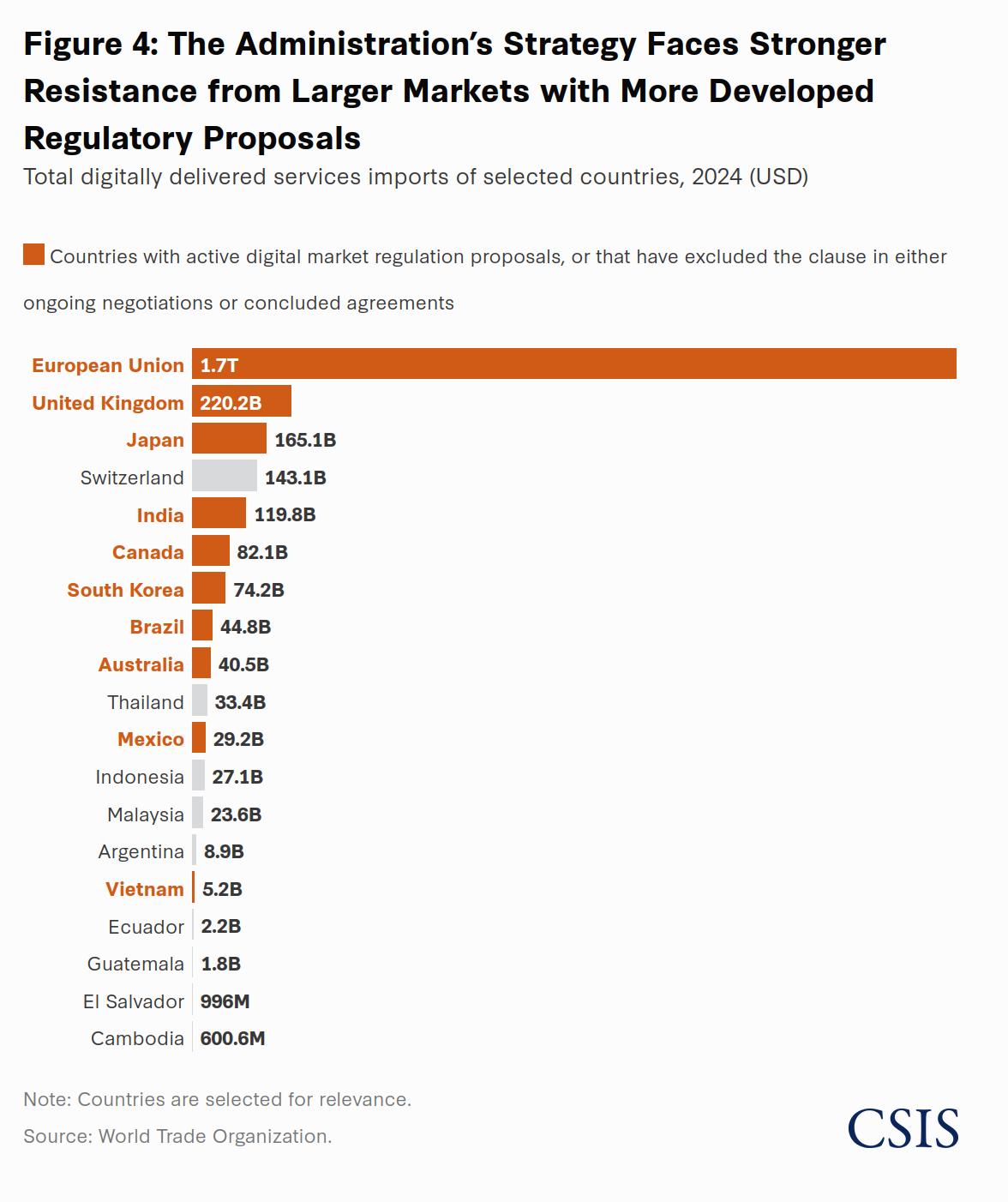
Brazil is testing the limits. In September 2025, Brazil’s government sent a bill on fair competition in digital markets to Congress. The proposal would create a specialized department to oversee “platforms with systemic relevance”—language that predominantly captures American companies like Google, Meta, and Amazon. The bill includes interoperability and data sharing provisions mirroring DMA requirements.
As a result, U.S. lawmakers pushed back. The House Judiciary Committee sent a letter to Brazil’s Ministry of Finance arguing the bill would “mainly capture American platforms” and constitute a nontariff trade barrier. The Office of the U.S. Trade Representative (USTR) simultaneously launched a Section 301 investigation into Brazil’s trading practices, including digital trade and electronic payment services. Despite this pressure, Brazil has not withdrawn the proposal. Tariff threats lose potency when regulatory stakes are high, and domestic political constituencies support intervention.
South Korea took a different approach but still drew fire. Rather than the DMA’s broad dominance-based regime, South Korea’s proposed Online Platform Fairness Act focuses narrowly on platform-merchant relationships: contract terms, transparency requirements, and intermediation conduct. The “fairness” framing was partly strategic—an attempt to avoid DMA-style confrontation.
Yet this has not insulated South Korea from U.S. pressure. The bill has surfaced repeatedly as a friction point in U.S.–South Korea trade conversations, with Washington claiming such rules function as discriminatory nontariff barriers regardless of framing. The dispute strains the alliance: South Korea is a critical security partner, yet even narrowly tailored digital regulation triggers U.S. pressure.
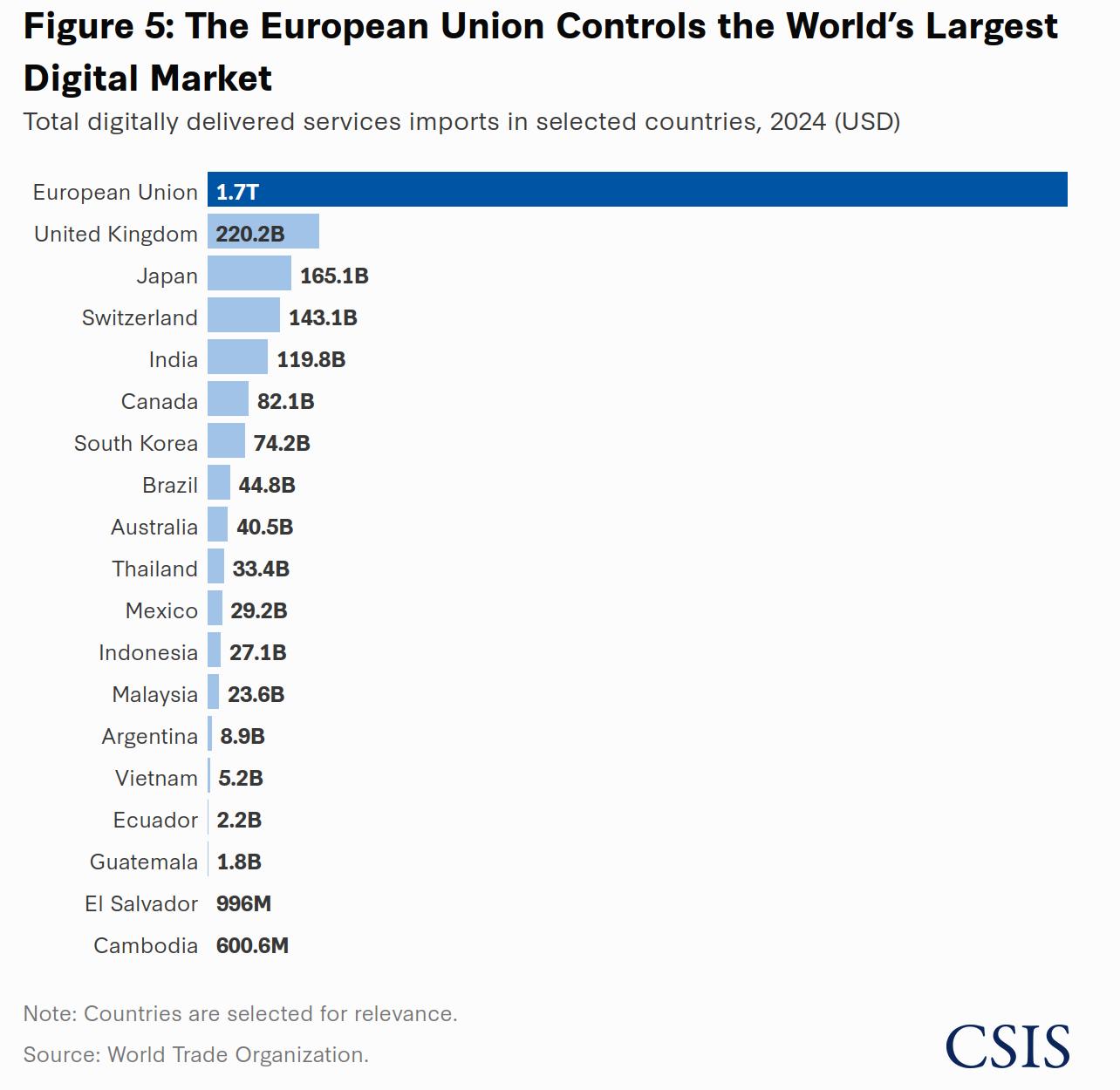
The European Union itself remains out of reach. The United States and European Union signed a framework agreement in August 2025 committing to address “unjustified digital trade barriers,” but the European Commission made clear the DMA and DSA are not part of trade negotiations. In March 2025, USTR designated both acts as digital trade barriers in its annual National Trade Estimate report. The Department of State’s visa restrictions on five EU officials involved in drafting the legislation marked an escalation, but Brussels shows no signs of retreat. The European Union’s control of the world’s second-largest digital market and unified member states’ support for regulations mean tariff threats from Washington carry less weight.
What This Means
The administration’s trade deal campaign has secured initial wins, embedding anti-regulation clauses into agreements with at least eight countries and establishing precedents that may outlast this administration. But the strategy’s limits are visible. Large economies like Brazil and South Korea demonstrate that tariff threats weaken when regulatory stakes are high and domestic constituencies support intervention.
Even in those jurisdictions where these clauses have been added, critical questions remain unanswered. How would the United States actually enforce these clauses, especially as the U.S. Supreme Court struck down IEEPA tariffs? The “discriminate against U.S. companies” language is deliberately vague. Does it prohibit any regulation that disproportionately affects large platforms? Could countries challenge enforcement through WTO dispute settlement? Would a future administration honor these commitments or quietly abandon enforcement? The agreements do not specify.
The approach treats digital regulation as purely a trade issue. Such a framing works for small economies seeking tariff relief, but breaks down when countries pursue what they see as legitimate governance goals. Platform power concentration is a political issue across democracies. The DMA catalyzed a global conversation about whether and how to regulate digital gatekeepers. That conversation will not end because Washington embeds anti-regulation language in trade deals with Cambodia and El Salvador.
The administration can lock in commitments from smaller partners. It cannot stop larger economies from regulating when domestic political pressure demands it. The Brussels Effect spreads through economic gravity—firms comply with EU rules because the market is too large to ignore, then apply those standards globally because fragmented compliance is expensive. Trade deal clauses might slow adoption in countries with minimal digital markets, but they will not reverse the regulatory tide in economies that matter.
What the strategy does accomplish is establishing a precedent: digital regulation as a negotiable trade concession. Future administrations will inherit these agreements and the principle they embody. Whether that principle survives depends on factors beyond this administration’s control—including whether the European Union’s regulatory model delivers the benefits Brussels promises, and whether U.S. technology companies maintain the market dominance that makes this fight worth having.
Duc Minh Nguyet (Moon) Nguyen is a research intern with the Economics Program and Scholl Chair in International Business at the Center for Strategic and International Studies (CSIS) in Washington, D.C. Philip A. Luck is director of the Economics Program and Scholl Chair in International Business at CSIS.