

The end of hyper-globalisation, resurgent imperialism and the prospects for genuine transformation
by Professor Emeritus Jane Kelsey, University of Auckland, Aotearoa NZ1
It seems fashionable these days to start by quoting Antonio Gramsci: “we in an interregnum – the old is dying, the new is yet to be born, we are surrounded by morbid symptoms”. The “old” is the international “rules-based” order that has prevailed since World War Two, or in the international trade regime, since the 1980s. Its breakdown is variously attributed to the rise of economic nationalism, great power rivalries, and populist politics that have enabled authoritarian government.
But too often those commentators forget that Gramsci was a communist imprisoned by Mussolini’s facist regime and chronicled the hegemonic crisis facing Italy’s ruling class and their system of governance in the 1920s. The morbid symptoms he observed – authoritarianism, political extremism, and social breakdown – were products of a political struggle over material and social relations, understood through the lens of historical materialism. Internationally, that was overlaid by the brutality and nihilism of colonisation and imperialism, which was beyond Gramsci’s immediate focus.
Translated to today, the same morbid symptoms of authoritarianism, political extremism and social breakdown need to be understood as products of hyper-globalised capitalism that has prevailed since the 1980s. And the deep disparities between rule-makers and rule-takers in the international trade and investment regime are built upon their colonial legacy, overlaid by new forms of militarisation and imperialism.
The popular, anemic version of Gramsci avoids having to address the inequities of hyper-globalisation and financialised capitalism and realign the global rulebook accordingly.
Take the much-celebrated speech by Canadian Prime Minister and former long-time Bank of England Governor, Mark Carney, to the World Economic Forum last January. Carney acknowledged the current “international rules-based system” was designed by and for powerful states, principally the US, to serve its interests. Canada and middle powers were content to “live within that lie” because it benefited them.
Now that fiction is starkly exposed, Carney’s solution calls for “managing the risks” and building a more cooperative, resilient world. He and other middle-power leaders are on a quest to restabilise the failing rules-based system on which they have come to depend by developing a multiplicity of new, more diverse relationships that reduce their dependency on the old hegemon, the US. In other words, decanting the old neo-liberal wine into new bottles. At the same time, they are struggling to straddle the geostrategic fence by divorcing their trade dependency on China from defense and security alliances with the US, to avoid having to choose sides.
Trade policy specialists will recognise this as the “wobbly bicycle theory”. When the system on which your economy depends is at risk of falling over, and genuine solutions would require a massive realignment of public and private power, you peddle faster in the same direction to keep the bicycle upright, accompanied by as many fellow travellers as possible. Even if that direction is taking you over a cliff.
There is no need, and no space, to critically analyse why the system is broken, let alone to rethink the paradigm. As loyal WTO citizens, they are busy expanding its “rules” through bilateral and regional free trade agreements (FTAs), increasingly in sectors such as digital, “environment-related” and critical minerals.
My own country, Aotearoa New Zealand, epitomises this myopia. Every couple of months, it seems, they are beginning to negotiate a new micro deal with a group of like-minded countries that has no clear purpose beyond the appearance of momentum. As one trade official told me recently, “NZ will be the last country to turn out the light on the current system”. Their “reform” agenda seeks to placate the US and rescue the WTO and its rules-based system by pragmatically ignoring the now-inconvenient parts of the rulebook they are purporting to defend. There is no discussion of, let alone answer to, the conundrum that our export-dependent domestic economy relies on China as its major market, while it seeks to appease the US and maintain an asymmetrical strategic, defence and intelligence relationship.
For some of us, the collapse of the “rules-based system” comes as no surprise. We have long argued that it is intrinsically unsustainable. Over four decades, “free trade” has deepened inequalities within and between nations and enabled an unstable form of financialised capitalism. New generation rules on e-commerce and digital trade have empowered unaccountable and unrestrained oligarchs to wield almost unfettered economic, political and military control over data, digital technologies, platforms and AI.
We now live in a world that is literally consuming itself and generating an existential climate catastrophe. The solutions to this, we are told, lie in ripping rare earths and critical minerals out of the land and sea, repeating of colonial exploitation of resource-rich, but economically impoverished states. The latest trend of critical minerals agreements that are designed to feed raw materials to the US and lock China out of supply chains, and so-called green economy agreements that promote tradeable carbon credits and Carbon Capture, Utilisation, and Storage (CCUs), carefully avoid commitments that would undermine carbon-emitting production on which contemporary capitalism depends.
The collapse of the WTO
Let me examine a specific morbid symptom. The WTO was created in 1995 to advance the hyper-globalisation paradigm. As Carney admits, the existing trade rules on agriculture, goods, financial and other services, and intellectual property rights were skewed to the advantage of US, EU and their corporates and markets. Developing countries agreed to the asymmetrical Uruguay Round outcomes of TRIPS, TRIMS, the Agreement on Agriculture and GATS on the promise of a future rebalance that reflects the WTO’s development acquis. They were told the multilateral Doha round, launched in 2001, would address outstanding development issues. But the round was effectively killed off when powerful states withdrew their support at the Nairobi ministerial conference in 2015.
For the past decade, the rule-makers, spearheaded by the US, have systematically worked to remake the WTO to serve their new priorities – effectively, executing a coup that avoids playing by their own rules. This process began well before Trump. The US began blocking appointments to the WTO’s Appellate Body over a decade ago and it has been moribund since 2019. They recently just vetoed new appointments for the 91st time.
At the Buenos Aires Ministerial in 2017, subsets of WTO Members announced plans to negotiate plurilateral agreements on their priority topics, without a mandate, but still serviced by the Secretariat. New Director-General Dr Ngozi Konjo-Iweala has enthusiastically championed what she calls “reform by doing”, irrespective of WTO rules. Ironically, India and South Africa have been derided as “blockers” for insisting that Members comply with the Marrakesh Agreement and deliver on existing mandates.
The reform agenda came to a head at the 14th ministerial conference in Yaoundé, Cameroon in March. I have witnessed many failed ministerials. But the manipulation and power plays here were unlike any other. The MC14 programme reflected two radical, and largely complementary, papers tabled by the US and EU. Rather than quit the organisation, the US laid down its core demands. These were largely echoed by the EU. Their common goal was to dilute the primacy of multilateralism and normalise plurilateral deal-making among self-selected members, who can cherry-pick favoured topics to which they attach the “trade-related” label. Geopolitical battles could be imported through competing plurilaterals on the same topic, pressuring developing countries to choose sides. Developing countries priorities would be left further behind.
There were three main reforms on the MC14’s agenda: first, “decision-making” to redefine and dilute consensus; second, “development and industrialisation” to link development status to limited criteria and redefine special and differential treatment to mean more time to adopt rich countries’ rules; and “leveling the playing field”, which targeted China’s “non-market” practices and state enterprises, while ignoring glaring asymmetries in favour of the global North.
These topics has been carefully curated over the previous year through selective consultations by a hand-picked “reform facilitator”, the Ambassador of Norway, and overseen by Director General Ngozi. Reinstating a functioning dispute settlement system was put off until a more appropriate time.
The middle-power “friends of the system” seemed willing to support whatever compromises were necessary to keep the US involved in the WTO and maintain it in some form. Significantly, China was also prepared to faciliate these moves, except for the “level playing field”.
Normalising plurilateralism is in the vanguard of the coup. Since Buenos Aires in 2017 several “Joint Statement Initiatives” or JSIs have been concluded by breakaway groups of Members operating without a mandate. But they face a major obstacle: the Marrakesh Agreement says plurilateral agreements must be adopted by consensus at the General Council or Ministerial Conference.
The JSI on Electronic Commerce tried for consensus and failed. So 66 of the original 91 endorsers simply declared at the MC14 that they were adopting what they still described as a WTO agreement. Many signatories were self-proclaimed “friends of the system”, as well as China. The new agreement would be administered by the WTO Secretariat and the D-G who have no authority to do so. This was promptly hailed as a precedent for “interim agreements” promoted by the US.
The “reform” agenda has now gone back to Geneva. The US insists the WTO must be “recast” to “prioritize and protect national interests while ensuring balance and fairness”, while retaining the good agreements on services and intellectual property. At the same time, the Brazilian Ambassador, who now chairs the Dispute Settlement Body and is expected to be the next GC chair, has signalled plans to resume talks on dispute body reforms.
Where does this leave countries of the global South? In the Pacific Islands and in Africa I constantly hear frustrations over the lack of capacity to add value to their resources and technology transfer, trade rules that prevent requirements for local processing, and digital deficits. The climate crisis and recent pandemics pose an existential threat to their entire populations, commodity and services economies, food sovereignty and physical survival.
So, would the collapse of those “rules” be a bad thing for them? They face an almost impossible choice. Do they fight an uphill battle to keep an international regime of trade rules whose asymmetries were born of colonisation and have been entrenched through successive power plays? Do they abandon the WTO and seek alternatives; if so, what do those look like in an international space where raw power, including military invasion and economic sabotage, is being legitimised? Can they even agree when solidarity among them has been severely fractured by their capitals’ deals with the Trump administration? Do alliances like the BRICS offer real alternatives when China, India, Brazil, South Africa and Russia are taking conflicting positions?
Fractured alliances
That brings me to my second morbid symptom. While the US has always selectively complied with international trade rules, the Trump administration has shattered any pretense of compliance. The weaponisation of tariffs, driven by economic, political, geostrategic and personal motives, has been unilateral, arbitrary and erratic. But the US does have a systematic strategy, set out in the National Security Strategy, Trade Policy Agenda, and other detailed policy documents.
This strategy has been operationalised, in part, through binding and enforceable “Reciprocal Trade Agreements” (RTAs), currently with 9 developing and middle-income countries, that are “reciprocal” in name only, and “framework agreements” with 9 major players, including Japan, the EU, UK, Switzerland, South Korea, and imminently, with India, that are non-binding, but subject to US cancellation. These texts incorporate provisions the US has refined in FTAs over several decades on digital, state-owned enterprises, procurement, labour and environment, and a self-judging security exception.
The ARTs go further, as instruments of modern-day imperialism. Beginning with Cambodia and Malaysia, countries that had little leverage effectively ceded their sovereign autonomy to the US over crucial foreign and defence policies, investment priorities and decisions, as well as mining and minerals supply chains, food standards and GMOs, infrastructure such as ports, and control of data and the taxing and regulating the digital domain. The US can effectively terminate these deals at will, along with the limited tariff concessions. Already these agreements, negotiated in secret, have generated domestic unrest from local producers, consumers, trade unions and parliamentarians.
The US’s new priority on “economic security” is evidenced by commitments on critical minerals, supply chains, procurement and defence trade, screening of investments, export controls and “non-market” practices. Again, this is not new – Biden’s Indo-Pacific Economic Framework (IPEF) concluded soft agreements on Supply Chain Resilience and Clean Economy, under which a Critical Minerals Dialogue was established with containment of China and domestic revitalisation in mind. But Trump’s deals carry hard obligations policed by the US, and which put countries in direct conflict with China with whom most signatories have deep ties.
More specific sectoral deals on critical minerals complement the RTAs. Some resource-rich players like Australia have enough bargaining power to get the best possible outcome in agreements. These include Action Plans designed to underpin a subsequent, binding, preferential trade agreement on critical minerals. By contrast, the framework agreements being signed with resource-rich but income-poor countries replicate coercive extractive relationships of the past. While formally non-binding they are backed by threats of US sanctions. Several states signing these deals have parallel agreements with China that include critical minerals. Others, often in the same region, have endorsed a moratorium on deep sea mining in their shared ocean, fearing the impacts on livelihoods and the ecosystem in a climate danger-zone.
These, among many other morbid symptoms, show the “rules based system” is broken. It will not be fixed by a change of US administration. The “middle powers” are kidding themselves that keeping bicycle upright will ward off collapse and demands for change. The Global South itself is fractured.
Activism, populism and transformation
This analysis has not yet addressed the contradictions of capitalism as the trigger for this collapse. So let’s bring in another old Marxist, Karl Polanyi, author of The Great Transformation, to give some agency to people in the dialectical struggle that underpins this crisis.
Polanyi insisted that economic relations, politics and ideology do not exist in a social vacuum. The economy is embedded in the social, and the social purpose of the state is to give effect to that reality. He attributed the collapse of laissez faire in the 1920s to attempts to dis-embed the social from the market. In what he termed a “double movement”, unfettered market forces wreaked havoc, while social forces within nation states organised to protect themselves through spontaneous, localised resistance by communities whose lives had been turned upside down.
In similar vein, today’s failing model of hyper-globalisation and financialised capital has no place for the state’s social function. As Thomas Picketty showed, the last few decades saw unprecedented external and internal inequalities of wealth and income. The human cost of non-trade elements of the trade regime was starkly exposed during the HIV AIDs and Covid pandemics: some governments broke the rules, but the US, EU and Switzerland have blocked reform to the Agreement on Trade-related Aspects of Intellectual Property Rights (TRIPS). Successive financial crises saw temporary interventions to re-stabilise this mode of capitalism and then restore the status quo ante through further liberalisation of financial services and investment. The Big Tech oligarchs who wrote the digital trade rules now dominate the military-digital complex as their AI-driven drones rain death daily on Palestine and Lebanon. Indigenous food sovereignty is under threat from climate disasters, biopiracy and GMOs. Export-driven economies are locked into unsustainable supply chains that rely on fossil-fuelled maritime and air transport that evade responsibility for global warming.
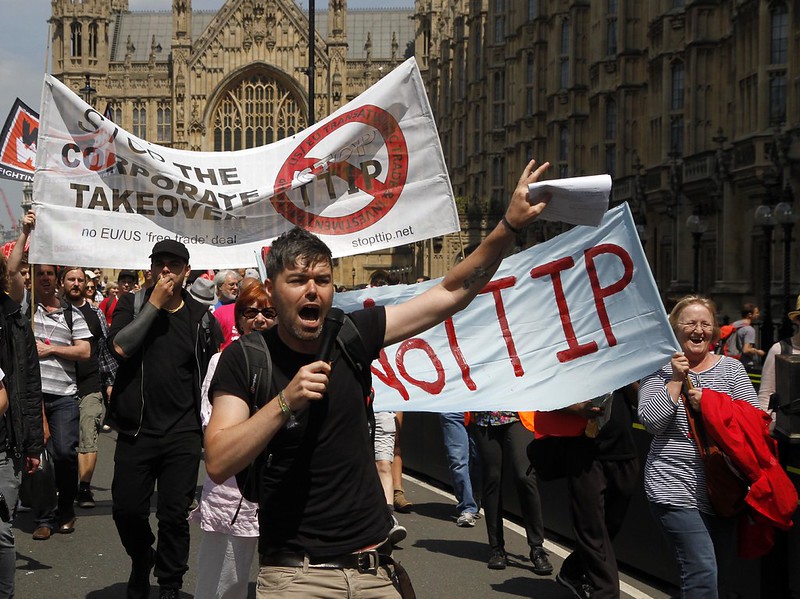
These impacts, and many more, have not been suffered in silence. The so-called anti-globalisation movement that has protested against the WTO since the Uruguay round, then in Seattle 1999, Cancun 2003 and Hong Kong 2005, exposed a lack of “social license” from which the WTO has never recovered. More recent campaigns stopped most of the mega-regionals inaugurated by the rule-makers because the WTO was failing: the Free Trade Agreement of the Americas (FTAA), the Trans-Pacific Partnership (TPPA), Trans-Atlantic Trade and Investment Partnership (TTIP), the Trade in Services Agreement (TiSA), among others. These trade campaigns ran alongside successful international opposition to the Multilateral Agreement on Investment in the late 1990s. Ongoing resistance to investor-state dispute settlement has seen countries block ISDS in FTAs and exit bilateral investment treaties altogether.
In a way, activist movements led by affected communities of farmers, trade unions, Indigenous Peoples, and NGOs have been victims of their own success. “Anti-globalisation” pressure has abated in recent years. The WTO is no longer such a target, the mega-regionals are largely sidelined, and activists are more focused on more concrete crises like climate, mining, digital and wars.
In their place, the rise of right-wing populism across the globe is another morbid symptom of dysfunctional capitalism, the state’s failure to perform its social functions, the capture of information channels by private digital oligarchs, and fear of “others”. As Polanyi predicted, the double movement has demanded that states address the precarious existence of people and planet, including in the US. Opportunist actors have harnessed this discontent to their authoritarian regimes and seek to normalise raw economic, military and political power.
Corporate lobbyists have adapted to the interregnum. Using whatever avenues their wealth can unlock, they continue to press for global rules to facilitate accumulation and minimise regulation, whether that is through corrupt political relationships and weaponising tariffs, hijacking the WTO, or the plethora of asymmetrical agreements and new micro-deals. The wobbly bicycle is taking sideroads to the same destination.
Some concluding thoughts
Gramsci predicted that the interregnum will be a highly contested space, as the “new” struggles to be born. Today, the dismantling of hyper-globalised capitalism is being championed by the populist right and authoritarian governments, in tandem with Janus-faced oligarchs. Those who seek a more just social and economic order, and action to save the planet for our future generations, are no longer in the ascendancy.
I would like to end on a positive note. But the future is very uncertain. It will not be determined by what happens to the WTO or FTAs. It will be affected most by how we engage with the interregnum. The “old” failing order is four decades old. Some governments are trying to keep it on life support, peddling their bicycles while continuing to treat social and ecological crises as externalities. Other authoritarians are attracted to the US regime of economic nationalism implemented by diktat, but lack the power and protection the US enjoys. China claims obedience to the rules, while its own economic nationalism supports changes that work for its long-term interests. The majority of the world’s nations and their peoples remain rule-takers in this era of neo-colonialism and imperialism.
States may not have the answers, or not those their people need. Failure to address the causes of the crisis in contemporary capitalism will force communities back on their own resources. Without being romantic, local people are resilient. Back in Aotearoa NZ, Indigenous Māori are focused on sustainable survival that applies traditional knowledge to contemporary challenges of food sovereignty, the climate crisis, control of data. But it’s an uphill battle. It is not one we can wait another of decades to address, while our governments continue to ride the free trade bicycles over the cliff.
- Keynote Panel, “International Law in a Fractured Global Order”, Bogazici International Law Conference, Istanbul, 13 June 2026 ↩