

The corporate siege of Honduras: international arbitration demands, energy transition, and state sovereignty
“We, the communities affected by renewable energy projects in southern Honduras, together with national and international social movements, address the Honduran people and the international community to express our concerns about the serious impacts these projects have generated in our territories. In the South, it is evident that the energy transition is led by private interests.” — Statement from the communities affected by energy projects in Southern Honduras and the organisations convened by the gathering “Without Human Rights, There Is No Energy Sovereignty.”
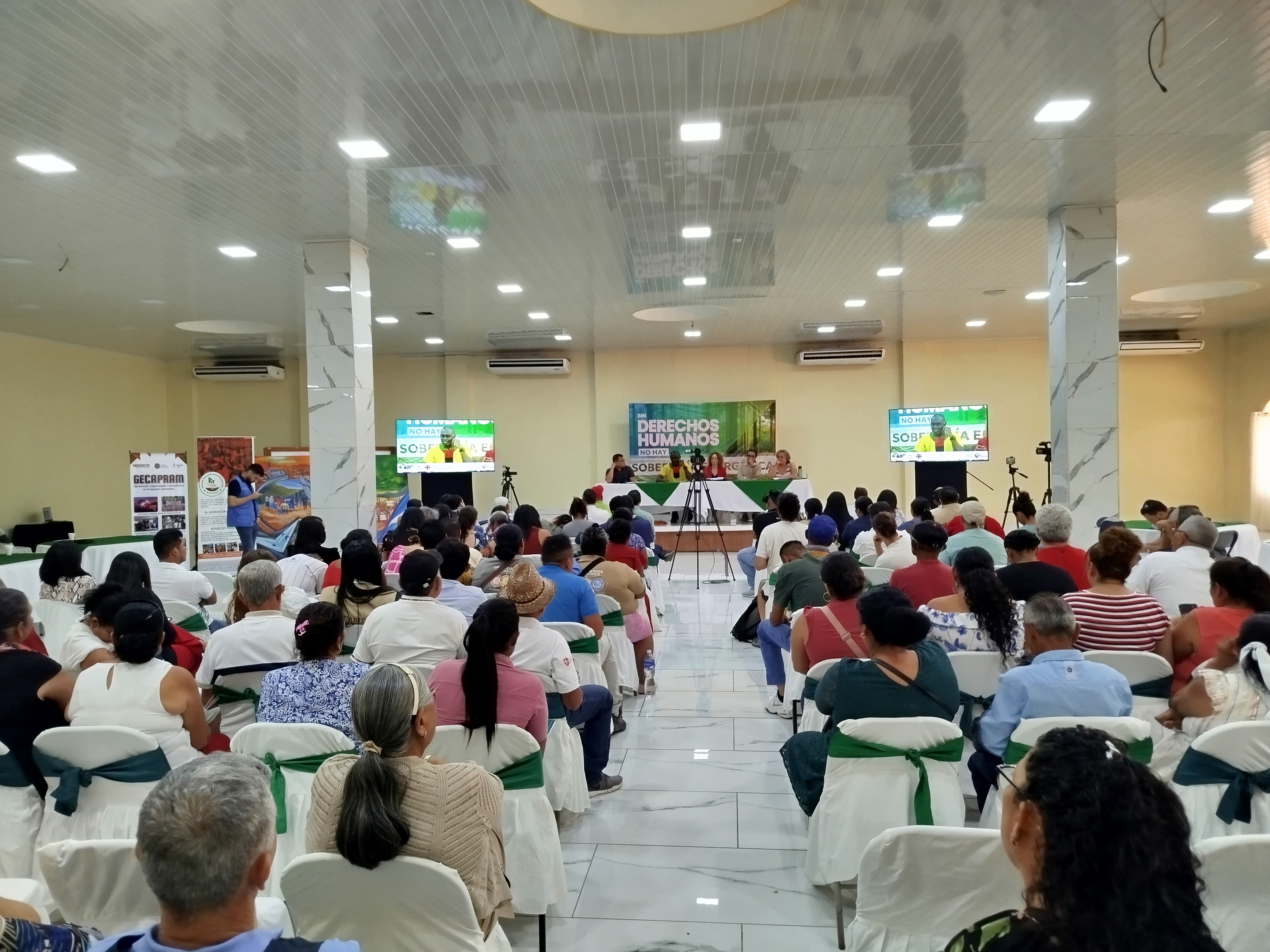
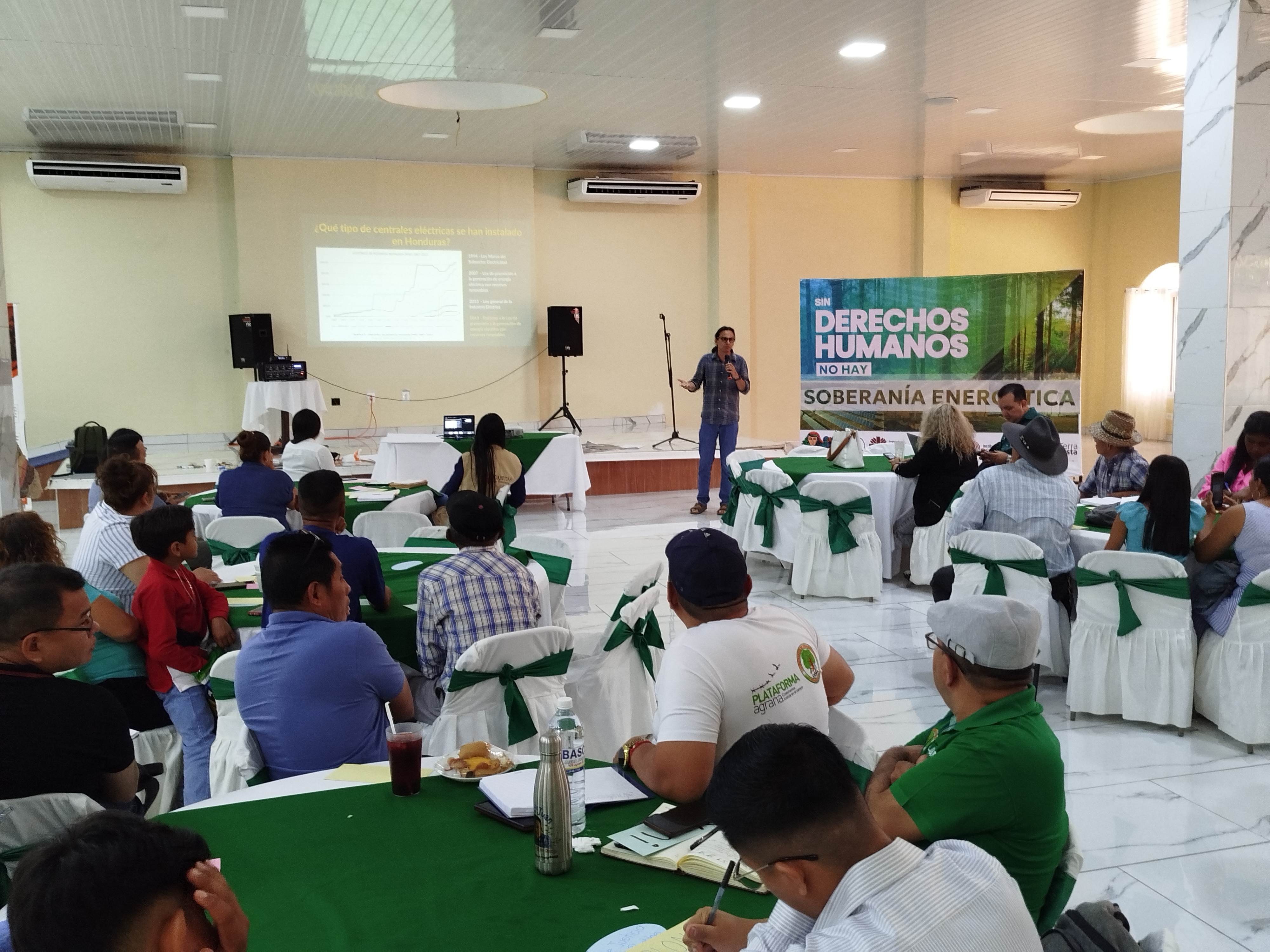
Between July 14 and 17, in the city of Choluteca (Honduras), more than 60 people from 20 local communities and representatives of national and international social movements gathered for the “Meeting of communities affected by energy projects in southern Honduras - Without human rights, there is no energy sovereignty.” The goal was to highlight the devastating impacts that many "renewable energy" projects (primarily photovoltaic) are generating in local communities. At the same time, participants analysed the siege that Honduras is facing in international courts due to the numerous international arbitration claims filed against it by transnational corporations that operate these energy projects.
Between 2023 and 2024, companies in the electrical sector used the Investor-State Dispute Settlement (ISDS) system to sue Honduras for introducing reforms intended to regain state control over strategic sectors, including electrical energy. The country is now at a crossroads, caught between exercising its sovereignty and protecting corporate interests under international treaties such as the Dominican Republic-Central America Free Trade Agreement (CAFTA-DR) and other investment agreements.
“The objective of the gathering was to strengthen the social processes of the communities in southern Honduras, as well as local, national, and regional alliances, regarding the implementation of renewable energy projects in southern Honduras, their impacts, and the international arbitration demands resulting from the government's energy reforms.” — Press release from the Meeting of communities affected by energy projects in southern Honduras “Without human rights, there is no energy sovereignty.”
Surge in ISDS Lawsuits: The Electrical Sector in the Crosshairs
According to a report released by the Transnational Institute (TNI), the Institute for Policy Studies (IPS), the Honduras Solidarity Network (HSN), and TerraJusta, as of June 2025, Honduras has been the target of 21 international arbitration claims, 16 of them in just the last three years (2023, 2024, 2025). All have been filed with the International Centre for Settlement of Investment Disputes (ICSID), a World Bank-affiliated body. Protected by Bilateral Investment Treaties (BITs), free trade agreements like CAFTA-DR, and Honduras's 2011 Investment Law, these claims constitute a "parallel justice system" that allows foreign investors to bypass national courts and sue sovereign states for millions of dollars in compensation for implementing regulations or public policies that affect their investments, according to these companies.
Electricity is one of the sectors most targeted by these types of lawsuits. Currently, there are seven pending arbitration claims related to this sector totalling over $1.6 billion. These legal actions are in retaliation for measures taken by Xiomara Castro's government in 2022 to renegotiate power generation contracts that were signed under highly unfavourable conditions for Honduras during the period known as the “narco-dictatorship” under Juan Orlando Hernández's government.
Between 2023 and 2024, seven companies filed arbitration claims against Honduras at ICSID totalling $1.6 billion (more than the Ministry of Energy claims the reforms will save Hondurans). These claims are based on free trade agreements, investment agreements, and the 2011 investment law. Among the claimants are Scatec ASA and Norfund for the Los Prados (Namasigüe) and Agua Fría (Nacaome) solar projects in Choluteca and Valle.’ — Press release: Meeting of communities affected by energy projects in southern Honduras: ‘Without human rights, there is no energy sovereignty’.
The claimant companies include Scatec ASA and Norfund (Norway), X-Elio Energy (Spain/Canada), Empresas Públicas de Medellín (Colombia), Inversiones y Desarrollos Energéticos (Panama), and other Central American investors. These companies own mega solar projects including Los Prados and Agua Fría in the departments of Choluteca and Valle. These projects have been the subject of multiple complaints regarding their environmental impact during installation, including land dispossession, the criminalisation of protest and human rights violations.
Four of these claims invoke trade treaties such as CAFTA-DR, the Central America–Panama FTA, and the FTA between Colombia, El Salvador, Guatemala and Honduras. The other three invoke the Honduras-Spain BIT and the 2011 Investment Law.
“These international lawsuits reveal a structural conflict between the pursuit of national energy and territorial sovereignty and the neocolonial privileges of transnational and national corporations. These interests are concentrated in the hands of a few, while the affected communities face the direct consequences of these imposed projects”. — Statement from the communities affected by energy projects in southern Honduras and the organisations convened by the gathering “Without Human Rights, There Is No Energy Sovereignty”.
CAFTA-DR: Legal Armour for Corrupt Foreign Capital
Of the 19 pending claims against Honduras, at least six invoke CAFTA-DR as their legal basis. In the case of the electricity sector, two of the claims include the case of Víctor Miguel Silhy Zacarías (El Salvador), who is demanding $80 million, and the case of Fernando Paíz Andrade and Anabella Schloesser (Guatemala), who are demanding $160 million. Both cases use the treaty to challenge regulatory and contractual changes to the electrical sector promoted by the Honduran government.
Like other commercial and foreign investment protection agreements, CAFTA-DR grants transnational corporations broad rights while exempting them from any obligation to account for their actions relating to the environment or human rights. This has been widely criticised in relation to the impacts of photovoltaic projects in southern Honduras. This imbalance has been widely documented and criticised by social movements. These treaties allow multi-million dollar lawsuits to be brought against sovereign countries and also have a deterrent effect on regulations for the collective good. In other words, their goal is to block any reforms proposed by governments, who then back down for fear of financial retaliation, regardless of whether these reforms, regulations or public policies aim to serve the common good, protect the environment or uphold human rights.
In the case of Honduras, particularly in the electricity sector, companies have turned to international law firms such as White & Case to litigate, seeking to reverse or halt reforms, such as the 2022 Electricity Law which recognises electricity as a human right and aims to rescue the National Electric Energy Company (ENEE) from a severe crisis.
As pointed out in the report Mafia investments against Honduras, an important aspect is that most of these claims are considered 'mafia-style', not only because of their punitive and disproportionate nature against the country, but also because the investments supporting the claims originated in contexts of high government corruption, repression and a lack of community consultation. Far from promoting development, these investments have caused environmental damage and social conflict. For example, community leaders in the Los Prados solar park have been persecuted for resisting the project.
“In the case of Los Prados, community resistance to the park has been systematically criminalised. One serious case was the murder of Reynaldo Reyes Moreno, who had opposed the projects. Furthermore, community leaders have faced legal complaints, threats and harassment from local authorities who promoted the installation of the parks.” — Statement from the communities affected by energy projects in southern Honduras and the organisations convened by the gathering “Without Human Rights, There Is No Energy Sovereignty”.
For these reasons, international claims against Honduras represent more than just an economic burden for the state; they also erode popular sovereignty and the processes of social justice that the Honduran people are trying to rebuild after decades of authoritarian and corrupt governments.
Possible Paths Forward
During the meeting of communities affected by energy projects, those present, including communities and organisations, formulated clear reflections which they published in a political document titled Statement from the Communities Affected by Energy Projects in Southern Honduras and the Organisations Convened by the Gathering: 'Without Human Rights, There Is No Energy Sovereignty'.
Honduras is clearly at a decisive moment. On the one hand, historically excluded and abused communities are fighting to defend their territories and establish a fair energy transition. Conversely, transnational companies are trying to prevent any reform that “threatens” their investments, many of which were imposed by force in corrupt contexts. The conflict between sovereignty and capital, and between rights and profits, is now at the centre of the national debate.
In response to this corporate offensive, Honduras took a first step in February 2024 by signing its withdrawal from ICSID. However, the country remains vulnerable to lawsuits from companies because its legal framework still includes multiple mechanisms that allow for international arbitration (ISDS). These legal frameworks are enshrined in agreements such as CAFTA-DR, investment protection agreements and the 2011 Investment Law. These “free” trade and investment treaties and tribunals, like ICSID, which enable international arbitration claims, are far from being neutral instruments. Instead, they have become tools of pressure and blackmail against the peoples of the Global South. Therefore, leaving ICSID is important, but not sufficient. The next step must be to denounce the trade and investment agreements that give foreign companies their true power.
The Honduran case, particularly with regard to energy-related lawsuits, is emblematic of the urgent need to dismantle an unjust system that exploits the discourse of the energy transition to benefit private capital at the expense of communities. Only then will it be possible to transition to an energy and economic policy that is grounded in human rights, equity, and popular sovereignty.
As the communities expressed in their final declaration:
“There can be no just energy transition alongside the exhaustion of our territories and the suffering of our communities. Energy sovereignty requires more than changing energy sources; it demands the democratisation of energy decision-making processes and the development of a model for energy generation and distribution based on economic equality and the guarantee of communities' economic, social, cultural and environmental rights. Without human rights, there can be no energy sovereignty!”