

South Korea resumes controversial US beef imports
SEOUL (AFP) - South Korea lifted its ban on US beef imports Thursday despite growing protests over fears of mad cow disease as it struggles to ratify a sweeping free trade deal with the world's biggest economy.
Agriculture Minister Chung Woon-Chun said the imports would resume under new rules proritising the public's health, but the opposition decried the move and thousands of people protested later Thursday.
"The government has fixed new sanitary conditions for importing beef," Chung said in a speech covered live on television. "The government will prioritise public health and safety in carrying out its policies."
He said the US beef imports would be thoroughly inspected and apologised for failing to prevent the spread of anxiety over mad cow disease. Seoul and Washington have previously said US beef is totally safe.
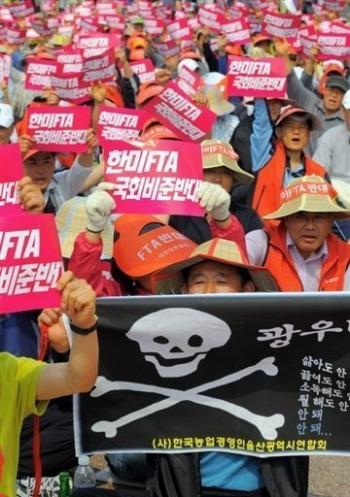
But police said more than 7,000 people held a candle-light rally late Thursday in Seoul to protest the end of the ban, continuing a spate of similar demonstrations over recent days.
They carried placards demanding the resignation of President Lee Myung-Bak, who was inaugurated February on a platform of revitalising the economy, and shouted, "The beef deal is invalid!", with police on alert nearby.
Protesters led by housewives clutching their babies also marched near the heavily guarded US embassy, while some 1,200 anti-riot officers were sent to protect 12 beef cold storage depots near Seoul.
"Today will go into history as a national humiliation day when the country sold out its rights to protect public health," said Cha Young, the spokeswoman for the main opposition United Democratic Party.
But Philip Seng, the president of the US Meat Export Federation, said the government's decision would give South Korean consumers a wider choice of beef.
"We will continue to do our best to build trust among South Korean consumers on our safe and high quality beef products," he said in a statement released in Seoul.
The resumption of beef imports is a pre-condition for Washington's approval of the separate free trade agreement with South Korea, which some analysts say could boost annual trade between the two nations by 20 billion dollars.
Lee's government sees the agreement signed last year as crucial to making South Korea more competitive over the long-term.
But South Korea's parliament failed to ratify the free trade deal due to an opposition boycott before the legislature dissolved Thursday to make way for a new assembly, in which Lee's Grand National Party holds a majority.
Labour unions have increased pressure on the government still further, vowing to block the planned distribution of US beef shipments.
"As the government pushes through with the announcement, it will face mounting protests from the people and we will lead them," said a spokesman for the Korean Confederation of Trade Unions.
Seoul agreed in April to lift its intermittent ban on US beef imports, which was first imposed in December 2003 amid a mad cow scare.
Over 2,000 tonnes of US beef are in the cold storage depots near Seoul, and the confederation has said unions representing truck drivers would physically block the transfer of the meat and refuse to unload further shipments.
The beef in storage would be among the first to be released to the market next week after procedural steps to lift the ban are completed, but distributors could face difficulties finding shops prepared to sell the meat.
The opposition claims the government has not secured safeguards against the alleged dangers posed by the human form of mad cow disease.
The Grand National Party has urged the opposition to approve the free trade deal in the new parliament convening Friday.
But legislators have to repeat procedures to ratify the deal which have already taken five months, and the opposition could take other steps to delay it.