

Food is not a commodity: Mobilization in Bizkaia against EU-Mercosur free trade agreement
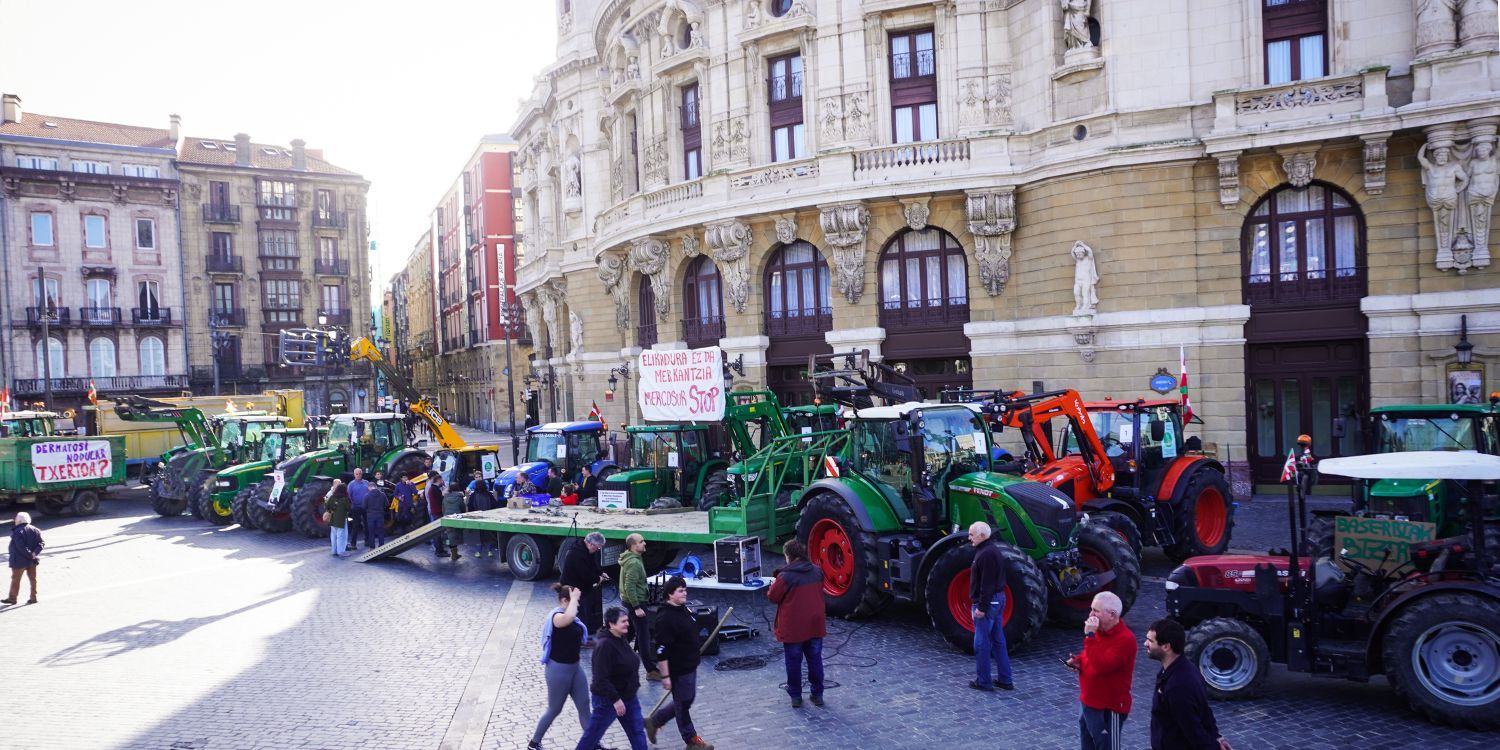
On the morning of Thursday, January 29, a caravan of peasant farmers and ranchers with their tractors left from different parts of the province of Bizkaia in Bilbao (Spain) to Bilbao to express their rejection of the free trade policies being promoted by the European Union.
The mobilization was called by the EHNE Bizkaia and EMBA unions with the aim of urging the European Parliament and the European Commission to maintain their rejection of the EU-Mercosur agreement.
This protest joins the peasant mobilizations in Europe that weeks ago pressured parliament representatives to take the agreement to the Court of Justice of the European Union for review and to declare it incompatible with the interests of the European bloc. It is also hoped that the Commission will suspend the agreement and refrain from any provisional application.
EU-MERCOSUR STOP! ELIKADURA EZ DA MERKANTZIA
Basque farmers have reaffirmed their rejection with the following arguments:
- The strengthening of international markets weakens the domestic market and hinders generational renewal.
- The liberalization of international markets is largely to blame for the current situation in the agricultural sector: low prices, lack of generational renewal, and increasingly widespread environmental health problems.
- The pursuit of competitiveness undermines the profitability of small and medium-sized agriculture.
- Large-scale industrial agricultural production (from Mercosur countries) is not compatible with the European production model.
- Market deregulation is causing increasingly sustained price volatility, which has a direct impact on agricultural precariousness in terms of wages, working conditions, and hours worked.
- Traditional productive sectors such as meat, honey, cereals, rice, etc. will suffer a major impact.
- For example, currently 58% of all beef imported by the EU comes from Mercosur. The increase in these imports will directly affect small and medium-sized farms.