

IATP | 20 August 2025
By Shiney Varghese
Battling for farmers' seed systems: UPOV 91 and trade agreements
We are grateful for the feedback and support from our partners in bringing out this memo: the African Center for Biodiversity (ACB), Association for Plant Breeding for the Benefit of Society (APBREBES), Biowatch South Africa, GRAIN, Pesticide Action Network (PAN), The Seed and Knowledge Initiative (SKI) in Southern Africa, The Southeast Asia Regional Initiatives for Community Empowerment (SEARICE), UBINIG-Bangladesh, as well as some of our North America based partners, including the Family Farm Defenders, Maryknoll Office for Global Concerns, National Family Farm Coalition, and the Semillas de Vida, Mexico.Download a PDF of this memo here.
Why Farmers’ Seed Systems[1] are central to agroecology
The global food and agriculture system, as dominated by industrial agriculture, poses a threat to humanity. As is becoming clearer by the day, it contributes not only to climate change, biodiversity loss, and abuse of water resources but also to “the “triple burden” of malnutrition that is, undernourishment, micronutrient deficiencies, and overweight and obesity, that often exist within a single country or even community”[2]. In this system, decisions on what to grow and how to grow it are determined without regard to the very real costs to human health and the environment, and without the invaluable contributions of farmers’ knowledge and innovations.
Against this background, agroecology is emerging as a preferred alternative not only among farmers movements in the Global South, but also among civil society and policymakers across the world as well as the Food and Agriculture Organization (FAO) of the United Nations. It offers a way for farming communities to improve their livelihoods and access healthy foods. Agroecology is built on the firm foundations of traditional knowledge and is enhanced by scientific enquiry and interactions among farmers, workers, consumers, and especially women and youth in those communities. In doing so, it focuses on principles such as building ecological and economic resilience of the system and addressing social equity.
Central to agroecology and the food sovereignty it presumes, as well as peasant agriculture, is the recognition of Farmers’ Rights to "save, use, exchange and sell" their own seeds, as their advocates have come to recognize.[3] These Farmers' Seed Systems often prioritize developing and maintaining seed varieties that are specifically adapted to local microclimates, soil types and the diverse cultural needs of farming communities. “Resilient seeds maintained by farming households are always ongoing experiments and evolve through local use in local conditions,” says Farhad Mazhar of UBINIG (Policy Research for Development Alternative), Bangladesh. He explains that “[h]istorically Farmers' Seed Systems (FSSs) evolved to keep this vital biological cycle active, and constituted farmers’ agencies to ensure seed and food sovereignty in most countries, particularly in Bangladesh.” For smallholder farming communities in the Global South, farmers’ seed sovereignty is key to maintaining agrobiodiversity, supporting local livelihoods, building food system resilience, and to dealing with ecological challenges — and therefore vital also for our current and future food systems.[4]
Guaranteeing farmers’ seed sovereignty has emerged as central to advocacy for agroecological transitions, along with farmers’ control of land and other agricultural inputs more broadly, which is needed to adapt to rapid climate change. This is especially true for smallholder producers, most of whom work directly on their farms and employ community members if needed in farm operations.
However, this plant genetic diversity — so essential in the fight against poverty and climate change — is at risk today. The diversity of domesticated plant varieties is disappearing at an alarming rate while private sector interest in the commercial use of genetic resources has increased in line with modern biotechnologies and accompanying demands for intellectual property rights.
This memo is an attempt to draw attention to the international policy-level challenges impacting Farmers’ Seed Systems broadly, but with a focus on communities in the Global South, and on how the U.S. and its seeds companies use free trade agreements to undermine the policy space available for farmers to save, use, exchange, and sell farm-saved seeds. It proceeds in three parts:
1) It shows how two sets of agreements — the Union for the Protection of New Varieties of Plants (UPOV) conventions[5] and the Agreement on Trade-Related Aspects of Intellectual Property Rights (TRIPs)[6] — have systematically shrunk this policy space by restricting Farmers’ Rights and undermining Farmers’ Seed Systems; it also shows how these initiatives consolidated the hold of industrial agriculture and threaten small and mid-scale agriculture and agroecological possibilities.
2) It shows how, potentially, policy spaces for traditional farming practices have been shored up especially through three mechanisms: the Convention on Biological Diversity (CBD) and its Nagoya Protocol, the International Treaty on Plant Genetic Resources for Food and Agriculture (ITPGRFA), and two initiatives from the United Nations Human Rights mechanisms: The United Nations Declaration on the Rights of Indigenous Peoples (UNDRIP) and the United Nations Declaration on the Rights of Peasants and Other People Working in Rural Areas (UNDROP).
3) It briefly explores the current context where many developing countries that are still outside the purview of UPOV-compliant plant variety protection (PVP) regimes and are facing multi-pronged pressure to adhere to those rules by countries such as the U.S., including through free-trade agreements.
It concludes with potential for mobilizations inside and outside of these policy spaces to protect Farmers’ Rights to save, use, exchange, and sell farm-saved seeds.
Challenges to Farmers’ Seeds Systems from Intellectual Property Rights (IPR)
For most of their history, farmers have planted their crops with the plant materials (seeds, bulbs, plant cuttings) saved from previous harvests or acquired from others in the community. But this began to change with industrialization, initially in the Global North. In countries such as the U.S., specialized breeders began lobbying early on to protect their intellectual property rights over the new varieties they developed. The national Plant Patent Act, enacted in 1930, protected the intellectual property rights of seed companies, but with limited coverage for a few asexually reproducing species that they were developing.[7] It was not until the adoption of the International Convention for the Protection of New Varieties of Plants by a diplomatic conference in Paris on December 2, 1961,[8] that an international system of plant variety protection (PVP) upholding breeders IPRs — the Union for the Protection of New Varieties of Plants (UPOV) — came into being, with the participation of 11 countries, almost all of them European.[9]
Further technological advances in the 1970s onwards led to multiple revisions of the UPOV, with an expansion of the breeders’ rights in scope and breadth with each revision in 1972, 1978, and 1991. The last, which came into force on April 24, 1998, was the most consequential. Breeders’ rights in the earlier versions of the UPOV Act (1961, 1972, 1978) were limited to production for purposes of commercial marketing, the offering for sale, and the marketing of the reproductive or vegetative propagating material. This meant that under these acts, farmers could still save and exchange seeds freely.[10]
This changed with the adoption of the revised 1991 Act of the UPOV convention (UPOV 91), when breeders’ rights were broadened to include all forms of ”multiplication” — production and reproduction of a protected plant variety — while also introducing an optional and limited “farmers' privilege”, which prohibits the sale and exchange of seeds from protected varieties in principle, and limits the use of farm-saved seeds to certain crops, which may be subject to payment to the seed breeder.
The revised 1991 Act of the UPOV convention locked in unfair intellectual property rights: it restricted the rights of member country farmers further, doing away with what was known as Farmers’ Exception Clause, and introducing much more limited and optional farmers’ privilege.[11] Negotiations were limited to the 20 members of UPOV 78 — 19 industrialized country members and one developing country, South Africa — but the restrictions on farmers were applicable in the countries that ratified and acceded to it from that point forward.[12] It is important to note that within the U.S., a “farmer’s right to save seed” is limited to the amount that can be used to plant their own farm (U.S. Supreme Court, 1995).[13] In the European Union (EU) and EU Member States, too, ”National seed catalogues and the EU Common Catalogue have been designed to promote industrial seeds and agriculture standards, largely excluding peasant seeds. Due to strong IPR regimes, peasant seed saving, exchange and selling have been outlawed or severely restricted in the EU.”[14]
UPOV 91 finally came into force on April 24, 1998,[15] and it allowed a one-year period from that point — when any new UPOV member had the option to join either UPOV 78 or UPOV 91 — at the end of which if a country wanted to join UPOV, the only option was to join UPOV 91. In countries that opted to remain part of UPOV 78, farmers could continue to save seeds (including those harvested from protected varieties) for their own use.[16] In countries which were outside the purview of UPOV altogether, farmers could continue to save seeds (including those harvested from protected varieties) for their own use. Countries which were outside the purview of UPOV altogether retained the leeway to not have legislation, or to amend their PVP legislation according to their national priorities such as protecting Farmers’ Rights to ”save, use, exchange and sell“ their seeds.
This changed with the TRIPs Agreement[17] at the conclusion the Uruguay Round (1986-1994), leading to the establishment of the World Trade Organization (WTO) that almost all countries were party to. Up until this point, the overwhelming majority of UPOV members were developed countries. Most developing countries’ farmers relied on strong Farmers’ Seed Systems or public breeding initiatives for their seeds, so most of these countries did not feel the need to develop PVP laws guaranteeing exclusive rights to plant breeders.
The WTO-administered TRIPs Agreement brought intellectual property rules into the international trading system, obliging all WTO members to develop PVP laws. The TRIPs Agreement, however, only stipulates that member states must seek to establish minimum standards of protection across the major fields of intellectual property, including for PVP. Nothing in TRIPs requires member states to either join UPOV or to enact national plant breeders’ laws consistent with UPOV convention to comply with their obligations under TRIPs.[18] In fact, in the case of countries that did not have legal regimes protecting plant varieties yet, TRIPs stipulated that "any country excluding plant varieties from patent protection must provide an effective sui generis system."[19] This allows countries space to develop nationally unique PVP laws that do not necessarily comply with UPOV 91 provisions — after all, UPOV is just one type of PVP among many. TRIPs has also allowed countries different periods of time to delay applying these provisions.[20]
In January 1995, when TRIPS came into force, UPOV membership comprised 27 countries, most of them developed countries. The one-year window kept open by UPOV — when any new UPOV member had the option to join either UPOV 78 or UPOV 91 — was to start on April 24, 1998. In the following months, UPOV along with WTO and WIPO conducted a series of joint seminars “aimed at pressurizing developing countries into adopting UPOV-type legislation, or joining the Union.”[21] Given the TRIPs requirement for all member countries to establish minimum standards of protection across the major fields of intellectual property, including for PVP, several developing countries opted to join UPOV 78, which would uphold a Farmers’ Right to save seeds at least for their own use. Once that window closed, the pressure on others to join UPOV 91 continued.
Even though the UPOV 91 did not actually enter into force until April 1998,[22] many free-trade agreements that came into being after 1991 required Parties to adhere to the UPOV 91 provisions, giving corporate plant breeders intellectual property rights over all plant varieties.[23] For example, since 1991, all bilateral or regional trade agreements signed by the U.S. have required member countries to ratify UPOV 91 and revise national seed laws accordingly, such as in the case of the U.S.-Mexico-Canada Agreement (USMCA).[24] As of June 2025, UPOV has 80 members covering 99 nations.[25]
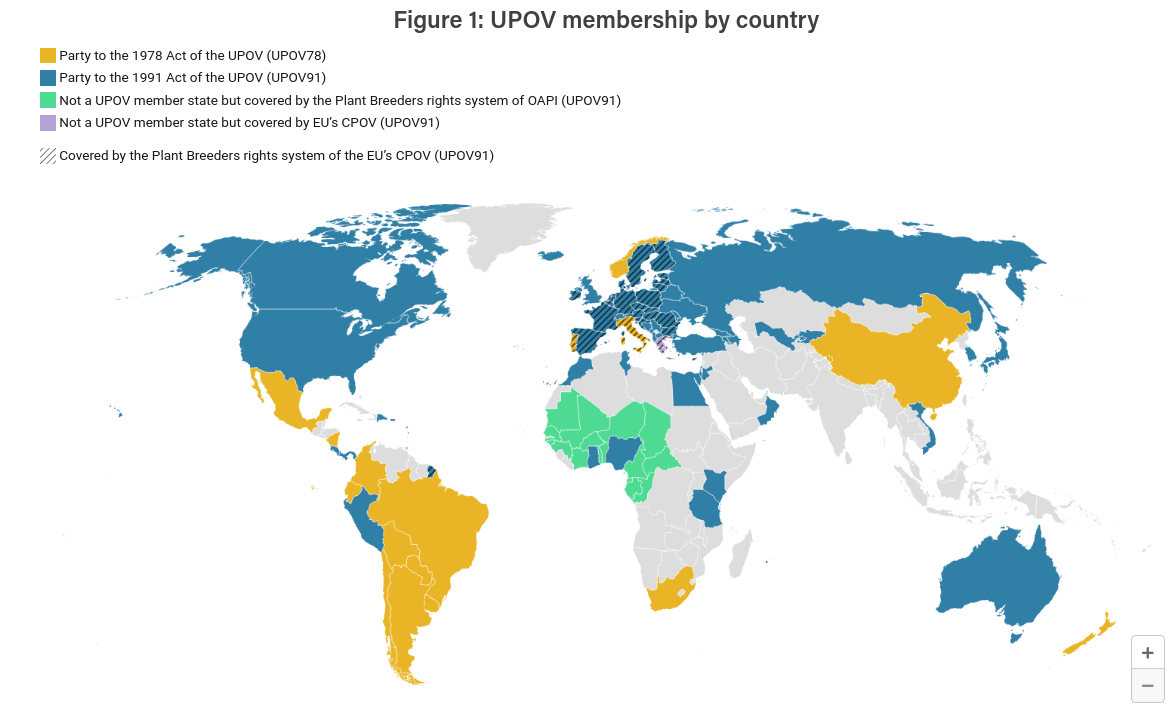
Map: IATP. Get the data. Created with Datawrapper
Why farmers and civil society advocates of agroecology oppose UPOV[26]
The restriction of Farmers’ Rights to “save, use, exchange and sell” seeds has always been one of the main reasons for farmers’ opposition to UPOV. These rights are critical for upholding the food security of small and mid-scale farmers and their food sovereignty. In fact, a collaborative of NGOs from several countries carried out Human Rights Impact Assessments (HRIA) of stronger PVP laws based on UPOV 1991. This provided convincing evidence from Kenya, Peru, and Philippines of the threat to the right to food of small-scale farmers.[27] More recently Dr. Michael Fakhri, the Special Rapporteur on the Right to Food, emphasized in his report to the Human Rights Council that, because seeds are central to people’s cultures and food systems, to control seeds is to control life.[28]
The second reason is the loss of local agrobiodiversity. The uniformity and stability requirements of PVP under the UPOV system incentivize breeders to work only with limited varieties of “elite” germplasm. This erodes the genetic diversity that currently protects the resilience of developing countries and their farming communities when faced with changing climate, erratic weather and other crises (as was evident during COVID 19[29]).
The experience in the U.S. of IPRs over plants and biological resources over more than half a century shows how it has resulted not only in diminishing local biodiversity and increasing monocultures, but also has led to corporate concentration in the food systems. Such monocultures are highly vulnerable to pests and disease and increase farmers’ dependence on agrochemicals. They also increase the economic cost of growing crops, locking farmers into financing mechanisms they often cannot sustain in the face of erratic farmgate prices, and contributing to farm debts. Globally, the use of agrochemicals has had devastating impacts on the health of farmers and agricultural workers, as well as others exposed to those chemicals, including through eating affected produce.[30] on the health of farmers and agricultural workers, as well as those eating the produce. It has also impacted pollinator populations and deteriorated local water quality, further impacting the health of the people, flora and fauna who use that polluted water.
The UPOV system has encouraged this process by providing breeders’ rights to corporations. Today, four global agribusiness corporations (Bayer, BASF, Corteva and Syngenta Group) control 62% of the global agrochemical market and 51% of the global seed market.
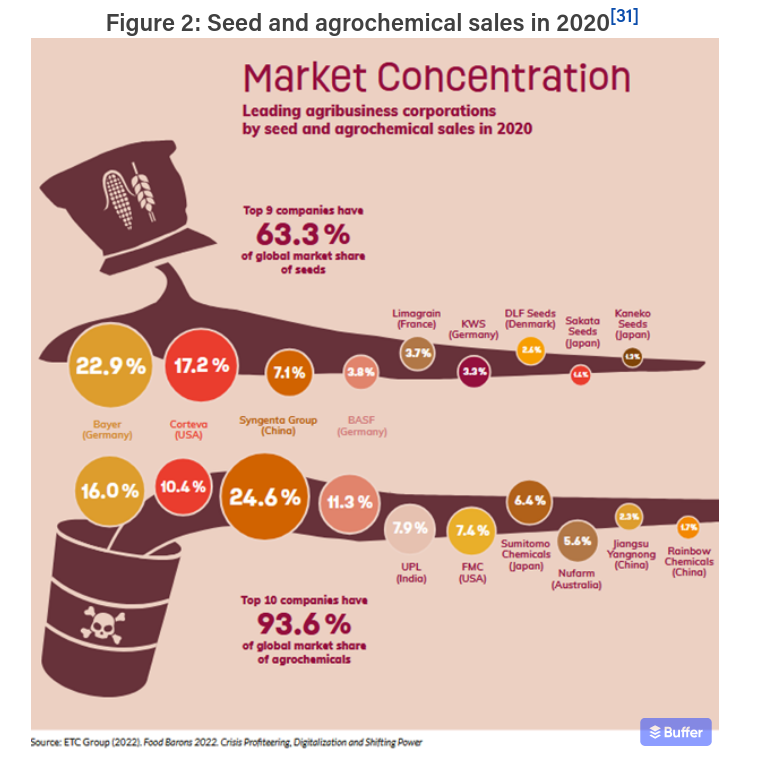
These same four corporations, plus Limagrain and KWS, control almost 99% of genetically modified crops.[32] Countries that currently remain outside the purview of the UPOV have the option to take an alternate path that supports agroecological transitions towards food sovereignty and biodiversity conservation.
Alternative approaches that uphold Farmers’ Seed Systems under multilateral processes
Against the background of these developments that seek to restrict Farmers’ Rights to seeds and contribute to reducing agrobiodiversity, there have been some important countervailing multilateral efforts. Especially noteworthy is the increasing insistence on the right to seeds in international treaties such as the International Treaty on Plant Genetic Resources for Food and Agriculture (ITPGRFA) and the Convention on Biological Diversity’s Nagoya Protocol agreement, as well as in the two UN declarations that uphold the Rights of Indigenous Peoples (UNDRIP) and the Rights of Peasants and Other People Working in Rural Areas (UNDROP).
As our focus here is on the U.S., it is important to note that the U.S. has ratified neither the Convention on Biological Diversity, nor its Nagoya Protocol, but it is a party to the ITPGRFA. While it voted against the adoption of the UNDRIP in 2007, by 2011 the U.S. government decided to support the UNDRIP.[33] But in the case of the UNDROP, the U.S. voted against the adoption of it in 2018 and continues to not support it as of May 2025.
While each of these processes have limitations, there are ongoing efforts over time in these spaces to address critical issues such as Farmers’ Rights and broader agrobiodiversity issues, unlike in the case with the UPOV which is locked in place as is. A brief outline of each is below.
1. The Convention on Biological Diversity and its Nagoya Protocol
The Convention on Biological Diversity (CBD), adopted in 1992, is the international legal instrument for the conservation of biological diversity. Its Nagoya Protocol on "Access to Genetic Resources and the Fair and Equitable Sharing of Benefits Arising from their Utilization to the Convention on Biological Diversity" (known as access and benefit-sharing, or ABS) is an international agreement that was adopted in 2010 and aims to provide a transparent legal framework for the effective implementation of one of the three key objectives of the CBD — the fair and equitable sharing of benefits arising out of the utilization of genetic resources. For example, the European Union Regulation (EU) No 511/2014, also known as the EU ABS Regulation, implements the Nagoya Protocol on access to genetic resources and benefit-sharing within the EU. It sets the rules for users of genetic resources and traditional knowledge associated with them to ensure compliance with the Nagoya Protocol's obligations for fair and equitable sharing of benefits.
In the context of ABS, it is important to note that the Nagoya Protocol recognizes the critical role that Indigenous peoples and local communities play in the conservation and sustainable use of genetic resources. The Nagoya Protocol entered into force on October 12, 2014, and obliges its 142 signatories to not restrict the customary use and exchange of genetic resources and associated traditional knowledge as far as possible in the context of implementing the Protocol.
2. International Treaty on Plant Genetic Resources for Food and Agriculture (ITPGRFA)
The ITPGRFA, adopted in 2001, focuses specifically on crop diversity. With 154 contracting parties (as of January 2025), ITPGRFA — also known as the International Seed Treaty or the Plant Treaty — aims to ensure the conservation and sustainable use of plant genetic resources for food and agriculture (PGRFA). Its aim is to promote the fair and equitable sharing of benefits arising from the Multilateral System of Access and Benefit Sharing (MLS)[34] that allows for facilitated access to plant genetic resources (see Annex I[35] of the International Treaty for the 64 major food crops and forages included in MLS) for research, breeding, and training for food and agriculture.[36]
The Plant Treaty is also the first binding instrument to formally acknowledge the immense contribution made by farmers, local communities, and Indigenous Peoples in developing and conserving crop diversity. Also, with the adoption of the Plant Treaty, the important role of farmers — as custodians and innovators of plant genetic diversity that are of global significance to food and agriculture — was formally and explicitly recognized for the first time at the international level.[37]
However, the Plant Treaty’s limitation is that it is not binding on national governments to take measures to protect and promote Farmers’ Rights, despite it recognizing the right to “save, use, exchange, and sell” farm-saved seeds and propagating material.[38] Measures to protect Farmers’ Rights are taken by the State only when they do not violate other national laws on PVP, such as those in the UPOV provision, if the country is party to both. But, there are some ongoing efforts to assist contracting parties to help promote and implement Farmers’ Rights. For example, in the last decade, FAO’s Expert Group has developed a set of ”options for encouraging, guiding, and promoting the realization of Farmers’ Rights, as set out in Article 9 of the International Treaty.”[39] This 2023 document provides examples of how these rights could be implemented.
One of the options (10B) suggests that “[c]ontracting Parties may consider reviewing and, as appropriate, adjusting intellectual property laws and related procedures, for example by including provisions to safeguard rights that farmers have to save, use, exchange and/or sell farm-saved seed,” keeping the option open for counties to revisit their PVP laws and strengthen them in favor of Farmers’ Rights. The other limitation is that user-based income from corporations — that is to fund the Benefit Sharing Fund (BSF) of the Plant Treaty — have not been forthcoming with recent developments around the collection of digital sequence information (DSI)[40] rather than seeds themselves by breeders, and the issues have become even more complex.[41] Negotiations to revise the Multilateral System (MLS) of the Plant Treaty are ongoing, with a focus on enhancing the system's effectiveness in ensuring access to plant genetic resources and sharing benefits arising from their use — one of the key areas of negotiations being DSI.[42]
3. The United Nations Declaration on the Rights of Indigenous Peoples (UNDRIP) and the United Nations Declaration on the Rights of Peasants and Other People Working in Rural Areas (UNDROP)
The United Nations Declaration on the Rights of Indigenous Peoples (UNDRIP)[43] was adopted in 2007, and the United Nations Declaration on the Rights of Peasants and Other People Working in Rural Areas (UNDROP)[44], was adopted in 2018.[45] Both UNDRIP and UNDROP recognize the rights of rural communities and Indigenous Peoples to protect their seeds. They also provide normative guidelines to implement these rights.
UNDROP, Article 19 further elaborates on these rights, and particularly noteworthy are Article 19.1 and 19.8:
Article 19.1
Peasants and other people working in rural areas have the right to seeds, in accordance with Article 28 of the present declaration, including:
(a) The right to the protection of traditional knowledge relevant to plant genetic resources for food and agriculture;
(b) The right to equitably participate in sharing the benefits arising from the utilization of plant genetic resources for food and agriculture;
(c) The right to participate in the making of decisions on matters relating to the conservation and sustainable use of plant genetic resources for food and agriculture;
(d) The right to save, use, exchange and sell their farm-saved seed or propagating material.
Article 19.8
States shall ensure that seed policies, plant variety protection and other intellectual property laws, certification schemes and seed marketing laws respect and take into account the rights, needs and realities of peasants and other people working in rural areas.
As the Association for Plant Breeding for the Benefit of Society (APBREBES, a global civil society network) explains, “In UNDROP, the right to seeds includes States’ obligation to avoid creating obstacles to peasant seed systems, which means for instance that they shall not adopt policies and regulations on seed marketing that impose stringent requirements as a precondition for the exchange or sale of peasants’ seeds.”[46] UNDROP provides a new opportunity for all countries to develop their own sui generis PVP systems that seek to protect Farmers’ Seed Systems, one that will help maintain agrobiodiversity, and help tackle climate resilience.
Meanwhile, several other developing countries such as Ethiopia, India, Malaysia, Pakistan, Philippines, Thailand, Zambia, and Zimbabwe decided to develop their own sui generis PVP systems, which comply with the demands of the TRIPs Agreement of the WTO while also upholding Farmers’ Rights to freely save, use, exchange, and sell farm-saved seed and propagating material. For example, Indian Law on Protection of Plant Varieties and Farmers’ Rights Act, [Farmers’ Rights, Chapter VI, Art. 39 (1) (iv)] says that:
A farmer shall be deemed to be entitled to save, use, sow, resow, exchange, share or sell his farm produce including seed of a variety protected under this Act in the same manner as he was entitled before the coming into force of this Act: Provided that the farmer shall not be entitled to sell branded seed of a variety protected under this Act.
But there are many countries that do not have legal regimes protecting plant varieties yet, since many of them are allowed a longer timeframe to comply with the TRIPs. Many of these countries are confronting pressure to join UPOV 91, but for now, they continue to have the legal option to develop their own sui generis PVP systems, which comply with the demands of the TRIPs while protecting Farmers´ Rights to freely save, use, exchange and sell farm-saved seed and propagating material, but lack the structural space, due to the multiple dependencies under which they operate.
U.S. pressure to harmonize seed laws
These PVP rules, and the pressure to impose them through free-trade agreements, are the result of years of pressure by industry groups. The American Seed Trade Association (ASTA), for example, played a crucial role in the establishment of African Seed Trade Association (AFSTA) in 1999, in partnership with U.S. Department of Agriculture (USDA) and the International Seed Trade Federation, providing the stimulus, technical support, and financial means.[47] Since its establishment, AFTSA has been promoting regional integration and harmonization of seed policies and regulations that are supportive of U.S. seed trade in target countries and regions in Africa. AFSTA members work with their government representatives to develop regulatory systems and intellectual property rights laws to promote private seed commerce, and protection of breeders’ rights. AFSTA efforts to harmonize seed marketing and trade laws in Africa began in earnest around 15 years ago via Regional Economic Communities (RECs) such as the Economic Community of West African States (ECOWAS), the Common Market for Eastern and Southern Africa (COMESA), the Southern African Development Community (SADC), and the East African Community (EAC), most of which include intellectual property rights agendas and the harmonization of seed marketing regulations.[48]
The requirement in U.S.-led trade agreements that countries ratify and implement UPOV 91 locks those rules in place. The USMCA removed the option in the North American Free Trade Agreement (NAFTA) that allowed Partiers to join either UPOV 78 or UPOV 91.[49] Mexico has been under pressure since then to ratify UPOV 91 and to change its national laws to come into compliance. So far, it has resisted that pressure.
Conditions in FTAs with Chile and Colombia have created similar pressure on those countries. Neither have so far joined the UPOV 91 despite U.S. efforts to enforce that trade rule, as has been noted by APBREBES reports.[50] As of May 2025, both remain on the U.S. Special 301 Report, an annual review of the status of intellectual property rights concerns and enforcement by U.S. trading partners.[51]
Campaigns in support of Farmers’ Seed Systems
The pressure[52] to develop PVP laws that are compliant with UPOV 91 has been increasing not only in Latin America and Africa, but also in Asia. In response, farmers organizations and civil society advocates of seed sovereignty and agroecology are mobilizing in countries across Africa, Asia, and Latin America to protect Farmers’ Seed Systems and instead develop systems tailored to their needs.[53] Such campaigns uphold the principle of food sovereignty, or each nation’s right to make its own decisions on its food system based on the needs of its citizens and of its environment. The #StopUPOV campaign is a coordinated effort of these campaigns in the Global South. Allies in Europe and North America could support these efforts by telling our own governments to back off from their efforts to compel trading partners to join and ratify UPOV 91.
U.S. trade policy is in a state of upheaval, with the Trump administration asserting that it is negotiating as many as 200 trade “deals”.[54] The content of those deals is currently unknown. However, a planned review of the USMCA will begin in 2025, culminating in a decision in July 2026 to either ratify a possibly revised version, or to enter into a 10-year process of annual reviews and possibly repeal the trade agreement altogether. This creates an important opportunity to remove the requirement for UPOV 91 and instead advance more flexible rules that ensure biodiversity and honor seed sovereignty. Similarly, there are opportunities to join the civil society efforts in the negotiations for a revision of the Multilateral System on Access and Benefit-Sharing of the FAO Plant Treaty (ITPGRFA). U.S. advocates for agroecology and Farmers’ Rights must be part of these efforts.
****
Download a PDF of this memo here.
Endnotes
[2] The Future of Food and Agriculture: Alternative Pathways to 2050 (Food and Agriculture Organization of the United Nations, 2018); https://go.nature.com/4e7zBKR
[3] Seed Saving and Seed Sovereignty, https://www.firstnations.org/wp-content/uploads/publication-attachments/2015-Fact-Sheet-11-Seed-Saving-and-Seed-Sovereignty.pdf
[4] Press release No.: IFAD/74/2022 https://www.ifad.org/en/w/news/no-biodiversity-no-farmers-no-food-security
[5] The acronym UPOV is for the French name of the organization, Union Internationale pour la Protection des Obtentions Végétales. See, An overview, UPOV: https://www.upov.int/about/en/overview.html
[6] Agreement on Trade-Related Aspects of Intellectual Property Rights (TRIPS Agreement) Date of Text: April 15, 1994 and Date of Entry into force: January 1, 1995, https://www.wipo.int/wipolex/en/treaties/details/231
[7] Today in the U.S. there are three types of intellectual property protection given to plant breeders: In addition to the IPRs covered through PVP Act, breeders in the U.S. can get two other types of intellectual property protection through patenting for new plant varieties: https://www.ams.usda.gov/services/plant-variety-protection For more on Plant patent Act enacted in 1930 in the U.S., see: https://www.govinfo.gov/content/pkg/USCODE-2018-title35/pdf/USCODE-2018-title35-partII-chap15.pdf
[8] The First Twenty-Five Years of the International Convention for the Protection of New Varieties of Plants - Dec 2 1961 - Dec 2, 1986 at https://www.wipo.int/publications/en/details.jsp?id=3357
[9] https://www.upov.int/edocs/pubdocs/fr/upov_pub_316.pdf
[10] The fact that UPOV acts of 1961, 1972, and 1978, did not disallow farmers ability to save and exchange seeds is sometimes referred to as “farmers’ exception clause.”
[11] Entry into force of the 1991 Act, https://www.wipo.int/wipolex/en/treaties/notifications/details/treaty_upov_63
[12] The 1991 Act of the UPOV Convention by Mr. Barry Greengrass, Vice Secretary-General, UPOV, Geneva, Switzerland, presented at the Seminar on the Nature and Rationale for the Protection of Plant Varieties under the UPOV Convention, Pretoria, south Africa, May 3-5, 1995, see at https://www.upov.int/edocs/pubdocs/en/upov_pub_747.pdf
[14] Geneva Academy, Practical manual on the Rights to Seeds in Europe, https://www.geneva-academy.ch/joomlatools-files/docman-files/Briefing%2019.pdf
[15] Entry into force of the 1991 Act, https://www.wipo.int/wipolex/en/treaties/notifications/details/treaty_upov_63
[16] https://www.upov.int/edocs/pubdocs/en/upov_pub_295.pdf
[17] Agreement on Trade-Related Aspects of Intellectual Property Rights (TRIPS Agreement) Date of Text: April 15, 1994 and Date of Entry into force: January 1, 1995, https://www.wipo.int/wipolex/en/treaties/details/231
[18] Overview: the TRIPS Agreement, https://www.wto.org/english/tratop_e/trips_e/intel2_e.htm
[19] Ibid; Sui Generis means of its own kind, in Latin (google translated), or unique.
[20] Uruguay Round Agreement: TRIPS, Part VI — Transitional Arrangements (Article 65): https://www.wto.org/english/docs_e/legal_e/27-trips_08_e.htm
[21] GRAIN: UPOV on the warpath, June 1999, h[ttps://grain.org/en/article/257-upov-on-the-war-path->ttps://grain.org/en/article/257-upov-on-the-war-path]
[22] Entry into force of the 1991 Act, https://www.wipo.int/wipolex/en/treaties/notifications/details/treaty_upov_63
[23] UPOV 91 and other seed laws: a basic primer on how companies intend to control and monopolize seeds, GRAIN.
[24] https://www.apbrebes.org/sites/default/files/2021-10/Apbrebes_UPOV-Flexibility_EN_10-21_def.pdf
[25] https://www.upov.int/edocs/pressdocs/en/upov_pr_143.pdf
[26] Thanks to GRAIN, APBREBES and allied groups for drawing attention to these concerns over the decades.
[28] United Nations (2021). A/HRC/49/43. Seeds, right to life and farmers’ rights - Report of the Special Rapporteur on the right to food, Michael Fakhri. https://www.ohchr.org/en/documents/thematic-reports/ahrc4943-seeds-right-life-and-farmers-rights-report-special-rapporteur
[29] https://www.csm4cfs.org/wp-content/uploads/2020/12/EN-COVID_FULL_REPORT-2020.pdf
[30] Forget G, Goodman T, de Villiers A. Impact of pesticide use on health in developing countries, Proceedings of a symposium held in Ottawa, Canada, 17–20 September 1990. Ottawa: International Development Research Centre. Available from: http://www.nzdl.org/gsdlmod?e=d-00000-00%2D%2 D-off-0hdl%2D%2D00-0%2D%2D%2D%2D0-10-0%2D%2D-0%2D%2D- 0direct-10%2D%2D-4%2D%2D%2D%2D%2D%2D-0-0l%2D%2D11-en-50%2 D%2D-20-about%2D%2D-00-0-1-00-0-0-11-1-0utfZz-8-00-0-0-11-10-0utfZz- 8-10&cl=CL1.9&d=HASH9a5ff6e89f19377a1b258a>=2; National Research Council (U.S.). Committee on Pesticides in the Diets of Infants and Children: Pesticides in the diets of infants and children/Committee on Pesticides in the Diets of Infants and Children, Board on Agriculture and Board on Environmental Studies and Toxicology, Commission on Life Sciences, National Research Council. National Academies of Sciences, Engineering, and Medicine. 1993. Pesticides in the Diets of Infants and Children. Washington, DC: The National Academies Press. https://doi.org/10.17226/2126. Available from: https://nap.nationalacademies.org/read/2126/chapter/1; and USEPA: EPA Releases Risk Assessment Showing Significant Risks to Human Health from the Herbicide DCPA; Released on May 31, 2023, Available from: https://www.epa.gov/pesticides/epa-releases-risk-assessment-showing-significant-risks-human-health-herbicide-dcpa
[31] Credit: https://www.rosalux.de/fileadmin/images/Dossiers/Ernaehrungssouveraenitaet/SeedsAtRisk_ENG_web2.pdf ; Source: Action Group on Erosion, Technology and Concentration (ETC Group): Food Barons 2022: Crisis Profiteering, Digitalization and Shifting Power. For an update, see: https://grain.org/en/article/7284-top-10-agribusiness-giants-corporate-concentration-in-food-farming-in-2025 ;
[32] Market Power: Corporate concentration and control of global food and agriculture, by Silvia Ribeiro, ETC Group, in https://www.rosalux.de/fileadmin/images/Dossiers/Ernaehrungssouveraenitaet/SeedsAtRisk_ENG_web2.pdf
[33] U.S. Department of State (January 12, 2011), Announcement of U.S. Support for the United Nations Declaration on the Rights of Indigenous Peoples
[35] https://www.fao.org/plant-treaty/areas-of-work/the-multilateral-system/annex1/en/
[36] Recipients of material from the MLS sign a standardized Standard Material Transfer Agreement (SMTA) that specifies the conditions for use and benefit sharing.
[38] https://faolex.fao.org/treaty/docs/tre000005E.pdf
[40] https://www.cbd.int/dsi-gr ;
[41] Update on the enhancement of the Multilateral System of the ITPGRFA by the National Focal Point (NFP) on Access and Benefit-Sharing of the Netherlands; https://www.absfocalpoint.nl/en/news-5/update-on-the-enhancement-of-the-multilateral-system-of-the-itpgrfa.htm
[42]https://infogm.org/en/despite-negotiations-in-2024-disagreements-over-dsi-persist/
[45] Four countries—Australia, Canada, New Zealand and the United States—all with origins as settler colonies, had voted against the adoption of UNDRIP in 2007, but by 2016 all four expressed their support for UNDRIP.
[46] APBREBES, The Rights to Seeds in Africa, https://www.geneva-academy.ch/joomlatools-files/docman-files/Briefing%2022_web.pdf
[47] https://www.betterseed.org/pdfs/about-asta/annual-report/asta-2000-2001-annual-report.pdf
[48] Harmonization of seed regulation in Africa: Paving the way for commercial seeds, Mariyam Mayet, ACB (African Centre for Biosafety) in https://www.rosalux.de/fileadmin/images/Dossiers/Ernaehrungssouveraenitaet/SeedsAtRisk_ENG_web2.pdf
[50] Association for Plant Breeding for the Benefit of Society (APBREBES) is an international network tackling IPR with regards to seeds. https://www.apbrebes.org/sites/default/files/2021-10/Apbrebes_UPOV-Flexibility_EN_10-21_def.pdf
[52] APBREBES, UPOV’s war against Rights of Farmers, https://www.apbrebes.org/news/upovs-war-against-farmers-rights
[53] UPOV: Intellectual property in conflict with farmers’ rights, by François Meienberg, APBREBES in https://www.rosalux.de/fileadmin/images/Dossiers/Ernaehrungssouveraenitaet/SeedsAtRisk_ENG_web2.pdf
[54] https://abcnews.go.com/Politics/trump-claims-200-tariff-deals-phone-call-chinese/story?id=121154205