


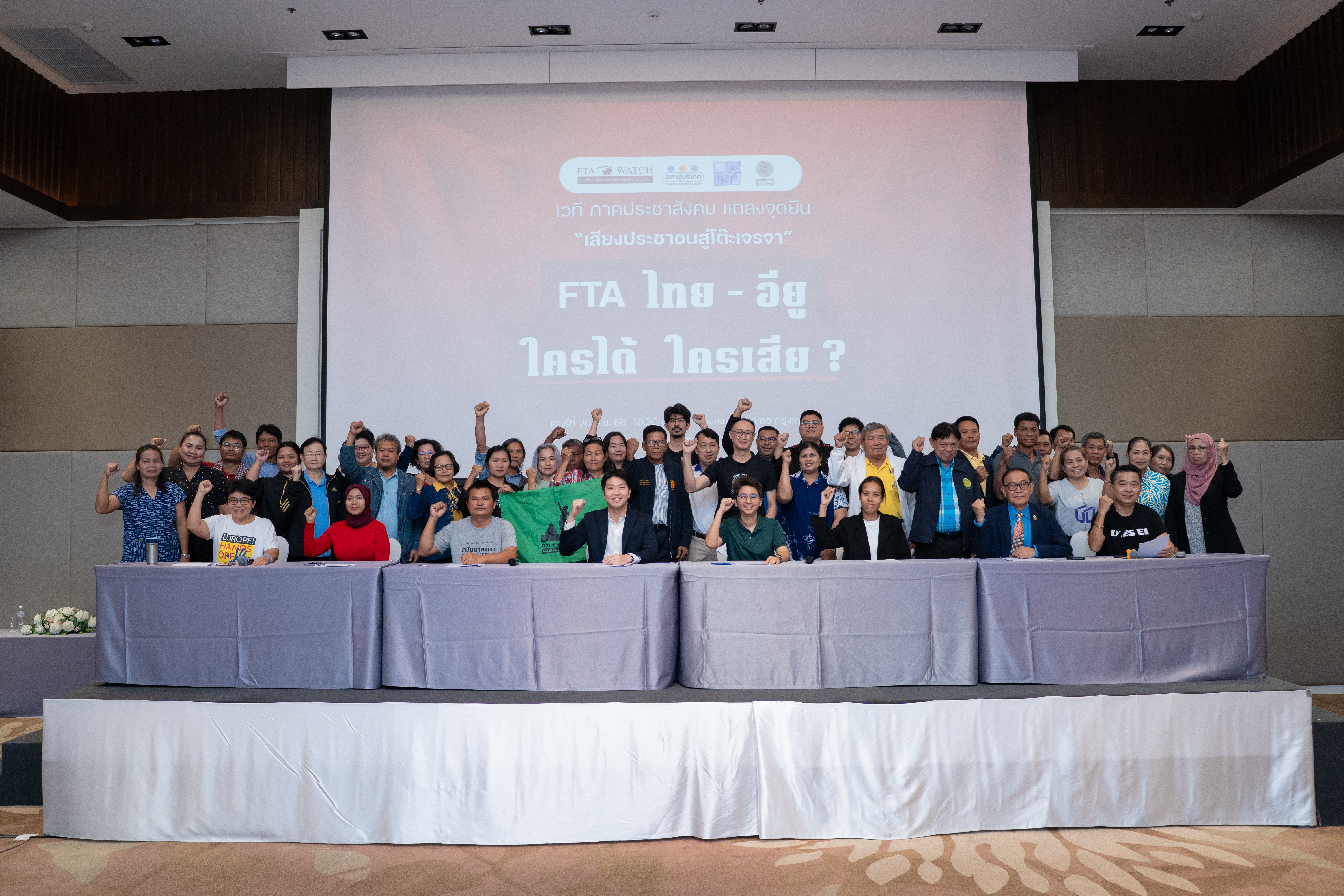
Statement on the voices of Thai civil society regarding the free trade agreement between Thailand and the European Union
We, the undersigned Thai civil society organizations, who have been closely monitoring the Free Trade Agreement (FTA) negotiations between Thailand and the European Union (EU), express our grave concern over the potential wide-ranging and adverse consequences of this agreement.
These include significant risks to agriculture, food security, environment, labour rights, access to medicines, universal health coverage, the influx of harmful goods such as alcoholic beverages, and other sensitive matters. We call on the negotiating team and the Thai government to conduct these negotiations with caution, transparency, and a steadfast commitment to protecting the rights and welfare of the Thai people - not to pursue short-term commercial gains at the cost of long-term public and social harms.
We therefore make the following urgent demands to the government and the negotiators of Thailand:- Intellectual Property: The agreement must not contain provisions exceeding the World Trade Organization's TRIPs Agreement, particularly those that would undermine and negatively impact access to medicines, threaten Thailand’s three national health insurance schemes and public health infrastructure, weaken the domestic pharmaceutical industry and its innovation ecosystem, or compromise national medicine security.
- Farmers’ Rights and Seed Sovereignty: Thailand must not be forced to become a party to the International Convention for the Protection of New Varieties of Plants 1991 (UPOV 1991) or to agree to any provisions requiring domestic laws to comply with it. Doing so would erode farmers' rights to save and exchange seeds, dismantle the benefit-sharing mechanism under the Plant Varieties Protection Act B.E. 2542, increase seed prices, and jeopardize Thailand’s biodiversity and food security.
- Market Access and Protection of Small Producers: Thailand must not liberalize imports in a way that harms small- and medium-scale producers or undermines public health. Specifically:
- Policy Space for Public Protection: The FTA must preserve Thailand’s right to implement and uphold policies protecting consumers, the environment, public health and social welfare.
- Government Procurement: Thailand must retain the right to use public procurement to support domestic innovations, industrial development, pharmaceutical security including medical supplies and devices, and technology transfer through offset policies that maximize national budget and national benefit.
- Sanitary and Phytosanitary Measures (SPS): Thailand must preserve its right to apply the precautionary principle and measures to protect human, animal, plant life, as well as the environment beyond the limited scope of WTO SPS Article 5.7.
- Digital Trade:
- Trade and Sustainable Development (TSD): Negotiations must advance equity, sustainability, and climate justice by:
- Labour Rights: The Thai government must immediately ratify the two core conventions of the International Labour Organization (ILO) on freedom of association and collective bargaining, namely Convention No. 87 on Freedom of Association and Protection of the Right to Organise, 1948, and Convention No. 98 on the Implementation of the Principles of the Right to Organise and Collective Bargaining, 1949.
- Transparency and Participation: The government and state agencies responsible for the negotiations must ensure equal access to the content of the negotiations to the private sector and civil society to ensure transparency in the negotiations and public participation both directly and through parliamentary process.
- Public Interest Provisions: The Thai negotiation team should proactively advance provisions that:
We are deeply concerned by the Thai government's stance in rushing the negotiator team to conclude the FTA negotiations by the end of 2025. It seems that the Thai government focuses only on the expected commercial benefits, not on the negative impacts on the general public and marginalized groups. Such a stance will pressure the Thai negotiator team to be unable to work independently and negotiate carefully, based on sufficient information to protect the interests of the public.
Therefore, we request the government, especially the Minister of Commerce, to lift time constraints and allow the negotiators the independence and time required to work at their full capability to safeguard national and public interest. The Minister should encourage the negotiators to take into account the interests and negative impacts of the majority of the people as the main consideration, and to comply with the Thai negotiating framework that the government and parliament have already approved. This includes encouraging government agencies to conduct comprehensive and credible academic studies of the impacts of the agreement, to provide empirical data for use in negotiations.
Finally, we would like to ask the government and the parliament of Thailand to support the amendment of the entire constitution, by fully respecting the voices of the people, especially Article 178, which is related to the negotiations of international treaties, regarding transparency, access to information and content of agreements, public hearings and participation, fair compensation and remedies that take into account both those who are disadvantaged and those who are advantaged, by taking Article 190 of the 2007 constitution as the example.
Signatories:
Alternative Agriculture Network of Thailand
Assembly of the Poor
Bangkok Consumer Rights Center Network
BioThai Foundation
Eastern Relations of Labour Group
Ecological Alert and Recovery – Thailand (EARTH)
FTA Watch
Healthy Forum Network
ILO 87/98 Driving Network
Migrant Working Group
National Farmers Council
Non Chueak Seed and Agricultural Processing Enterprise Group
Textile, Garment and Leather Workers' Federation of Thailand
Thai Climate Justice for All (TCJA)
Thai Network of People Living with HIV/AIDS (TNP+)
Thailand Consumers Council (TCC)
Thailand Pesticide Alert Network (Thai-PAN)
Workers Union


