


US-Thailand


The US and Thailand started negotiations on a comprehensive bilateral free trade agreement in June 2004.

Like other recent bilateral free trade agreements with the US, the US-Thailand FTA will cover investment, services, government procurement, intellectual property, as well as agriculture. Many expect it to be modeled on the US-Singapore FTA.

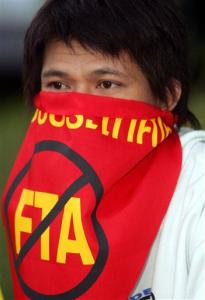
The negotiations have attracted strong opposition and concern among many Thai social movements, farmers to people with HIV/AIDS. A broad civil society coalition, FTA Watch, was formed at the outset to closely monitor the process from a public interest perspective. (Likewise, business interests set up their own US-Thai FTA Coalition.) Under the banner of "sovereignty not for sale!", key issues of popular concern include access to medicine, GMOs in agriculture and patents on life.

The last round of talks took place in Chiang Mai in January 2006 with 10,000 people protesting in the streets and disrupting the meeting. Negotiations have not resumed since.

last update: May 2012


Thai-US free trade talks stuck on finance sector
The latest round of bilateral free trade negotiations between Thailand and the United States in London hit a serious snag over how much to liberalise the sensitive finance sector, one of the negotiators said.
FTA negotiators fear financial sector liberalisation could trigger capital outflow
Dr. Narongchai Akraseranee, chairman of the Working Group on FTA Negotiations, reaffirms that Thailand will not speed up the opening of its financial sector because domestic players are not ready for such competition. The Working Group is also concerned about possible capital outflows once liberalisation frees up deposit transactions.
As the TNCs catch you: An analysis of the liberalization of biotechnological products in the Thai-US FTA
One of the books the Thai Prime Minister suggested his cabinet members read was “As the Future Catches You” by Juan Enriquez, a Mexican writer. The book's contents relate to the fact that countries need to catch up with the development of biotechnology. Otherwise they will be alienated and left behind.
'Negative list' approach seen for US talks
Thai negotiators could ultimately be forced to accept a "negative list" approach in negotiating the Thailand-US free trade area agreement, according to Pongpanu Svetarunvra, deputy director-general of the Fiscal Policy Office. Under a negative list approach, all sectors and services will be liberalised except for those explicitly stated in the agreement.
US, Thailand make 'significant progress' in free trade talks
The United States and Thailand have made "significant progress" in their latest round of talks to forge a free trade agreement, the US Trade Representative's office said on Monday.
Hawaii talks leave key points out
Thailand and the United States have sorted out some technical issues but not major points during the week-long fifth round of the Thailand-US free trade talks that ended yesterday in Hawaii.
Negotiations on Thai-US FTA on well progress
Negotiations between Thailand and the United States on a planned bilateral free trade area (FTA) are on well progress in its fifth round, with Washington agreeing in principle to protect Thai intellectual property on the Internet and to use the Thai laws to take care of the environment.
The importance of the FTA to Thailand
Ambassador Nitya Pibulsonggram, the chief negotiator for the Thailand-US Free Trade Agreement, spoke to AMCHAM members on May 25, 2005 about the importance of the FTA to Thailand.
US responsive to Thai concerns
US congressmen have pledged to accommodate Thailand's concerns about drug prices and freer mobility for Thais into the United States once the two countries conclude their free trade area (FTA) agreement.
Not all share PM's wish for fast FTA
Finance Minister Thanong Bidaya said yesterday that the Thai-US free-trade agreement (FTA) would be difficult to hurry as Thai bankers are concerned about competing with their sophisticated counterparts in the field of e-banking. “I can't say when the deal could be concluded because both sides still use absolutely different approaches,” Thanong said.