US-Korea


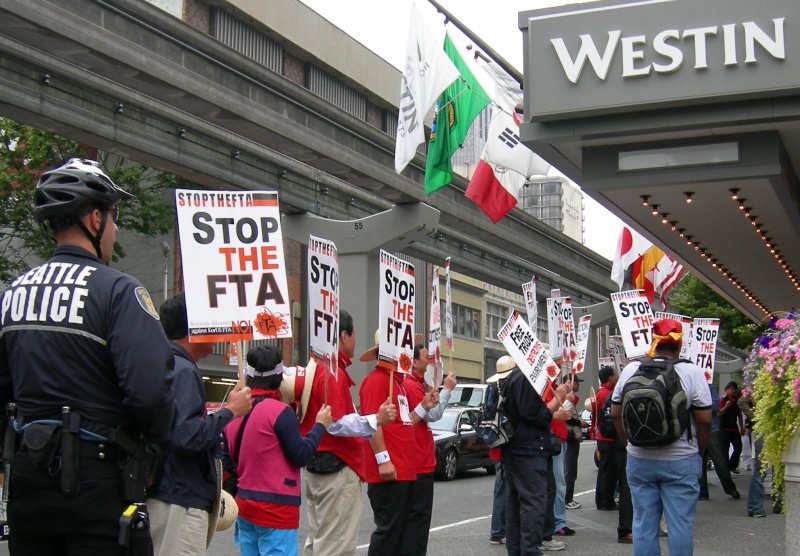
The US-Korea free trade agreement (or KORUS FTA, as called in Korea) has been one of the most controversial since NAFTA, if one could measure in terms of social mobilisation. Millions of people have fought against this deal, taking to the streets and flying across the Pacific to try to defeat it.

Washington and Seoul talked about a possible free trade agreement for several years before anything got started. As it turns out, the US had four preliminary demands for the Korean government to fulfil before any FTA talks could start. The four prerequisites were:

- suspending regulations on pharmaceutical product prices so US drug firms could get a better deal in the Korean market (secured in October 2005)
- easing government regulations on gas emissions in imported US cars so that more American cars could be sold in Korea (secured in November 2005)
- resuming importation of US beef, which were stopped in 2003 because of mad cow disease in the US (agreed in January 2006) and
- reducing South Korea's compulsory film quota for cinemas from 146 days per year to 73 days so that more American films could be shown (agreed in January 2006).

Once the Roh administration caved in to the last item, the two governments announced, on 2 February 2006, that FTA talks would start in May 2006 and end by June 2007.

The implications of the US-Korea FTA stretch far beyond Korean movie houses as the agreement would open the entire Korean economy to US corporate penetration. Korean farmers and workers organised a strenuous resistance to the deal, with support from actors, students, health professionals, consumers groups, environmental organisation, veterinarians, lawyers and other sectors. Alliances were also built with opponents to the deal in the US, including AFL-CIO, the country's largest labour union.

The first round of negotiations took place in the US on 5-9 June 2006. Ten months and eight formal rounds (not to mention numerous side talks on side agreements) later, the deal was concluded on 2 April 2007 in Seoul, just hours after a Korean taxi driver commited self-immolation in protest to the signing.

This was not the end, however. Two weeks later, newly elected Korean President Lee Myung-Bak travelled to Washington to sign the FTA. While there, on 18 April, the two governments inked yet another side deal that the US insisted was necessary for the FTA to go through. This deal laid out explicit rules on how Korea was to open its market in the broadest way to US beef imports, despite concerns about mad cow disease. The adoption of this secret pact triggered off what became known as the "beef crisis" in Korea. Students, mothers and consumers raised a fury of candlelight protests and other actions that by June 2008 had ministers resigning and the president own tenure under threat.

After several more years of sustained opposition to the agreement, the US-Korea FTA was finally ratification by both countries’ parliaments and took effect in November 2011 However opposition to, and concerns about the FTA have not faded since it passed, with many worried about the implications of the investor-state dispute mechanism in the deal.

last update: May 2012

Photo: Joe Mabel / CC BY-SA 3.0


800 NGOs: "KorUS FTA is invalid!"
Korean Alliance against KorUS FTA concludes people's protest should go on. They declared "KorUS FTA is Invalid" and decided to have nationwide strikes at the end of June, which is supposedly when the agreement will be signed.
BIO commends USTR for successfully concluding US-Korea free trade agreement
BIO congratulates US Chief Agricultural Negotiator Richard Crowder and his staff for negotiating a separate understanding on several agricultural biotechnology issues. The FTA will go a long way in providing additional market access opportunities in Korea for US biotechnology companies.
KCTU union member dies from self-immolation attempt in protest of the KOR-US FTA
On 11:23 am, April 15th, KCTU union member, Bro. Heo Se-Wook, passed away from septicemia as a result of the massive immune system response to the third degree burns all over his body after he attempted to commit suicide by setting himself on fire as an act of resistance against the KORUS FTA on April 1st.
Roh rebuts officials questioning FTA
On April 12, Jeon Yun-churl, chairman of the Board of Audit and Inspection, raised questions over the introduction of an investor-state dispute system in the South Korea-U.S. free trade agreement (FTA).
FTA protestors hold joint meeting, notch up efforts
About 100 representatives of more than 800 civic and social organizations opposed to the South Korea-US free trade agreement (FTA) held a meeting in downtown Seoul on April 13, urging the government to hold a national referendum regarding the trade deal and to release information regarding the FTA negotiations, which concluded with a preliminary agreement on April 2.
Labor in limbo under FTA with US
Korea's labor market is emerging as a hot-button issue in the South Korea-US free trade agreement (FTA). If the US Congress and other stakeholders continue to request to add or modify some labor provisions in the agreement, it could prompt South Korea to lose support for the deal at home because domestic business circles may oppose the request.
Analysis: Korean cab driver self immolates to protest free trade agreement
Although this FTA is poised to reshape the landscape of South Korea and become the United States' second largest trade deal after NAFTA, Americans have heard virtually nothing about it.
Korean culture industry feels the FTA
The nation's culture industry is gearing up for the repercussions of the free trade agreement (FTA) signed with the United States, and each sector is preparing damage control for possible side effects from the pact.
Gov't warns teachers union off anti-FTA classes
The Ministry of Education and Human Resources Development has asked provincial education offices to prevent the Korean Teachers and Education Workers Union from teaching classes against the recently concluded Korea-US free trade agreement. The teachers' union has been conducting anti-FTA classes since March 26 and posted anti-FTA class materials on its homepage.
Negotiator says US may have to reopen FTA discussion on labor, other provisions
The United States may have to renegotiate labor and possibly other provisions in its free trade agreement (FTA) with South Korea, a senior official said Wednesday. A South Korean official had said Tuesday that Seoul considers the labor chapter of the agreement closed.