


US-India

The governments of the United States and India have been talking about negotiating a bilateral investment treaty for several years. The idea of a broader trade agreement between the two countries has often been mentioned as a longer term goal.

Bilateral relations between the two powers over the past decades have been complex. During the Cold War, India was non-aligned but friendly with Russia. Since 1991, India took a major turn by adopting neoliberalism as an economic frame for the country's "development" strategy, and relations with the West subsequently thawed. Starting in 2005, India and the US signed a series of major bilateral cooperation agreements including the areas of defence, agriculture and food security, nuclear technology, energy, education, etc. Many of these initiatives met strong criticism at home in India as they frequently create conditions that benefit global capital and elites at the expense of local communities, especially in the rural areas.

In this process, since 2008, the governments of both countries also committed to signing a bilateral investment treaty, but this is taking some time. In 2014 and 2015, India reviewed its earlier "bilateral investment protection and promotion agreements" (BIPPAs) and decided to draw up a model "bilateral investment treaty" (BIT) to replace those BIPPAs. The Indian model BIT is still under debate but it departs from the US model BIT in several respects. Thus it could be a challenge to come to a common agreed text. But US business associations, which include many major TNCs among their members, are pushing hard to finalise a deal. Civil society organisations both in India and the US have been mobilising against the deal.

In parallel to this, India has been revising its policies on foreign direct investment, notably by opening up the country to foreign investment in multibrand retail (e.g. Walmart or Tesco), and on taxation.

US-India trade, in the meantime, has grown massively, with the US having a huge services trade deficit, much of which reflects the growth of outsourced US jobs to India.

Recommended reading:
- Kavaljit Singh, "The India-US Bilateral Investment Treaty: Not an easy ride", January 2015

Last updated: 21 August 2015
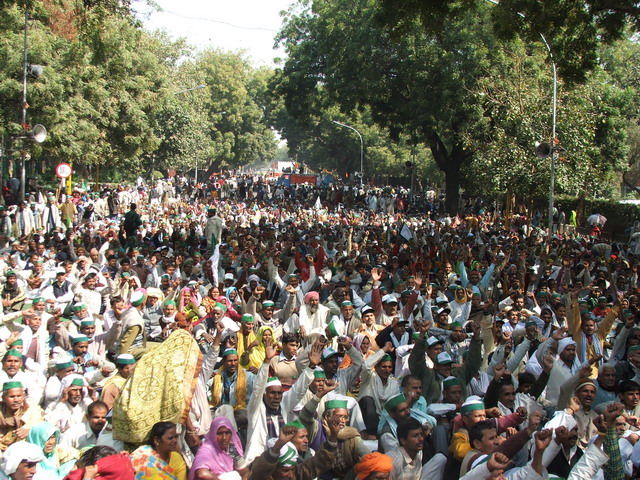
Photo: La Via Campesina


Digital trade chapter not in India-US interim trade pact; to be taken up in BTA, says official
India and the US have not yet discussed digital trade in their initial trade agreement. This crucial chapter will be negotiated as part of the larger bilateral trade agreement. US companies are eager to explore India's rapidly expanding digital trade sector.
Bharatiya Kisan Union opposes deal with US, to burn effigies of Modi, Trump
BKU leader Rakesh Tikait says Centre had lost the trust of farmers and the trade agreements with U.S. and European Union will have far-reaching adverse impacts on farmers.
India to commit zero tax on digital services in trade pact
India will commit to zero tax on digital services and avoid customs duties on digital transmissions under the India-US trade pact, a move that experts warn could limit future policy space as AI and digital services expand.
US and India move toward interim trade agreement, BTA talks to continue: White House fact sheet
The two countries will also continue negotiations to address remaining issues, including services and investment, labour and government procurement.
What’s at stake for Indian agriculture in Trump’s trade deal?
Indian farmers have expressed concern that New Delhi has made too many concessions to Washington after the two countries brokered a new trade deal that would lower tariffs. Groups called on farmers to join a nationwide protest on Feb. 12.
US, India unveil interim trade framework, move closer to broad pact
The United States and India moved closer to a trade pact, releasing an interim framework that would lower tariffs, reshape energy ties and deepen economic cooperation as both countries seek to realign global supply chains.
US agrees to drop tariffs after India stops Russian oil purchases
US President Donald Trump announced that he agreed to a trade deal with India's Prime Minister Narendra Modi, where the US will lower tariffs on goods from India to 18% from 25%.
India, US actively engaged on trade deal; next call on Jan 13: Sergio Gor
India and the United States continue to remain “actively” engaged on the proposed trade deal and the “next call” will take place as early as Tuesday, US ambassador to India Sergio Gor said.
Thank you Donald Trump, again. India now has reason to shed fear of trade deals and risky reform
Donald Trump’s aggressive trade policies inadvertently forced India to undertake long-overdue economic reforms, reviving labor laws, dismantling protective non-tariff barriers, and securing key trade deals. While acknowledging the threat to low-wage jobs, it urges India to remain pragmatic—allowing limited U.S. corn imports, for example—without bowing to pressure, using the crisis as a rare chance to transform its economy.
No call from PM Modi to Trump blocked India-US trade deal, US commerce secy says
The India–US trade deal has not been finalised because Prime Minister Narendra Modi did not call Donald Trump, claimed US Commerce Secretary Howard Lutnick.