
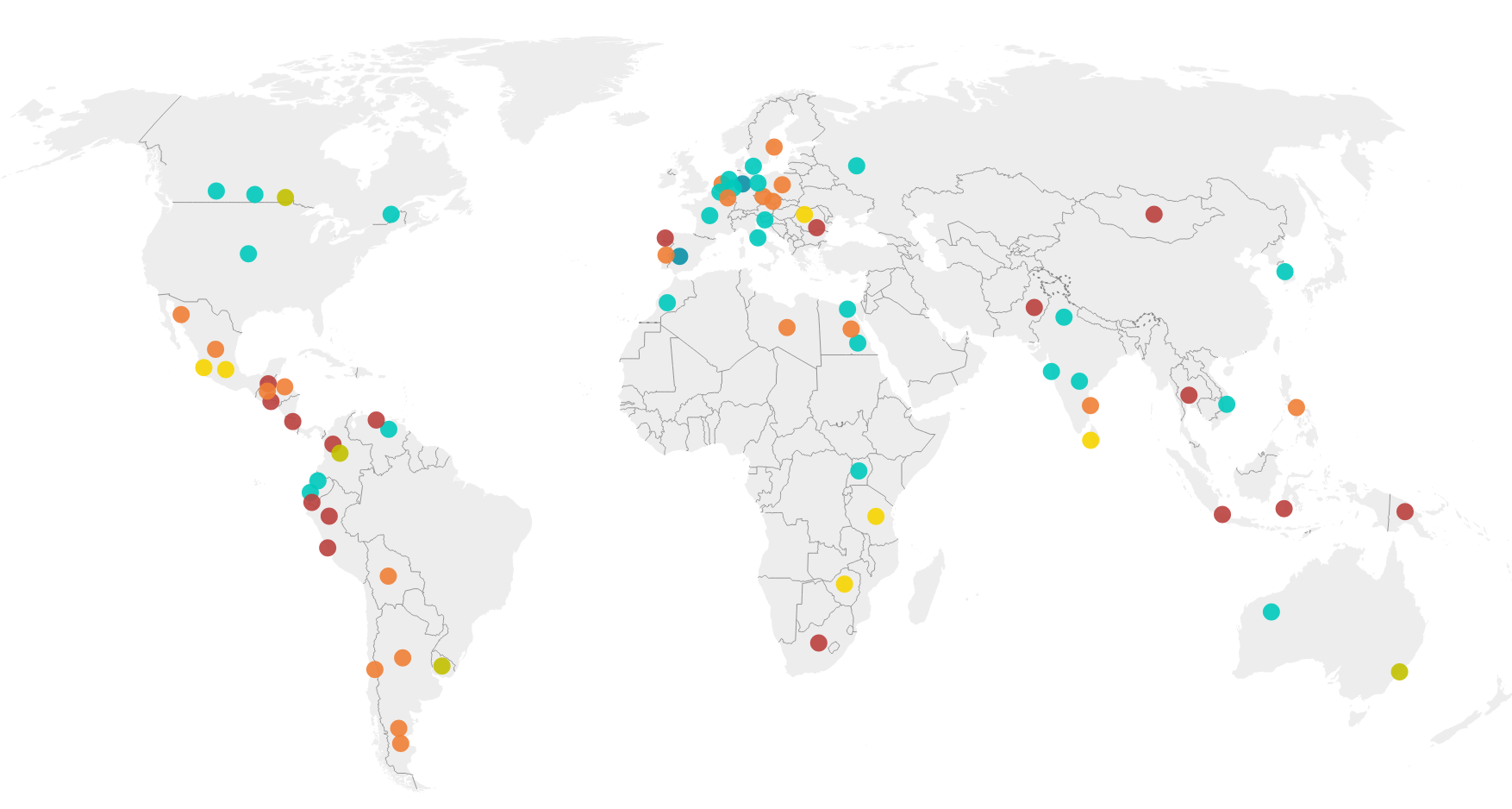
ISDS Case Map

It began as an agreement between the four Pacific states of Brunei Darussalam, Chile, New Zealand and Singapore. The P4 (Pacific 4), as it was then known, was signed on 3 June 2005 and came into force on 1 January 2006 as the Trans-Pacific Strategic Economic Partnership.
In September 2008, the US Trade Representative announced that the US would seek entry into the P4 agreement. For Washington, the P4 offered a neoliberal agenda-friendly platform to expand US economic and strategic interests in Asia. A few months later, the governments of Australia, Peru and Vietnam announced their intention to join as well. Malaysia, Mexico, and Canada joined the negotiations in 2010, while Japan joined in 2013. The US quickly assumed leadership of the whole negotiating process of the now called Trans-Pacific Partnership (TPP or TPPA).
The TPP was signed in New Zealand on 4 February 2016. But on 23 January 2017, the new US President Donald Trump signed an executive order formally withdrawing the US from the trade pact. On 21 May 2017, on the margin of the APEC forum in Vietnam, the remaining members agreed to conclude talks on an alternative arrangement of the deal without the US by November.
The remaining 11 countries signed the newly-dubbed Comprehensive and Progressive Agreement for Trans-Pacific Partnership on 8 March 2018.
Over the years, trade unions, advocacy groups, internet freedom activists, indigenous peoples, environmentalists, health professionals and elected officials criticised and protested against the treaty because it was designed to extend and concentrate corporate power at the expense of people’s rights.
For instance, by granting corporations and investors enormous privileges, the CPTPP helps to to further undermine conditions and wages for workers which have already been eroded by other trade and investment agreements.
Among other controversial clauses, the CPTPP parties agreed to enhance cooperation on certain activities related to agricultural biotechnology. The treaty requires member states to ratify the UPOV Convention of 1991, a kind of patent system for seeds. This will expand the market for privatised genetically modified organisms (GMOs) and hybrids, and threaten traditional seeds and knowledge.
The CPTPP’s chapter on regulatory coherence forces a signatory government to engage with “interested persons” when it intends to strengthen public policies. This means that companies from CPTPP countries are given the ability to provide input to national policy making in other member states. Governments also have to conduct regulatory impact assessments, justifying the “need for a regulation” and exploring “feasible alternatives” before proceeding.
Finally, the CPTPP’s sweeping investment chapter extends transnational companies ability to challenge public policies related to health, the environment (the treaty fails to mention climate change even once) or labour. It includes the controversial investor-state dispute settlement (ISDS) mechanism that allows corporations to sue a state if a new regulation hampers their expected profits or investment potentials.
Mexico ratified the treaty on 28 June 2018, followed by Japan on 6 July, Singapore on 19 July, New Zealand on 25 October, Canada on 29 October, Australia on 31 October and Vietnam on 15 November. The Treaty went into force on 30 December 2018 among the members who have ratified it.
The text of the agreement is available here: https://www.bilaterals.org/?tpp-trans-pacific-partnership
last update: July 2021
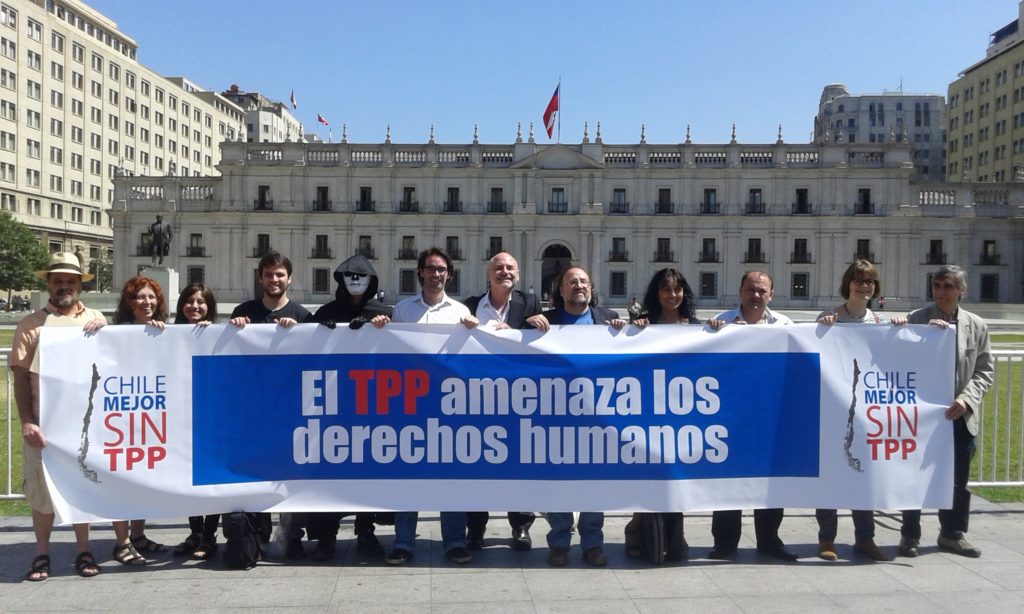
Photo: Chile Mejor Sin TLC


Web page on the Trans-Pacific Partnership Agreement maintained by the Australian Fair Trade and Investment Network
The TPP would expand and lock in corporate power. At the heart of the TPP are new rights allowing thousands of multinational corporations to sue the U.S. gov...
The Trans-Pacific Partnership agreement--which some have come to refer to as "NAFTA on steroids"--could ultimately affect the lives of billions of people wor...
Website on the implications of the Trans-Pacific Partnership agreement for New Zealand
Convergencia de Organizaciones Sociales y Ciudadanxs contra el Acuerdo Transpacífico de Cooperación Económica (TPP por sus siglas en inglés)
Pua Mohala I Ka Po in collaboration with the International Forum on Globalization presents an international conference on Pacific transitions: "Moana Nui: Pa...
The Trans-Pacific Partnership Agreement (TPPA) is a mega-treaty across nine or more countries. If the negotiations succeed they will put a straightjacket on ...
Join us for a nationwide uprising and concert tour to stop the biggest corporate power grab in history: the Trans-Pacific Partnership.
Japanese alliance website
The bilaterals.org team is pleased to announce the launch of an upgraded version of the website and its content management system.
Click here for more information.