


JPEPA


The governments of Japan and the Philippines reached a basic political agreement on the Japan-Philippines Economic Partnership Agreement (JPEPA) on 29 November 2004 at the ASEAN Summit in Laos. The agreement was then signed in Helsinki on 9 September 2006 and came into force on 11 December 2008. It was the Philippines' first free trade agreement and Japan's fourth.

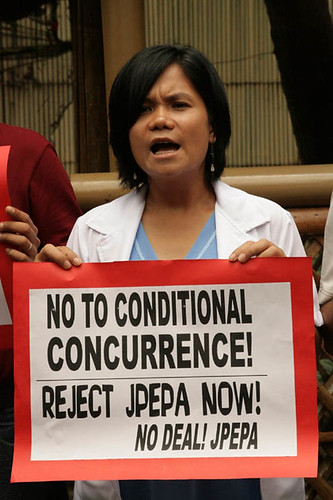
JPEPA was and remains hugely controversial. Filipinos -- and on some issues, Japanese groups -- mobilised to stop the deal for many reasons, including the following:

- the small job market openings for Filipino healthcare workers are very limited (the workers must learn Japanese, undergo equivalency exams, stay for only a restricted time etc) and overlook the real potential for abuse of Filipino workers in Japan;
- concerns that Japan will gain access to and be able to overfish Philippine waters, ruining the livelihoods of small fisherfolk;
- any supposed benefits for increased pineapple and banana exports to Japan would in fact go to corporations like Dole and Del Monte, and their local business partners, who own and run the plantations in the Philippines -- not to small or landless Filipino farmers;
- its unconstitutionality, since JPEPA allows Japanese corporations to own land, operate schools and practice certain professions in the Philippines which the Philippine Constitution does not allow;
- the huge imbalances in the deal, e.g. Japan excluded almost 200 tariff lines from the agreement, the Philippines only six; and
- the fact that JPEPA gives explicit legal ground for Japan to dump toxic wastes in the Philippines.

last update: May 2012
Photo: Karasantos / CC BY-NC-SA 2.0


RP may lose up to P4B in JPEPA's 1st year - DOF
The Philippine government stands to lose P3 billion to P4 billion in revenues in the first year alone of the implementation of the Japan-Philippines Economic Partnership Agreement, estimates by the Department of Finance showed.
Japan scoffs at review of economic deal
Tokyo is not amenable to a renegotiation of the Economic Partnership Agreement it has signed with Manila, according to an official of the Japanese Embassy in the Philippines.
Best safety net is complete rejection of JPEPA
Philippines government negotiators now finally acknowledge that the Japan-Philippines Economic Partnership Agreement (JPEPA) will have adverse effects, hence the need for “safety nets”. But no amount of safety nets will be enough precisely because Japan's intention is to create conditions for the maximum exploitation of the Philippines' natural and human resources through JPEPA.
NGO hits trade official, proposes conditionalities on JPEPA
The multisectoral Fair Trade Alliance (FairTrade) hits Ambassador Manuel Teehankee when he revealed that he's “guessing too much” on the projected gains that the country will be getting on the JPEPA during a Senate hearing presided by Sen. Mar Roxas on Friday.
CALABARZON workers and the imminent danger posed by JPEPA
On September 10, 2006, the governments of Japan and the Philippines signed the Japan-Philippine Economic Partnership Agreement (JPEPA) in the Asia-Europe Meeting in Helsinki, Finland. JPEPA, the Philippines' first full-fledged bilateral free trade agreement (FTA), was signed despite protests from the Filipino people even at its proposal stage in 2002.
Philippine fisherfolks seek international support against Philippine-Japan trade deal
An alliance of Philippines fishermen is trying to protect itself and Philippine waters from being over fished by huge Japanese factory fishing ships.
Reject the JPEPA
WHEN environmentalists read news reports about Philippine and Japanese officials holding "quiet talks" to save JPEPA and "spare" Gloria Arroyo from embarrassment, they were visibly agitated. They have long voiced their opposition to the controversial pact and lobbied for its rejection by the Philippine Senate.
FairTrade bats renegotiation for JPEPA
The multisectoral Fair Trade Alliance (FairTrade) strongly urges the Senate to inexorably decide for the interest of the nation by concluding to renegotiate Japan Philippine Economic Partnership Agreement (JPEPA), as this is the only viable solution to cure the inherent imbalances of this treaty and become acceptable to Filipinos.
Trade chief says no need for JPEPA side accord
Favila said clarificatory statements or an exchange of diplomatic notes would be enough to clarify the "toxic issues" of the JPEPA.
DFA, Japanese envoy in talks to save JPEPA--Santiago
“It will be declared unconstitutional by the Supreme Court. That is my prediction," Philippine Senator Miriam Defensor-Santiago said.