The Indian government has been active in seeking out bilateral trade agreements, with other so-called developing countries and the developed world as well.
India has signed limited FTAs with Sri Lanka (1998) and Thailand (2003) plus a number of preferential trade agreements (tariff concession schemes) with countries/blocs such as Afghanistan, Nepal, Chile and Mercosur.
India is also part of SAFTA (the South Asia FTA), BIMSTEC (aiming to develop an FTA), the Asia-Pacific Trade Agreement (a preferential trade agreement with Bangladesh, China, Laos, South Korea and Sri Lanka) and IBSA (the India-Brazil-South Africa triangle aiming to develop a trilateral South-South FTA).
At the end of June 2005, the government signed a Comprehensive Economic Cooperation Agreement with Singapore, what many consider India’s first "comprehensive" FTA. India also signed FTAs with ASEAN (2009), Korea (2009) and Japan (2010), which were later criticised for widening India’s trade deficit with the three trade partners. These deals were followed by another one signed with Malaysia (2011). India expects to upgrade its pact with Sri Lanka into a similar type of Comprehensive Economic Partnership Agreement.
In 2007-2008, India commenced FTA talks with European powerhouses EFTA (European Free Trade Area) and the EU (European Union), but in 2013 talks stalled with the Union, over issues such as market access given by India to automobiles and alcohol from the EU, and Delhi’s refusal to open up its public procurement and financial services sector like banking, insurance and e-commerce.
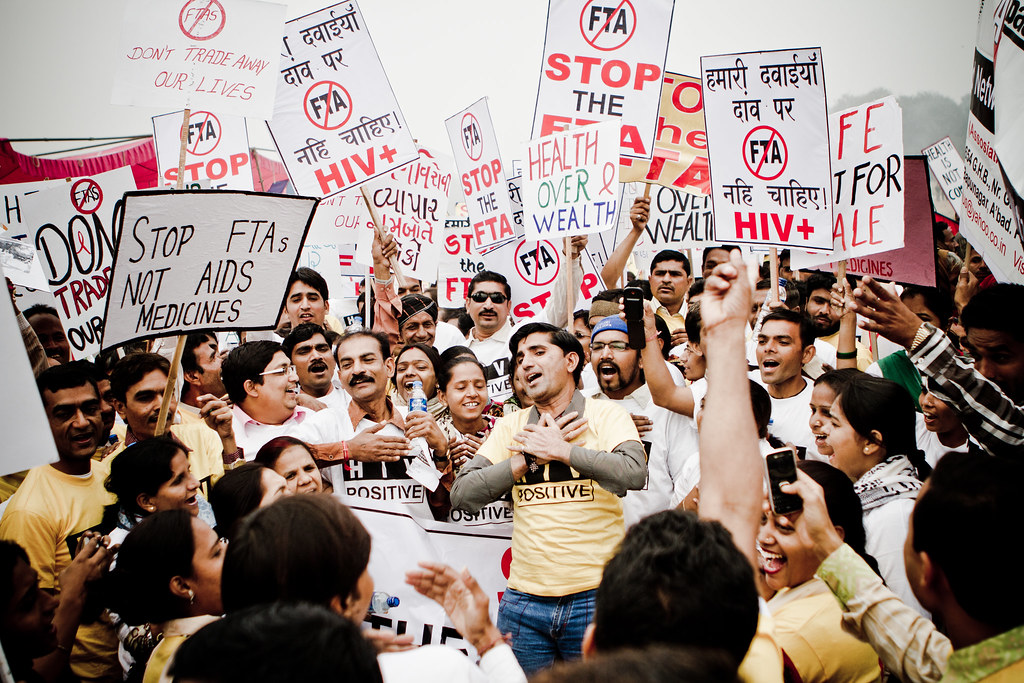
In 2010, it began talks with New Zealand and in 2011 with Australia, but they were put on hold in 2013 when India started negotiating the mega-regional RCEP (Regional Comprehensive Economic Partnership) agreement with the 10 ASEAN nations, Australia, China, Japan, New Zealand and South Korea. In November 2019, India pulled out of the RCEP negotiations, due to concerns over trade deficits, notably with China, and countries’ reluctance to open markets to Indian services and investments. RCEP has generated a lot of controversy and resistance at home, mostly from farmers, unions, dairy cooperatives and patients' groups that were concerned about the impacts on medicines.
India dropping out of RCEP has led the country to renew its interest in bilateral talks. The Australia and New Zealand FTAs are in the process of being revived. India is looking into ways to restart negotiations with the EU and speed up those with EFTA. An India-US FTA has been on the table as well, which has angered farmers and unions at home because it would hurt local agriculture.
Apart from these deals, bilateral trade negotiations are going on with Bangladesh, Canada, Colombia, the GCC (Gulf Cooperation Council), Iran, Israel, the Russia-led Eurasia Economic Union, Uruguay, Venezuela, and Mauritius, the last of which would provide a foothold into Africa through the African Continental Free Trade Area. Further down the line, the government is in various stages of considering talks with Cambodia, China, Costa Rica, Egypt, Hong Kong, Indonesia, Korea, the Philippines, SACU (Southern African Customs Union) and the United Kingdom.
India has also signed 86 bilateral investment treaties (BITs) with a wide array of countries, even though only 13 of them are still in force. Following a few controversial investor-state disputes (ISDS), India terminated most of its BITs and released a revised model BIT in December 2015, which was to serve as a basis for future negotiations and should replace existing treaties. This new model tries to achieve more balance by, for instance, requiring investors to use local courts before turning to international arbitration and leaving out the highly contested provision on “fair and equitable treatment”. However, it is not clear how much the government is using it as a red line, rather than a starting point for negotiations.
See also: The Government of India's trade agreement portal
last update: October 2020
Photo: Rico Gustav/CC BY 2.0