

EU-ASEAN


The European Union was planning on a bilateral trade agreement with the Association of South East Asian Nations (ASEAN) for many years. On 4 May 2007, the two sides agreed to start negotiations.

The EU-ASEAN FTA is supposed to be a comprehensive agreement. While ASEAN states are hoping to gain additional market access in the EU, the agreement is expected to have a much bigger impact in strengthening business opportunities for European TNCs in the region.

The talks have moved slowly and it's not clear if the final deal will take the form of separate agreements between the EU and individual ASEAN members, something the EU seems to prefer. This would allow European governments to avoid taking on any commitments that support the regime in Burma but also to deal with the economic heterogeneity among ASEAN members.

EU procedures require that all ASEAN countries sign a Partnership Cooperation Agreement, containing a commitment to human rights, as a prerequisite to an FTA. Indonesia has already concluded its PCA with the EU, Singapore and Thailand are in advanced stages of negotiations, and Vietnam, Malaysia and Brunei are soon to begin. The Philippine government stated early on that it expects problems in negotiating a PCA, as the agreement apparently requires that the signatory state join the International Criminal Court.

Click here for the European Commission's page on the EU-Indonesia FTA

last update: May 2012
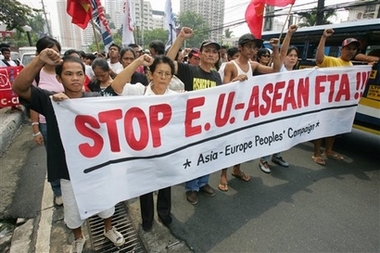
photo: People's Health Movement


Thailand: Uncertainties continue to plague FTA deal with Europe
Thai trade representative Olarn Chaiprawat has given civil society groups a confirmation that "TRIPS-plus" and drug issues will not be included in the Thai-EU FTA negotiations.
Mass protest to greet EU free trade envoys
About 5,000 health, consumer, and farming activists are planning a mass demonstration in Chiang Mai next week to protest against free trade talks between Thailand and the European Union.
Thai-EU talks could hinder access to affodable medicine, public health experts say
Round two of Thai-EU FTA talks in Thailand later this month will see strong opposition from more than 2,000 people from various civic groups in Thailand, including medical patients, consumers and farmers protesting against what they claim to be "unfair arrangements" set to be discussed under the FTA.
Thailand set to resume talks for FTA with Europe
Thailand will soon resume the long-suspended free-trade talks with the European Free Trade Association in order to ensure a level playing field with other Asean countries.
Govt keen to quickly wrap up FTA with EU, says top negotiator
Thailand is eager to wrap up a free-trade agreement with the European Union after the bloc began pursuing bilateral deals with many major markets.
Prospects high for fruitful end to Thailand-EU FTA talks
Michelangelo Pipan, Italy's ambassador to Thailand, is bullish on the prospects of a successful free trade agreement between Thailand and the European Union.
Next round of EU-Malaysia FTA talks to resume in Q4, says envoy
The next round of negotiations on the EU-Malaysia Free Trade Agreement is expected to resume in the fourth quarter, says Ambassador & Head of Delegation of the European Union to Malaysia, Luc Vandebon.
Congress agreement to defend the tuna industry in negotiations with Thailand
Political spokespeople of the Agriculture, Food and Environment Committee of the Spanish Parliament have agreed to develop an institutional statement in defense of the Spanish tuna processing industry in relation to the negotiations on a free trade agreement between the European Union and Thailand
EU-Singapore agree on Partnership and Cooperation Agreement
EU High Representative, Catherine Ashton and Singapore's Minister for Foreign Affairs and Minister for Law K. Shanmugam confirmed last Friday the conclusion of negotiations on an EU-Singapore Partnership and Cooperation Agreement (PCA).
European firms push Thai-EU FTA talks
Representatives of the European business community in Thailand yesterday said the country's service sector was in a dangerous situation due to strict local regulations that obstruct foreign investment, especially from Europe.