



:: Across the board ::


This section contains news and analysis of sweeping developments that affect the overall push and pull towards FTAs and bilateral investment treaties. This means major trends relating to bilateralism, often with global consequences, and other cross-cutting issues. New developments arising from US politics, the WTO or South-South alliance-building, for instance, are often reported here as they tend to have systemic impacts.

last update: May 2012


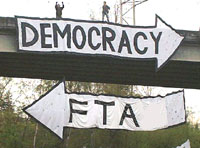
Global week of action on trade: 10-16 April 2005
The main aims of the week are to challenge the free trade myth, put forward our alternatives, strengthen the already existing trade campaigns and show the strength of the global movement, campaigning in solidarity.
Stiglitz raps bilateral trade pacts
Unilateralism, in which the largest economies, notably the United States, impose their will on smaller ones, is the main driver for the proliferation of bilateral trade agreements and represents a growing risk for the global economy, according to Joseph Stiglitz, the 2001 Nobel laureate for economics.
Tectonic trends in trade [Christian Science Monitor viewpoint]
Two political tremors in recent days reveal that the global trading system may be creaking and groaning into isolated blocs of countries - without the United States.
Trade negotiating power likely to be extended, USTR says
US Trade Representative Robert Zoellick predicts that Congress will allow a two-year extension of President Bush's trade negotiating authority to go forward, giving more time to conclude World Trade Organization negotiations as well as bilateral and regional negotiations.
A serendipitous exception in FTAs
At the Asia-Pacific Economic Cooperation summit in Chile last weekend, leaders discussed economic issues, especially trade. Singapore and Peru, for example, agreed to initiate talks for a free trade agreement.
New World Bank study on regional and bilateral trade agreements
This report addresses two questions: What are the characteristics of agreements that strongly promote-or hinder-development for member countries? Does the proliferation of agreements pose risks to the multilateral trading system, and how can those risks be managed?
Lockwood Smith: Second-term Bush presidency good for world trade
While terrorism and security are, for good reason, high in people's minds right now, global trade developments are critically important for New Zealand over the next two to three years.
Unravelling the complex rationale of RTAs
Proliferation of regional trade agreements (RTAs) has been a striking development in the world's trading systems since the mid-1990s.
More trade caution seen with Kerry, more deals under Bush
An election win for Senator John Kerry could make the United States tougher and more cautious on trade, while a victory for President George W Bush would keep the country on the path to more deals, experts say.
Stiglitz: New trade pacts betray the poorest partners
In negotiating trade agreements with Morocco, Chile and other countries, the Bush administration has used the same approach that earned us the enmity of so much of the rest of the world. The bilateral agreements reveal an economic policy dictated more by special interests than by a concern for the well-being of our poorer trading partners.