


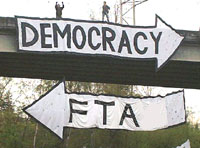

:: Across the board ::


This section contains news and analysis of sweeping developments that affect the overall push and pull towards FTAs and bilateral investment treaties. This means major trends relating to bilateralism, often with global consequences, and other cross-cutting issues. New developments arising from US politics, the WTO or South-South alliance-building, for instance, are often reported here as they tend to have systemic impacts.

last update: May 2012


Gloomy trade outlook
Economic considerations are well down the list of reasons why bilateral trade agreements get negotiated
We must lead the way on free trade
Free trade is one of the critical components of U.S. efforts to develop enduring, stabilizing influences in the Middle East, South Asia and Africa -- key regions for our work to thwart the rise of terrorism and illiberal government.
Peter Mandelson speech on 'Strengthening the Lisbon Strategy'
"The hoped-for success of Doha should be complemented by bilateral or regional initiatives, such as Regional Trade Agreements with Mercosur and the Gulf Cooperation Council, which allow the pursuit of a wider agenda."
WTO wrong to abandon core values
Free trade agreements are popping up everywhere. In its first term the Bush administration pushed four through Congress and started another three. China is negotiating FTAs with Chile and New Zealand. And Australia has negotiated three with Washington, Singapore and Thailand, and is in the process of dealing with Beijing. Not everyone thinks they are good.
The rush to regionalism
This paper aims to set out the issues of importance in addressing the links between sustainable development and the rush to regionalism (FTAs).
Regional, bilateral deals seen as impeding trade
Far from being a stepping stone to freer trade, the NAFTA and other regional and bilateral trade deals have created a conflicting web of preferential arrangements that may be impeding rather than spurring trade, the authors of a report commissioned by the World Trade Organization have concluded.
Vaile defends trade deals
Trade Minister Mark Vaile today defended Australia's free trade deals with foreign countries after a new World Trade Organisation (WTO) report said such agreements could be discriminatory.
WTO hampered by 'spaghetti bowl' deals
The World Trade Organisation is being undermined by the intransigence and short-sightedness of its member countries, according to the report of a high-level commission released on Monday.
Bill Day: Bring back the multilateral pact
Now that Trade Representative Robert Zoellick is moving to the State Department as Condoleezza Rice's deputy, U.S. trade policy may see a shift from small bilateral pacts back to big, sweeping multilateral trade agreements.
Zoellick plies a new trade
Although not part of the new right's militarist and neo-conservative camps, Zoellick's personal arrogance, his unilateralism, and his loyalty to Bush and the Republican Party's new radical elite make him a perfect fit for Bush's new foreign policy team.