


Americas


Bilateral deal-making involving governments of Latin America, the US and Canada.

last update: May 2012

Photo: rabble / CC BY-SA 2.0


The Southern Bank: the result of the struggle of movements
The Southern Bank is not just a bank, not even a further development bank. It is the expression of the struggle against a model that takes out resources from the poorest nations. If this bank no longer manages to represent such expression and becomes more of the same, the movement will have a new institution to resist.
The story of IIRSA
Colourful booklet for popular outreach on the struggle of Latin American people versus mega infrastructure projects and trade negotiations with the European Union.
Bolivia: Two years of 'post-neoliberal' Indigenous nationalism -- a balance sheet
The right laments the "isolation" of the Bolivian economy from the global currents of trade because it has put three crosses against the free trade agreement with the United States and there isn't the will to take part in an agreement with the European Union, the "biggest markets on the planet".
Latin America's free trade agreements with the European Union - An agenda for domination
The EU is currently negotiating FTAs with Central America, the Andean Community of Nations and Mercosur. Its objective is to use these agreements to complete the privatisation process, to remove restrictions on European property and activity in the region, to acquire full access to natural resources and to obtain guarantees that European companies will be able to operate with clear advantages over national companies. Moreover, all these concessions granted to European companies are to be protected from any political changes that the peoples of the region might want to undertake in the future.
Truck drivers strike at Panama/Costa Rica border
The first major disruption of the nine-month-old Costa Rican-Panamanian free trade agreement came on July 6, when approximately 200 truck drivers from Panama, Costa Rica, and other Central American countries paralyzed cargo crossing from Paso Canoas, Panama to Cerro Punta, Costa Rica.
What good is Caricom? Regional unity losing steam
The question must now be asked, just how effective is Caricom, and does it serve any useful purpose? This has proven to be a watershed year for the regional body coming less than two years after the Caribbean Single Market and Economy (CSME), prevailing rampant food price, high energy cost and uncontrollable crime, all afflicting the region. Has Caricom address these issues effectively?
Mexico seeks combined FTA with Central American countries
Mexico has begun negotiations with several Central American countries to merge its three individual Free Trade Agreements (FTA) with them into a single one
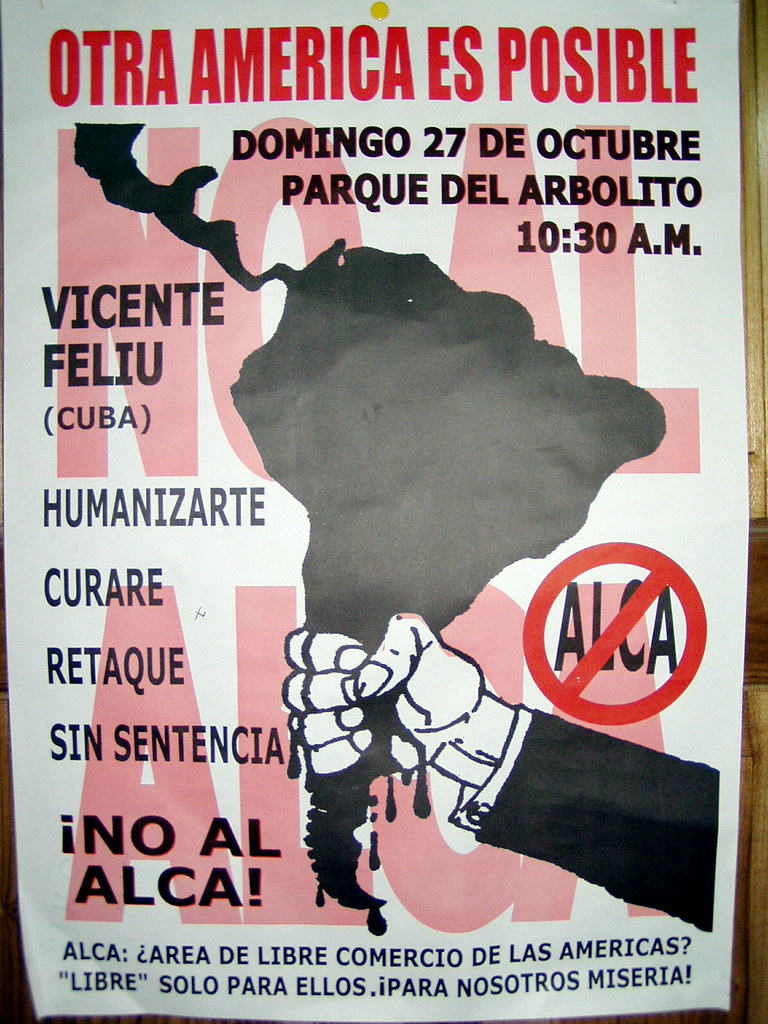
FTAA vs ALBA - Choosing trade routes
Even as the FTAA cools on the back-burner and Venezuela President Hugo Chavez pitches ALBA as a viable trade alternative, there are concerns that ALBA may not suit Trinidad and Tobago's palette.
Bolivian president urges Peruvian counterpart to respect Andean Community rules
Bolivian President Evo Morales on Tuesday urged his Peruvian counterpart Alan Garcia to respect the pledges made under the Andean Community of Nations (CAN) before signing any unilateral free trade agreements
Statement: UNASUR must be used to strengthen the integration of South America
Social organisations and popular movements of South America demand a genuine role in the decisions made regarding how UNASUR is designed and rolled out.

