

Resisting the weaponization of interdependence
By Joseph Purugganan
Co-Director, Focus on the Global South and Co-Convenor of Trade Justice Pilipinas
At the gathering of the elite—world leaders and CEOs of the biggest corporations—at the World Economic Forum in Davos, EU President Ursula von der Leyen delivered a special address that outlined the way forward for Europe amidst a world she described as “more fractured and more fractious than ever”.[i]
“It is time to seize this opportunity and build a new independent Europe,” said von der Leyen. “Europe must speed up its push for independence—from security to economy, from defence to democracy,” added the EU President
While there was no mention at all of US President Donald Trump—who was scheduled to speak at Davos a day after von der Leyen’s address—nor of the unilateral trade actions taken by his administration against the EU, the call for independence was clearly a reaction to Trump’s disruptive trade policies. At the heart of Von der Leyen’s message is the realization of the need to address the EU’s dependence on the US, not just economically but on matters of security and defense as well.
Elsewhere in the speech, however, this call for independence was coupled with the rhetoric of partnership and cooperation. Von der Leyen cited the newly minted EU-Mercosur trade agreement, which she described as “the largest free trade zone in the world.” She also mentioned new agreements with Mexico, Indonesia, and Switzerland, and continuing negotiations with Australia, Thailand, Malaysia, the UAE, and the Philippines. A week after, the EU-India FTA negotiations were also concluded.
The EU President underscored the message that the EU is “choosing fair trade over tariffs. Partnership over isolation. Sustainability over exploitation. And that we are serious about de-risking our economies and diversifying our supply chains”.
Two things stand out in Von der Leyen’s speech. First, when the EU talks of economic partnerships, what is being pushed really are corporate-driven partnerships. As von der Leyen emphasized: “the ultimate aim is to create a new, truly European company structure. We call it EU Inc.” She went further to describe the approach as “the creation of a single and simple set of rules that will apply seamlessly all over our Union. So that business can operate across Member States much more easily.” “Europe wants to do business with the growth centres of today and the economic powerhouses of this century. From Latin America to the Indo-Pacific and far beyond,” she added.
That emphasis on ease of doing business highlights the second key point in the speech, urgency. As the European Commission press release pointed out: “ the President said Europe is moving with speed and determination, from energy and raw materials to defence and digital.”[ii]
Rather than being a totally new approach, however, what Von der Leyen outlined at Davos is more a turbo version of what one may argue has always been the EU’s and all the major superpowers’ approach to that matter in international trade. An approach to advance its strategic agenda at all costs.
Why should this approach of pushing the corporate-driven agenda with utmost urgency matter to us?
EU-Philippines FTA
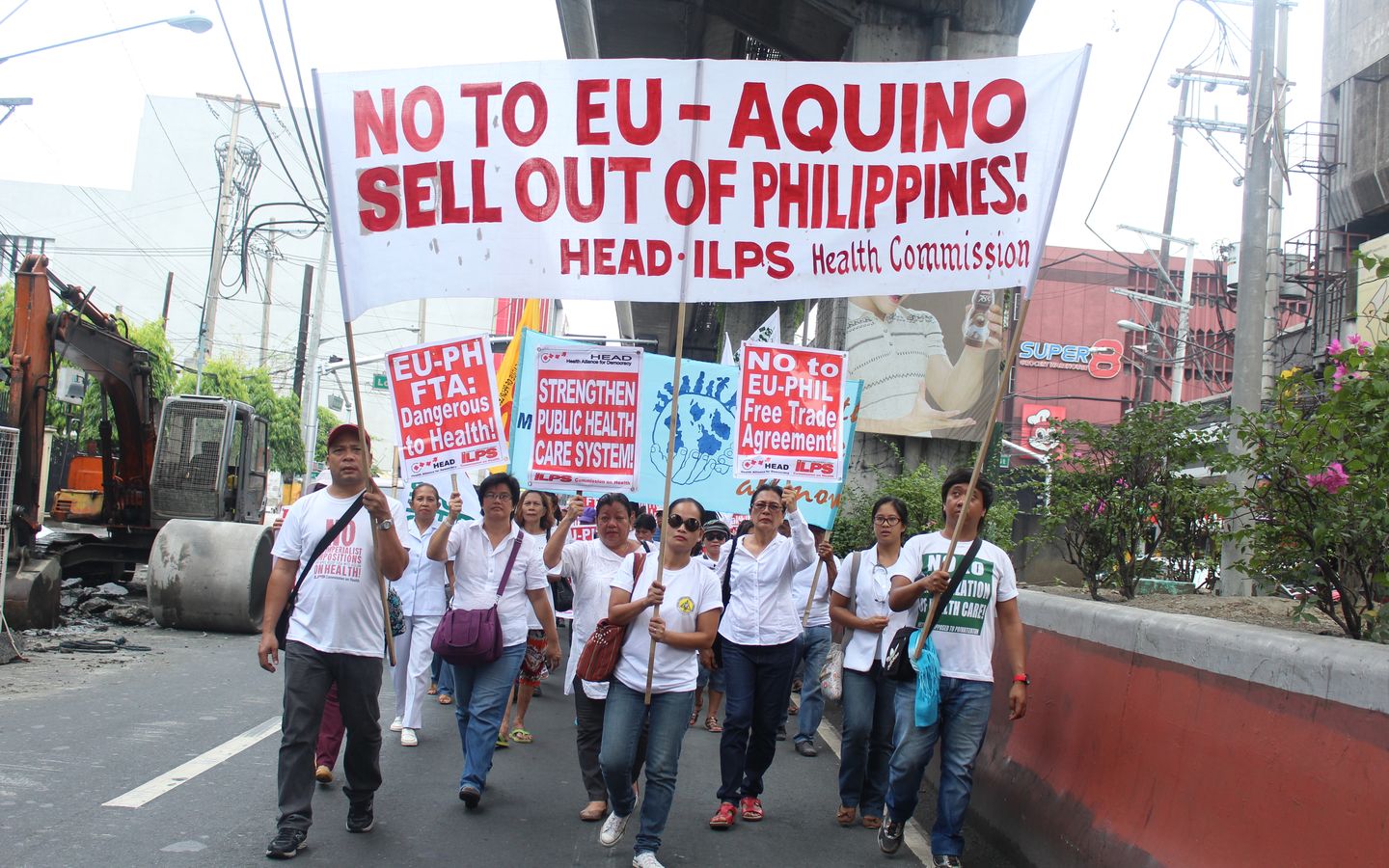
In 2015, the European Union launched negotiations for an ambitious free trade and investment agreement with the Philippines as part of the EU’s effort to build new partnerships in the Asian region. The bilateral negotiations were suspended in 2019 under the administration of President Rodrigo Duterte owing to concerns over human rights. The talks were revived under the Marcos, Jr. administration, and a formal resumption of negotiations commenced in March 2024.
Then and now, a key question of trade justice campaigners in the Philippines is whether the so-called economic partnership between the highly developed European Union and a developing country like the Philippines is a partnership among equals? Especially in terms of who benefits and who bears the costs.
We revisit that question today amidst a totally changed context- one characterized by growing geopolitical tensions and great power rivalries.
The unilateral actions by Trump in the US have exposed a highly skewed system where powerful economies essentially flex their muscles and weaponize trade instruments like tariffs to suit their own economic and political agendas.
The EU is hedging that its so-called economic partnerships via FTAs will be different from the transactional, “might is right” approach of Trump.
A more cautious approach for the Philippines is to view it through the lens of weaponized interdependence.
Weaponization of interdependence is the phrase used by scholars Farell and Newman to describe the dynamics within what they call “asymmetric network structures” where “some states are able to leverage interdependent relations to coerce others.”[iii] Coercion, they explained, can happen “If (states) have appropriate domestic institutions, they can weaponize networks to gather information or choke off economic and information flows, discover and exploit vulnerabilities, compel policy change, and deter unwanted actions”[iv].
In Whose Interest and At What Cost?
Over the years, trade justice campaigners have raised a number of issues and concerns over the FTA with the EU. These include possible impacts on prices of medicines, farmers’ right to seeds, impacts on traditions indigenous knowledge and practice from biopiracy, access to affordable generic medicines under the intellectual property rights (IPR) chapter, as well as the erosion of policy space through provisions prohibiting measures like local-content stipulations, requirements pertaining to hiring local workers, export restrictions, and technology-transfer specifications.
In addition, the new emphasis on energy, raw materials, and digital trade brings with it a host of other concerns. It is perhaps in these two new areas where the coercive power of the EU states, backed by its corporations are clearest.
FTAs curtail states’ power to regulate trade and investment and ensure that rules are not captured by big corporations. The energy and raw materials chapter, for example, would induce further expansion in the mining sector that would go against the proposals for alternative minerals management proposed by environmental and human rights groups.
Powerful tech companies, for example, have pushed rules against data localization, local content, source code disclosure, and the introduction of taxes on companies. These corporate-driven rules would have huge implications for government revenues, privacy and consumer protection, security and law enforcement, and policies in support of domestic industrialization and development.
Revenue losses resulting from a ban on duties on electronic transmissions, for example, are estimated to have cost developing countries around “USD 48 billion in tariff revenue from duty-free imports of specific ET products from 2017 to 2020”[v].
Trade and Human Rights
Lastly, the issue of trade and human rights remains a sensitive issue. There are those who are pushing the EU to leverage the fact that the Philippine government supports the FTA, in order to put pressure on the Philippine government to pass pending legislation to protect human rights defenders in the Philippines. While we agree that those laws are urgent and necessary, we should also not forget that when we talk of trade and human rights, it is important to question as well how the agreement itself could lead to violations and abuse of human rights, as the EU’s own sustainability impact assessment in 2019 had pointed out.
“A future FTA would be likely to have impacts on [Filipinos] occupied in and around the sectors that see rapid expansion, and especially the sectors where concerns already exist on human rights issues. Expansion of the manufacturing sector could see increased land conversion for industrial manufacturing zones, potentially leading to indigenous peoples’ or minorities’ decreased access to customary lands as well as an increase in land disputes, which are not always properly handled (i.e. not according to the principles of free, prior, and informed consultation and consent) “[vi]
Overall, three main questions and concerns remain with respect to these ongoing negotiations.
First, do we need a trade deal in this moment of instability? Will it provide the desired stability and predictability amidst a volatile situation, or will the obligations and commitments serve as binding constraints on the country’s own development goals?
Second, while there has been a lot of emphasis on maximizing or realizing untapped potential, the Philippine experience with FTAs generally has not been good in terms of delivering promised benefits and gains. Based on experience, the rosy projections and promises of benefit for all under a liberalized trade regime have simply not materialized. Instead, we have seen how corporate-driven globalization has led to an agricultural sector in crisis and de-industrialization.
Finally, it is clear that on the new issues (technology and digitalization, energy, and critical minerals), the European Union has a more developed and strategic agenda for securing its interests and those of large European and Transnational corporations.
By committing to the rules that will be set under the agreement, the Philippines would be coerced into accepting revenue losses and restrictions on its ability to regulate trade and investments to ensure its own development goals without interrogating the issues of equal benefits, on the one hand, and shared obligations to address negative impacts on the environment and human rights, on the other.
Our negotiators can take guidance from the ASEAN Geoeconomics Report 2025: “The challenge is not simply how to expand trade, but how to pursue the right kind of trade. It is not only about joining global initiatives but ensuring that the Philippines’ participation reflects its own interests and principles. This requires sharper articulation of what the Philippines stands for and what it will resist.”[vii]
Notes
[i] Special Address by President von der Leyen at the World Economic Forum delivered on 20 January 2026. https://ec.europa.eu/commission/presscorner/detail/en/speech_26_150.
[ii] President von der Leyen delivers an address at the World Economic Forum: It is time to seize this opportunity and build a new independent Europe. Press Release from the European Commission. https://ec.europa.eu/commission/presscorner/detail/en/ac_26_171
[iii] Farell,H and Newman, A. Weaponized Intersependence: How Global Economic Networks Shape State Coercion. International Sevurity, Vil.44, No.1. 2019 by the President and Fellows of Harvard College and the Massachusetts Institute of Technology. https://direct.mit.edu/isec/article/44/1/42/12237/Weaponized-Interdependence-How-Global-Economic
[iv] ibid
[v] Banga, R. WTO Moratorium on Customs Duties on Electronic Transmissions: How much tariff revenue have developing countries lost? South Centre. 03 June 2023. See PDF
[vi] Sustainability Impact Assessment in sypport of the EU-Philippines FTA. Fina Report. 2019. https://circabc.europa.eu/ui/group/09242a36-a438-40fd-a7af-fe32e36cbd0e/library/7ce196ff-3fba-487e-a6ce-1f72e04e40d0/details?download=true
[vii] ASEAN Geoeconomics Report 2025 – This Time It Is Different: ASEAN’s Agency in Shaping The New Global Agenda https://asean.org/book/asean-geoeconomics-report-2025-this-time-it-is-different-aseans-agency-in-shaping-the-new-global-agenda/