

Peace Brigades International | 19 November 2025
Canada to pursue free trade negotiations with the Philippines as land and environmental defenders continue to be killed
by Brent Patterson
On November 5, 2025, the Canadian government tabled a Notice of Intent to enter into free trade negotiations with the Philippines. Just a few days earlier, on November 2, Canada and the Philippines signed a “Status of Visiting Forces Agreement” to further deepen security cooperation after a closed-door meeting in Manila.
The Government of Canada notes: “It will allow the Canadian Armed Forces and the Armed Forces of the Philippines to work more closely together through participation in joint and multinational operations and exercises in each other’s territories.”
At that time, Canada’s defence minister David McGuinty stated: “Peace is built on rules, not recklessness. …The Philippines has shown true leadership in upholding international law … and for that [it has] Canada’s greatest and deepest respect.”
This follows a meeting on October 26 between Canadian prime minister Mark Carney and Philippines president Ferdinand Marcos Jr. in Kuala Lumpur, Malaysia.
Third deadliest country for land and environmental defenders
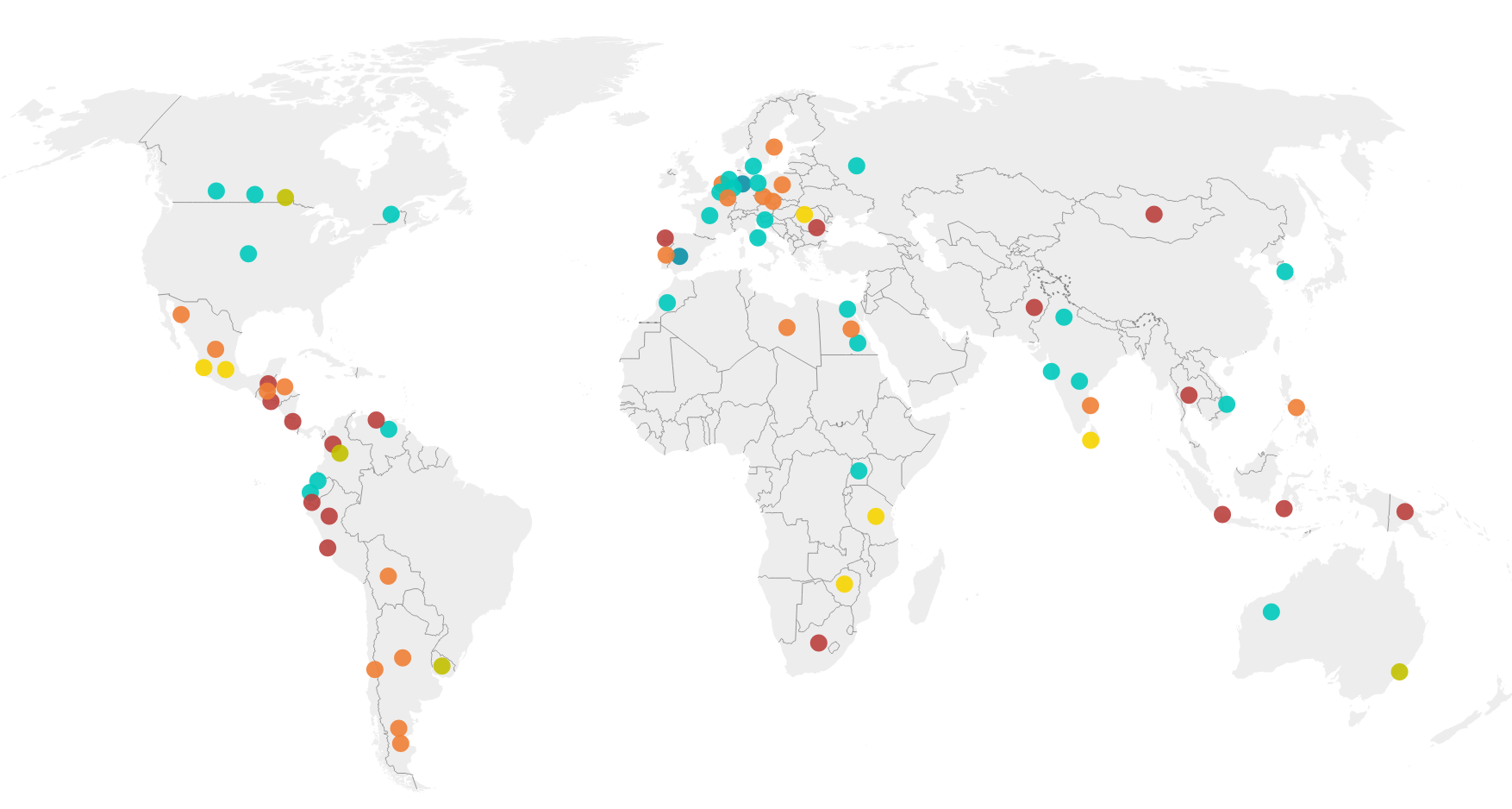
Between 2012 and 2024, the Philippines was the third deadliest country for land and environmental defenders, according to data from Global Witness. They note that 306 defenders were killed in the Philippines during this period, with 413 killed in Brazil and 509 killed in Colombia during these years.
In just the last five years, at least 8 defenders were killed in the Philippines in 2024, 17 in 2023, 11 in 2022, 19 in 2021 and 29 in 2020.
Those killed in 2024. Image by Global Witness.
Commenting on the situation in the Philippines, Front Line Defenders has noted: “Those who defend economic, social and cultural rights, including the right to land and the environment, are most at risk of assassination.”
They add: “Numerous reports indicate that HRDs are the target of violence, intimidation, harassment, especially from government officials, when seeking information about projects, investors or the process of approving a project, which often involves facts of corruption. If they persist in their work despite threats, they risk judicial harassment or execution. extrajudicial. Rural or indigenous HRDs who peacefully defend their lands or who oppose major industrial projects face similar threats. The lack of legal protection also puts LGBTI rights defenders at risk in their daily lives.”
And Amnesty International has documented: “The practice of ‘red-tagging’ human rights defenders, including young activists, persisted, and the government continued to use counterterrorism measures against humanitarian workers.”
Armed forces, mining implicated in killings
Global Witness has further noted about the situation in the Philippines: “The military has been linked to the highest number of killings and detentions of land and environmental defenders in the last decade… A Global Witness investigation published in December 2024 found that the government’s push to expand critical minerals mining in the country is putting frontline communities, especially Indigenous Peoples, at risk of militarisation and violence.”
Canadian interest in critical minerals
Rappler, the Philippines’ leading digital media company, has reported: “[Canadian Ambassador David] Hartman [has] emphasized Canada’s interest in critical minerals.”
It quotes the Ambassador saying: “One of the areas that we’re really quite keen to pursue with the government of the Philippines, the people of the Philippines, is the area of critical minerals…. The Philippines is the fifth most mineralized country on Earth. The crass reality is we cannot have a clean energy, a green energy transition without critical minerals.”
The Ambassador further explains in the Rappler article: “The candid reality is that the global community needs the Philippines. What Canada wants to be able to do is to be able to help the Philippines extract its mineral wealth responsibly, ethically, and in an environmentally sustainable and sound manner. Canada has a tremendous track record of being able to do that for ourselves back home.”
Indigenous defenders resisting mining targeted
Global Witness adds: “Indigenous Peoples account for a staggering one-third of land and environmental defender killings in the Philippines in 2012-23. Neary half of these cases were linked to mining. The military was responsible for 64 out of 117 killings of Indigenous defenders between 2012-23.
Military exports
Despite the involvement of the military in the killing of defenders in the Philippines, Canada has approved the export of just over $14 million in “military goods” to the Philippines over the past 13 years: $22,929.81 (2024); $514,604.48 (2023); $385,000.00 (2022); $399.95 (2021); $18,100.00 (2020); $458.00 (2019); $175,497.00 (2018); $3,219.78 (2017); $6,050,640.67 (2016); $192,490 (2015); $2,190,000 (2014); $1,226,392 (2013); $3,268,594 (2012).
PBI South East Asia Project
Peace Brigades International continues to be in the process of exploring the formation of a South East Asia Project that would include Cambodia, Malaysia, Myanmar, the Philippines and Thailand.
According to Global Witness data from 2012 to 2024, at least 339 land and environmental defenders have been killed in this region: Philippines (as noted above, 306), Thailand (13), Cambodia (11), Myanmar (8) and Malaysia (1).
We continue to follow the situation in these countries.