


Online Office of Congressman Mike Michaud | Wednesday, June 24 2009
106 Members of Congress Introduce TRADE Act; Promote a Better Trade Model
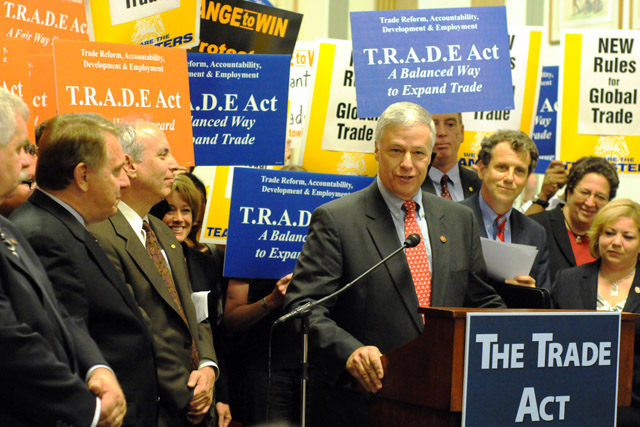
“We all know that we live in a globalized world. But we need to ensure trade is fair for our workers and economy. The TRADE Act shows what we are for in future trade agreements – and paves the way on how to fix our existing agreements,” Michaud said.
The cosponsors reflect the broad demand in Congress for a new direction on trade. 106 Members of Congress cosponsored the bill, including 9 committee chairs, 45 subcommittee chairs and members of the classes of 2006 and 2008. The cosponsors include members of the Democratic Caucus, Republican Caucus, 17 Blue Dogs, 14 New Democrats, the Hispanic Caucus, the Black Caucus, the Progressive Caucus and the Populist Caucus. They represent a diversity of both urban and rural districts which have been negatively affected by current U.S. trade and globalization policy.
“This is an exciting day for trade policy,” said Michaud. “Last year, we had 74 cosponsors of the TRADE Act and this year we have 106. Members are sick and tired of being against trade agreements and they want to stand for something. I have no doubt the number of cosponsors have increased because the American people are demanding a new course on trade. The TRADE Act is a tremendous step forward in the debate and could help shape the future of our trade policies.”
The full text of the bill can be found here: http://www.michaud.house.gov/images//tradeactfinal.pdf
----
Summary of Key Provisions of the TRADE Act:
Review: The bill requires the Government Accountability Office (GAO) to conduct a comprehensive review of the major trade pacts that comprise the model on which U.S. trade agreement have been based, such as NAFTA, WTO, and CAFTA. The review, which must be completed before new trade negotiations or congressional consideration of pending pacts, includes an assessment of economic outcomes in the United States and abroad and various security, human rights, social and environmental indicators. The GAO must also report on how the current pacts measure up to the bill’s criteria with respect to what must and must not be included in trade pacts.
What Must and Must Not Be in All Agreements: The bill contains a detailed description of the key provisions that must be included in all future U.S. trade agreements and what aspects of the current model must never again be replicated to ensure that trade pacts provide broader benefits. It sets forth the environmental and labor, food and product safety, agriculture, trade remedy, human rights, federalism safeguard and currency anti-manipulation rules and national security exceptions that must be included in all U.S. trade pacts. This section also lists what aspects of the NAFTA-WTO model cannot be included in future deals, including bans on Buy American and anti-sweat shop or environmental procurement policies; new rights and privileges for foreign investors to promote offshoring and expose domestic health and environmental laws to attacks in foreign tribunals; service sector privatization and deregulation requirements; and special protections for Big Pharma to limit affordable access to drugs. This section comprises over half of the bill, given that today trade pacts extend far beyond traditional trade matters to cover so many different essential policy topics that are the crux of Congress’ domestic agenda - from access to essential services such as health care and education to regulation of financial services to medicine patents to investment, procurement and local development policy to procurement and food and product safety policy.
Renegotiation: The bill requires the President to submit a plan to address through renegotiation the gaps identified between our current major pacts and the criteria for what must and must not be included in U.S. trade agreements. The bill establishes a special congressional super committee chaired by the Ways and Means and Finance Committee chairs to work with the President on formulating this plan. The super committee also includes a role for the chairs and ranking members of other committees whose core jurisdiction is directly affected by today’s expansive trade pacts.
Replacing Fast Track: The bill lays out criteria for a new mechanism to replace the anti-democratic Fast Track negotiating process. To obtain agreements that benefit a wider array of interests, this new process includes Congress setting readiness criteria to select future negotiating partners; mandatory negotiating objectives based on the bill’s criteria of what must be and must not be in future trade pacts; and the requirements that Congress must certify that the objectives were met, and then vote on an agreement before it can be signed. These criteria have been supported in AFL-CIO, Change to Win and National Farmers Union resolutions.
Support for the 2009 TRADE Act:
- AFL-CIO
- Change to Win
- Communications Workers of America (CWA)
- American Federation of State, County and Municipal Workers (AFSCME)
- International Association of Machinists and Aerospace Workers (IAM)
- International Brotherhood of Boilermakers
- International Brotherhood of Electrical Workers (IBEW)
- International Brotherhood of Teamsters (IBT)
- International Federation of Professional and Technical Engineers (IFPTE)
- International Union of Painters and Allied Trades
- United Steelworkers (USW)
- United Brotherhood of Carpenters (UBC)
- Workers United
- American Manufacturing Trade Action Coalition (AMTAC)
- Sierra Club
- National Farmers Union
- National Family Farm Coalition
- NETWORK, A National Catholic Social Justice Lobby
- United Methodist Church General Board of Church and Society
- Friends of the Earth U.S.
- Public Citizen
- Citizens Trade Campaign
- Institute for Agriculture and Trade Policy
- Americans for Democratic Action
- Witness for Peace
- Church World Service
- TransAfrica Forum
Original Cosponsors of the TRADE Act:
1. Abercrombie, Neil
2. Altmire, Jason
3. Arcuri, Michael
4. Baca, Joe
5. Baldwin, Tammy
6. Bocceri, John
7. Boswell, Leonard
8. Brady, Robert
9. Braley, Bruce
10. Capuano, Michael
11. Carnahan, Russ
12. Carney, Christopher
13. Carson, André
14. Chandler, Ben
15. Childers, Travis
16. Cleaver, Emanuel
17. Cohen, Steve
18. Conyers, John
19. Costello, Jerry
20. Cummings, Elijah
21. Dahlkemper, Kathy
22. DeFazio, Peter
23. Delahunt, William
24. DeLauro, Rosa
25. Dingell, John
26. Doyle, Mike
27. Edwards, Donna
28. Ellison, Keith
29. Filner, Bob
30. Fudge, Marcia
31. Gordon, Bart
32. Grayson, Alan
33. Green, Al
34. Green, Gene
35. Grijalva, Raúl
36. Gutierrez, Luis
37. Hall, John
38. Hare, Phil
39. Hastings, Alcee
40. Hinchey, Maurice
41. Hirono, Mazie
42. Holden, Tim
43. Holt, Rush
44. Jackson Jr., Jesse
45. Jackson-Lee, Sheila
46. Johnson, Hank
47. Jones, Walter
48. Kagen, Steve
49. Kanjorski, Paul
50. Kaptur, Marcy
51. Kildee, Dale
52. Kilpatrick, Carolyn
53. Kilroy, Mary
54. Kissell, Larry
55. Kucinich, Dennis
56. Langevin, James
57. Lee, Barbara
58. Lipinski, Daniel
59. Loebsack, David
60. Lynch, Stephen
61. Massa, Eric
62. McCollum, Betty
63. McGovern, James
64. McIntyre, Mike
65. Michaud, Michael (sponsor)
66. Mollohan, Alan
67. Moore, Gwen
68. Murphy, Patrick
69. Murtha, John
70. Nadler, Jerrold
71. Napolitano, Grace
72. Norton, Eleanor Holmes
73. Oberstar, James
74. Pallone, Frank
75. Payne, Donald
76. Perriello, Tom
77. Peters, Gary
78. Peterson, Collin
79. Pingree, Chellie
80. Rahall, Nick
81. Ross, Mike
82. Rothman, Steven
83. Roybal-Allard, Lucille
84. Ryan, Tim
85. Sarbanes, John
86. Schakowsky, Jan
87. Schauer, Mark
88. Scott, Bobby
89. Shea-Porter, Carol
90. Sherman, Brad
91. Shuler, Heath
92. Slaughter, Louise
93. Smith, Chris
94. Spratt, John
95. Stupak, Bart
96. Sutton, Betty
97. Tierney, John
98. Tonko, Paul
99. Visclosky, Peter
100. Walz, Tim
101. Wasserman-Schultz, Debbie
102. Waters, Maxine
103. Welch, Peter
104. Wilson, Charlie
105. Woolsey, Lynn
106. Wu, David