

The EU-US trade deal locks Europe into US dependence
by Lora Verheecke
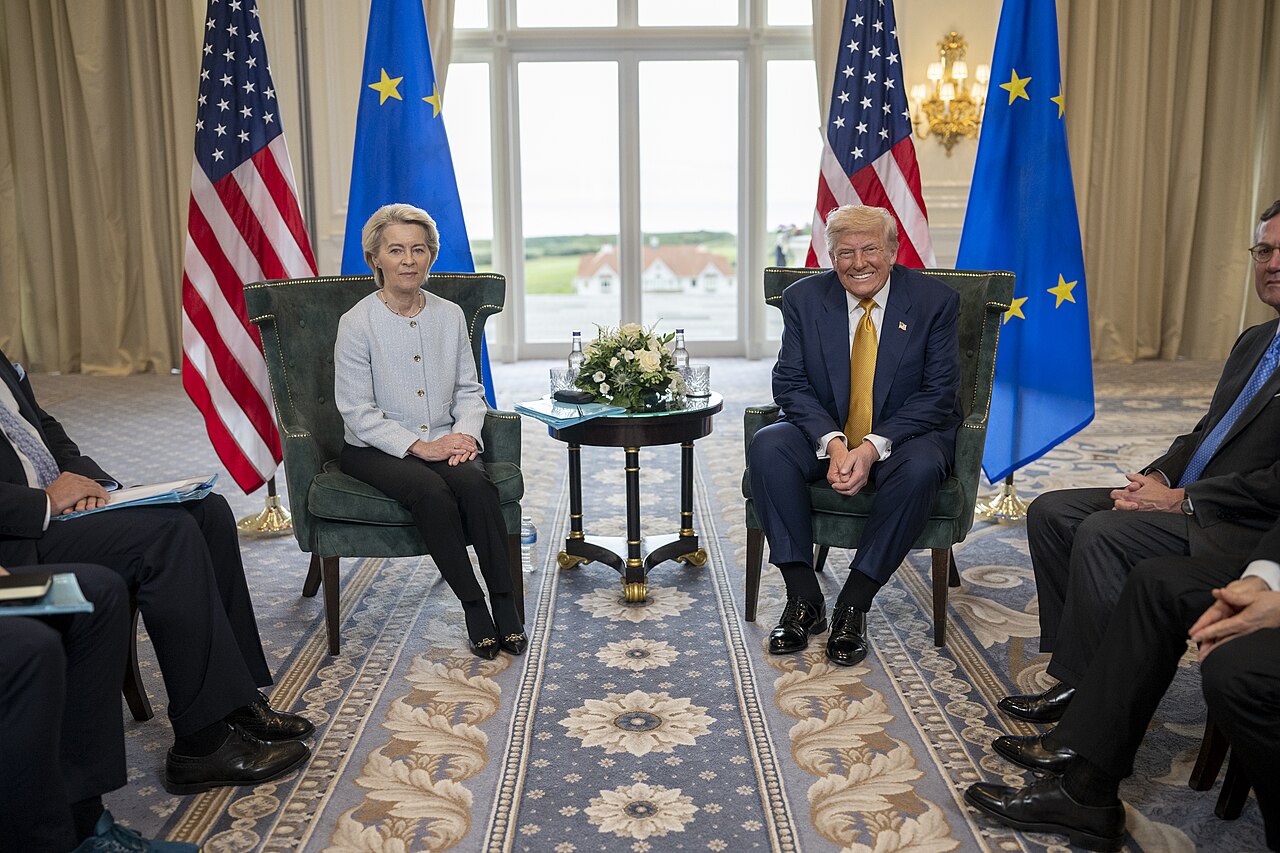
On 16 June, the European Parliament approved a trade deal agreed a year ago by Ursula von der Leyen and Donald Trump at Trump’s golf resort in Turnberry. The Left was the only political group united in opposing the agreement, which will not only damage the European economy and lock Europe into obscene purchases of US fossil fuels and armaments, but also legitimise the right-wing deregulation agenda.
This so-called “Turnberry deal” ratification was put on hold in early 2026 amid Trump’s threats to acquire Greenland, to impose a trade embargo on Spain for its opposition to the US-Israel war against Iran, and the US Supreme Court’s ruling that many of Trump’s tariffs were unconstitutional. Since then, Trump threatened to raise tariffs by 25 per cent on European automobiles by 4 July 2026 if the Turnberry deal was not implemented. Consequently, the ratification process moved rapidly. The bullying worked, from beginning to end.
The Trump deal: the bad and the ugly
The Turnberry deal falls under Trump’s MAGA policy of rearranging global trade in favour of the US. It is easy for Trump to apply his impulsive and deliberately erratic tariff coercion on the EU because the US economy is less sensitive to tariff increases than both the EU and China, the key target of Trump’s protectionist trade policies. US imports and exports amount to the equivalent of 14 per cent and 11 per cent of its GDP, respectively. By comparison, the EU imports and exports stand at around 22 per cent and 23 per cent of its GDP, respectively (1.8 and 2.8 per cent with the US).
Even so, the general imbalance is striking. “We give in, we don’t get anything,” said former Trade Commissioner Cecilia Malmström about the deal, which she deems “humiliating.” The EU agreed to remove tariffs on US industrial goods and certain agricultural products, in return for the US capping tariffs on most European exports at 15 per cent. The 15 per cent tariffs on European goods have some exceptions — aircraft and aircraft parts and generic pharmaceuticals — but overall, they apply to 70 per cent of European goods entering the US market. This has a major implication: EU industries exporting to the US will most likely see their products become more costly on the US market. Naturally, this will favour products made in the US over those made in the EU.
In terms of agricultural products, the EU opens its borders to quantities of US agri-food products without tariffs: pork, milk products, cheese, nuts, soy, oil, salmon and other fish, etc. This will likely severely damage the livelihoods of small and local European farmers active in those markets, who will have to face competition from the US agribusiness sector with less strict regulations and bigger farms. The European farmers’ network Via Campesina has described the deal as “unbalanced competition.”
More than a trade deal
One might wonder why von der Leyen conceded to the deal in Turnberry. According to EU Trade Commissioner Maroš Šefčovič, “It’s not only about the trade. It’s about security. It’s about Ukraine.” For this reason, the deal includes a commitment by the EU to purchase “hundreds of billions of dollars” of US arms and military equipment.
The concept of “security” is also extended to enterprise. Former Belgian prime minister Sophie Wilmès, now a Member of the European Parliament (MEP) from the Renew group and Vice-Chair of its US Delegation, stated that “one could hardly say that the Turnberry agreement is balanced, but we are ready to accept it if it provides our businesses with stability and predictability in their trade relations with the United States.”
The trade deal also includes a pledge by the EU to purchase USD 750 billion worth of US energy — primarily liquefied natural gas, oil and nuclear power — by 2028. The figure is impressive. The US exported roughly USD 70 billion worth of energy products to the EU in 2024, more than ten times less than the 2028 target. The target is unrealistic and undeliverable — and could turn into a source of Trump’s next round of coercive demands at any point. Furthermore, at a time of climate emergency, a significant increase in imports of US fossil fuels puts Europe on the wrong path — especially as the majority of gas extracted in the US comes from highly polluting fracking technology. Those imports also risk delaying the clean energy transition in the EU, making it even more dependent and less competitive in the long term.
In addition, in the July 2025 deal, the European Commission had to pledge that its corporate due diligence legislation would not impose any “undue restrictions” on transatlantic trade. This European law aimed to improve the climate and human rights impact of global supply chains, but it has been the target of concentrated US corporate lobbying and was severely watered down after Turnberry. In fact, the US is a key driver behind the EU deregulation agenda: the Trump administration wants to suppress all European regulations that complicate, increase the cost of, or prevent US companies’ access to the European market — such as digital regulations and car or agri-food standards. This includes digital rules. In August 2025, Trump threatened to impose tariffs on countries that do not eliminate their digital taxes or rules which are all designed, according to him, to harm or discriminate against American technology companies.
One might think all this should be reason enough to protect European laws and workers. In principle, the EU has the tools to do so: retaliation in the tariff war, as it did during Trump’s first term or making use of its economic anti-coercion instrument. Adopted in 2023, the tool enables the EU to take certain steps, such as export-import restrictions or tariffs, if a state applies or threatens to apply trade or investment measures that ‘interfere with the legitimate sovereign choices’ of the EU and its member states. Yet the political will to do so has been missing.
The bully won in all three EU institutions
The political negotiations — or rather the lack thereof — over the trade pact show that, once again, corporate and defence sector interests were put over economic and social wellbeing by the continent’s current leaders, who were largely supportive of the deal. In July 2025, German Chancellor Friedrich Merz welcomed the deal, highlighting it as the solution to avoid a trade conflict that would have hit Germany’s export-driven economy and its large automobile sector. The Italian Prime Minister Giorgia Meloni also supported the deal, and while French President Emmanuel Macron was more critical, saying that the EU hasn’t been “feared enough”, even he eventually supported it.
The European Parliament demanded changes, but neither the Commission nor the Council wanted to reopen the Turnberry deal. Consequently, Parliament entered the negotiations with many demands but left with only a few that made it into the final deal. One such demand was the inclusion of safeguards allowing the deal to be suspended if, or when, Trump reneges on the agreement. Whether and how to use these safeguards, however, will remain in the hands of the Commission, which now has the power to step in, but there is no automatic end to the agreement if the US fails to respect it.
According to MEP Martin Schirdewan from The Left group, this agreement is “an act of political surrender to the blackmail tactics of an unpredictable US President following poor negotiating by the European Commission.” In the right-wing European People’s Party (EPP), reactions were different. MEP Željana Zovko from the group said that they are already seeing “a positive reaction from European industry.” The EPP is happy as long as big business is too.
Beyond the EPP, 440 lawmakers voted in favour of the deal, with 50 abstentions and 151 votes against. The votes of lawmakers from the far-right groups Patriots for Europe (PfE) and Europe of Sovereign Nations (ESN) reveal the contradictions of the European far-right. While ESN MEPs voted against the deal or abstained, members of the PfE group were divided and voted in favour, against, or abstained. However, in September 2025, the PfE group was critical of the deal. Jordan Bardella, its leader from the French party National Rally (RN), claimed that the agreement is not a trade deal, but “a political setback, a capitulation.”
The Council of the EU is now expected to rubber-stamp the text on 26 June, and the deal will enter into force shortly afterwards.
There is an alternative
Recent years have shown that globalisation as we know it is dead. As the US and Europe can no longer claim to be the economic powers winning from the global “free trade” framework imposed on the world, including its poorest countries, they are turning to tariffs and protectionist policies that nurture industries at home. Of course, this is because China is now a global competitor dominating critical raw materials and rare earth supply chains, as well as clean technology manufacturing. But rather than rethinking its role in the global trading system, the EU is maintaining the same old neoliberal agenda — even with new tariffs and more protectionist industrial policies. Trump, too, appears to be discarding the free trade regime that served to enrich the US over centuries, while seeking no end to American imperialism. This is akin to “decanting the old neo-liberal wine into new bottles”.
A case in point is the recent EU-Mercosur trade agreement, negotiated over the past twenty-five years and then implemented undemocratically in February 2026 by Ursula von der Leyen. It enables the EU to import cheap raw materials and food products from Latin America and to export EU products such as cars, without including elements such as technology transfer that would strengthen Latin America’s economies. Instead, the deal will lead to unemployment in the Argentinian car industry and hit the European farming sector hard — but it will bring greater profits to large Latin American agribusinesses and European multinationals. The same old model, all over again.
Instead of blindly following the US lead, the EU would do well to consider the benefits of multilateralism and advocate for a fair global trade system in the current environment of chaos. The Left should seize this moment to promote its vision for Europe’s trade relations — based on decent working conditions, public investment in universal public services, infrastructure and clean energy, and rooted in international solidarity.