

US-DR-CAFTA


The US-Central America Free Trade Agreement, commonly referred to as “CAFTA,” was signed in December 2003 after twelve short months of negotiation. The negotiations involved the US, Costa Rica, El Salvador, Guatemala, Honduras and Nicaragua. Costa Rica at first refused to join the agreement, then changed its position in late January 2004. The US separately negotiated a bilateral treaty with the Dominican Republic, with a view to folding the deal, and the country itself, into the US-CAFTA scheme.

The US-CAFTA was signed late May 2004, and the Dominican Republic became an additional party to it in August 2004. Since then, the accord has been officially renamed the “United States-Dominican Republic-Central America Free Trade Agreement” or US-DR-CAFTA. But the overall agreement -- which a lot of people continue calling just “CAFTA” -- still needs ratification by all parties to go into force.

CAFTA is a wide-ranging agreement covering many areas: agriculture, telecommunications, investment, trade in services (from water distribution to gambling), intellectual property, the environment, etc. It essentially serves US business interests by giving them a concrete and high-level set of rights to operate in Central America. Some US sectors, such as sugar producers, feel threatened by the treaty. But by and large, the threats are mainly against the Central American countries which signed on, as it opens the depths of their economies -- public and private -- to the interests and power of US companies.

In July 2005, US Congress approved the DR-CAFTA and Bush signed it into law in early August. The Central American parliaments eventually also approved it. For the Dominican Republic, the treaty took effect in 2006.

Costa Rica was the Central American country with the strongest resistance to DR-CAFTA. There were large public demonstrations and information campaigns, and a broad grouping of civil society organizations, from trade unions to small farm organizations, signed on. This coalition successfully pushed for a referendum on ratification, which was held on 7 October 2007. The result: 51.62% in favour and 48.38% opposed. The result was considered binding since more than 40% of the electorate voted. In view of these results, CAFTA was ratified.

On December 23, President Bush issued a proclamation to implement the DR-CAFTA for Costa Rica as of 1 January 2009.

last update: May 2012
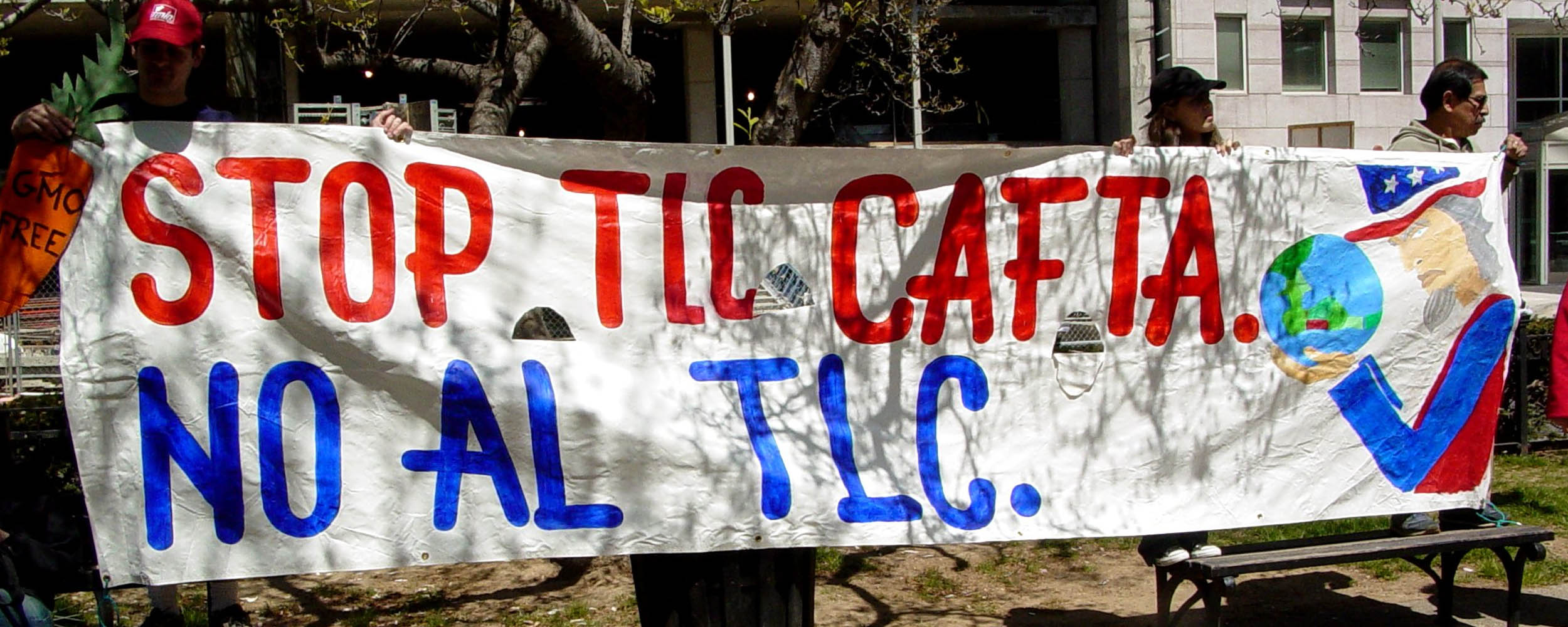
Photo: Public Citizen

Dominican Republic-U.S. trade deficit jumps to US$688M on imports
In the first three months this year the country posted a trade deficit with the United States of US$688 million, much higher than the US$426 million in the year earlier period, reports newspaper Hoy.
Sweetheart Deal
The deadline for completion of a new farm bill has been pushed back to May 16. But the endless wrangling over a piece of legislation that Congress once hoped to finish in 2007 has not induced a significant change in the thinking of those who regard it as an opportunity to lock in lush new benefits for American agricultural producers.
U.S. sock makers wage war on Gildan imports
Just two years after launching an ambitious plan to become a major player in the North American hosiery business, Gildan Activewear Inc. finds itself caught up in an international trade dispute over the flood of socks into the U.S. from Honduras.
Bullets and bananas: The violence of free trade in Guatemala
The ongoing violence against workers in Guatemala makes it clear that talk of free trade improving human rights in developing countries is lost in translation.
Guatemala accused in CAFTA labor complaint
Guatemalan and US labor groups filed a complaint Wednesday with the US Department of Labor alleging that Guatemala had failed to uphold its own labor laws as required under the Central American Free Trade Agreement.
Dominican Government sacrificed RD$2.3B with Free Trade
Figures from the Customs Agency (DGA) show Dominican Government has sacrificed RD$2.3 billion since the United States-Central America Free Trade Agreement began.
U.S. or E.U.? Tico politicos split over best foreign investor
Costa Rican lawmakers are divided over who makes a better investor in their country, the United States or the European Union, according to a recent questionnaire.
Dominican business criticizes FTAs
Dominican businesspeople do not see any advantages on the Free Trade Agreement signed between the Dominican Republic, the US and Central America (CAFTA-DR), said Ignacio Mendez, president of the Dominican Industrials Association.
The ravaging effects of capitalism on my hometowns
What will become of Costa Rica? That's the question on my mind, now that my adopted country has narrowly accepted CAFTA. Our national slogan is "Pura vida!" meaning "pure life," and it's commonly used as an affirmation that life is good. It's easy to understand how such an expression could catch on here: Costa Rica has virtually no enemies, a temperate climate, and a hell of a lot of good beaches. However, as an expatriate whose previous hometowns have been despoiled by global capitalism, I find it difficult to imagine that life will be as pure or as good once the effects of CAFTA begin to kick in.
Costa Rica telecom market seen opening soon
Costa Rica, one of the few Latin America countries still with a state-run telephone sector, is expected soon to open to big foreign players as part of a trade deal with the United States.

Referenced sites

De pie, Costa Rica de pie!!!

Publicación del Partido Frente Amplio para informar sobre la resistencia al TLC en Costa Rica

DR-CAFTA Tratado de Libre Comercio de las Américas

Temas relevantes acerca del tratado de libre comercio, República Dominicana, Centroamérica y Estados Unidos.

Sin pelos en la lengua: NO al TLC

Espacio alternativo a los medios de (des)información tradicionales que dice las verdades sobre el TLC sin pelos en la lengua

US-CAFTA-DR website

By the US government