

US-DR-CAFTA


The US-Central America Free Trade Agreement, commonly referred to as “CAFTA,” was signed in December 2003 after twelve short months of negotiation. The negotiations involved the US, Costa Rica, El Salvador, Guatemala, Honduras and Nicaragua. Costa Rica at first refused to join the agreement, then changed its position in late January 2004. The US separately negotiated a bilateral treaty with the Dominican Republic, with a view to folding the deal, and the country itself, into the US-CAFTA scheme.

The US-CAFTA was signed late May 2004, and the Dominican Republic became an additional party to it in August 2004. Since then, the accord has been officially renamed the “United States-Dominican Republic-Central America Free Trade Agreement” or US-DR-CAFTA. But the overall agreement -- which a lot of people continue calling just “CAFTA” -- still needs ratification by all parties to go into force.

CAFTA is a wide-ranging agreement covering many areas: agriculture, telecommunications, investment, trade in services (from water distribution to gambling), intellectual property, the environment, etc. It essentially serves US business interests by giving them a concrete and high-level set of rights to operate in Central America. Some US sectors, such as sugar producers, feel threatened by the treaty. But by and large, the threats are mainly against the Central American countries which signed on, as it opens the depths of their economies -- public and private -- to the interests and power of US companies.

In July 2005, US Congress approved the DR-CAFTA and Bush signed it into law in early August. The Central American parliaments eventually also approved it. For the Dominican Republic, the treaty took effect in 2006.

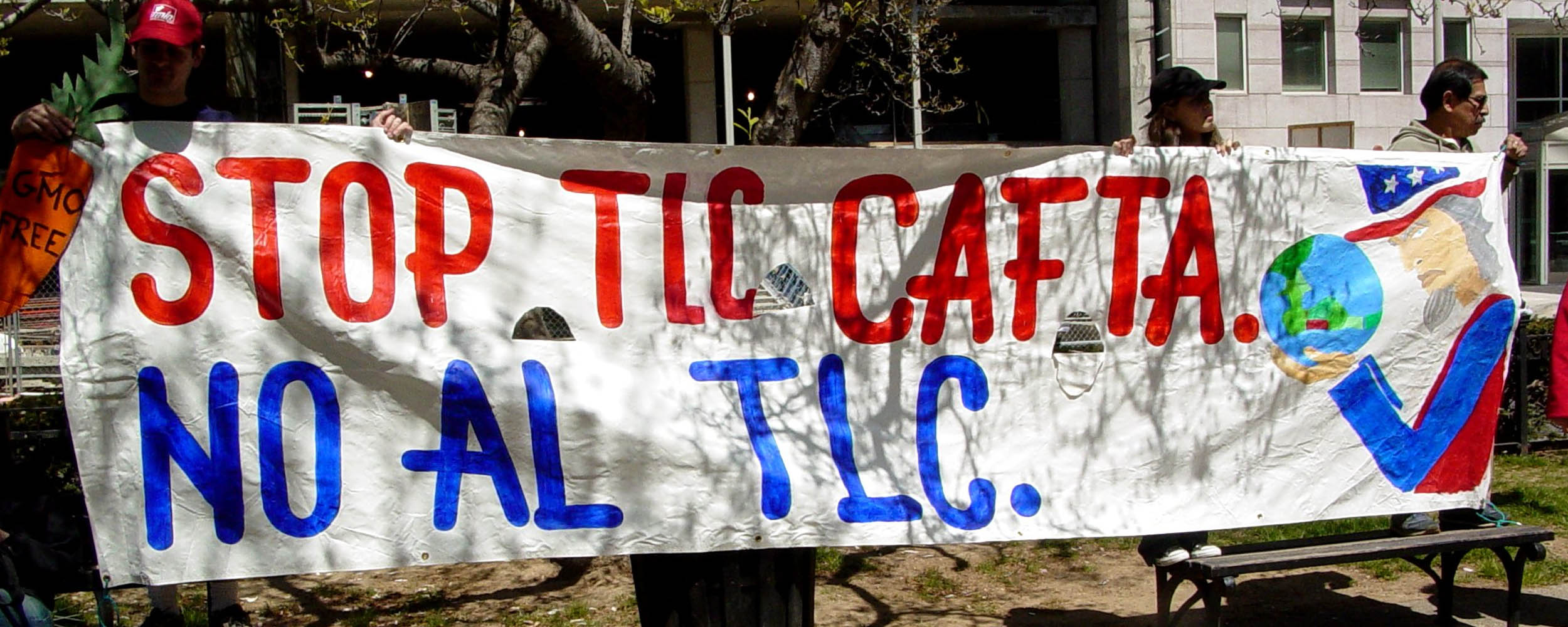
Costa Rica was the Central American country with the strongest resistance to DR-CAFTA. There were large public demonstrations and information campaigns, and a broad grouping of civil society organizations, from trade unions to small farm organizations, signed on. This coalition successfully pushed for a referendum on ratification, which was held on 7 October 2007. The result: 51.62% in favour and 48.38% opposed. The result was considered binding since more than 40% of the electorate voted. In view of these results, CAFTA was ratified.

On December 23, President Bush issued a proclamation to implement the DR-CAFTA for Costa Rica as of 1 January 2009.

last update: May 2012
Photo: Public Citizen


More CAFTA failures for the Bush administration - thousands protest free trade agreement in El Salvador
As President Bush touted the benefits of free trade in his State of the Union address, protests filled the streets of San Salvador on Jan. 31 in the latest of a string of events demonstrating the continued failure of the US-Dominican Republic-Central America Free Trade Agreement (DR-CAFTA).
Food-safety dispute stalls trade agreement
The U.S.-Central American Free Trade Agreement that was supposed to take effect Jan. 1 is being held up by the U.S. because some of the countries involved have yet to recognize U.S. meat-inspection procedures as valid.
US official: free trade is big boost for DR
United States Under-Secretary for the Western Hemisphere Patrick Duddy affirmed last night while visiting the Congress that the Free Trade Agreement will be greatly beneficial to the Dominican Republic and other co-signing countries.
Anti-trade feelings delay CAFTA
The Central American Free Trade agreement faces skepticism and negative sentiment in countries working to implement the pact.
New year sees delay in CAFTA implementation
A key argument used by US transnationals and the Bush administration to pass the Central America Free Trade Agreement (CAFTA)--that Central American countries themselves needed and wanted the agreement--has broken down on the eve of implementation of the controversial pact. This is a summary of the status of CAFTA implementation in each country.
Anti-trade feelings delay CAFTA
Growing anti-trade sentiment in several Central American countries has held up a trade agreement with the United States that was slated to launch Jan. 1.
Guatemalan FTA with US said risky
“The Free Trade Agreement imposed by the United States on Central America and Dominican Republic will have negative consequences for our countries,” said Guatemalan jurist Alfonso Bauer Paiz.
Exports plummet in post-FTA trade
Government figures show Australian exports to the US have fallen since the US Free Trade Agreement (FTA) came into force a year ago. In the 12 months to October last year, Australian exports to the United States fell by 4.7 per cent while US imports rose by 5.7 per cent.
Denounce chaos in prices
National Merchants and Entrepreneurs Federation president Antonio Cruz assured today that there is generalized disarray throughout the Dominican Republic with initial implementation of the tax reform, and requested the government to reconsider enforcing it as of next July when CAFTA comes into effect.
Opposition delays free trade implementation
As CAFTA member-nations struggle to comply with the free trade pact's requirements, opponents of the deal say the delays show how unpopular and undemocratic the mandated reforms are.

Referenced sites

De pie, Costa Rica de pie!!!

Publicación del Partido Frente Amplio para informar sobre la resistencia al TLC en Costa Rica

DR-CAFTA Tratado de Libre Comercio de las Américas

Temas relevantes acerca del tratado de libre comercio, República Dominicana, Centroamérica y Estados Unidos.

Sin pelos en la lengua: NO al TLC

Espacio alternativo a los medios de (des)información tradicionales que dice las verdades sobre el TLC sin pelos en la lengua

US-CAFTA-DR website

By the US government