


US-Colombia

On 27 February 2006, the United States and Colombia reached a Trade Promotion Agreement whose negative impacts were immediately subjected to severe criticism by civil society. The perks granted to the US by the new FTA, especially concerning agriculture and national treatment, rapidly became public knowledge.

One controversial provision concerned quotas on “special” agricultural products that are allowed to enter Colombia in limited quantities without tariffs from the very first year of the FTA; these quotas were increased at the signing of the agreement. Furthermore, the US insisted on Colombia’s acceptance of beef from cows over 30 months, a latent animal and human health risk due to the possible entry of “mad cow” infected animals.

The agreement was approved by the Colombian Congress over the opposition of the Polo Democrático Alternativo and the Colombian Liberal Party. The U.S. Congress later emerged as its chief opponent, rejecting the treaty after the Democratic Party won majorities in both houses and adopted a more aggressive stance on Bush administration policies.

The Democrats argued that the Uribe government had not done enough to curtail the paramilitaries’ crimes against humanity. Colombia, they said, should first put an end to violence against trade unionists and peasants, and indict politicians implicated in the “paragate” scandal (collusion with the paramilitary United Self-Defense Forces and with drug trafficking mafias).

A vote on the deal was put off in April 2008 after President Bush sent the corresponding bill to Congress despite a recommendation against this move on the part of Speaker Nancy Pelosi. Pelosi sought a change to the House rules to prevent the fast-track timetable from kicking in.

In Colombia, opposition has remained firm in recent years, with various sectors mobilizing heavily to resist the FTA. The most recent large-scale mobilization was the “Minga,” in which indigenous people from all over the country traveled thousands of kilometers to Bogotá to reject the FTA, among other demands. Many other sectors of Colombian society signed on to the indigenous mobilization.

Despite the continuing resistance, the Colombian government benefitting from an improved image under President Santos (even though the policies and problems of the Uribe administration persist) won the approval for its FTA with the United States from the US Congress on 10 October 2011. It entered into force on 15 May 2012. Putting this FTA into motion required the approval of more than 15 regulations in the form of laws or decrees to bring Colombia legislation into line with the FTA on issues such as intellectual property, safeguards and tariffs.

last update: May 2012
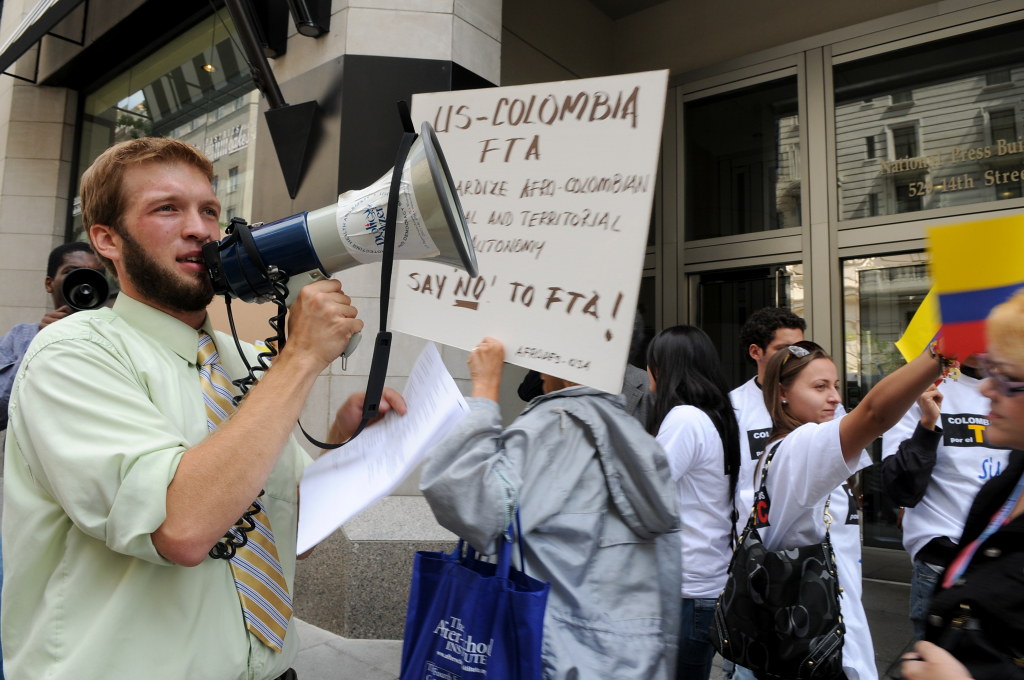
Photo: Public Citizen


Anti-labor violence in Colombia imperils US free trade pact
More than 800 trade unionists have been killed in Colombia over the past six years, by government count, yet the number of those murders solved can be counted on one hand.
US "free trade": Death, drugs and despair in Colombia
The so-called "free trade" deal between Colombia and the US would likely displace hundreds of thousands of poor rural Colombians from their lands, sending them into far deeper economic despair-and forcing many of them to work for the very groups that violently displaced them from their lands. You can not make this agreement--or any similar past agreement--better by tinkering around the edges.
An open letter to US Congress from the Colombian Oil Workers Union regarding the FTA
Our organization, the Colombian Oil Workers Union (USO), knows of your interest regarding the Colombian government's record on human, labor and union rights within the framework of current discussions about a Free Trade Agreement between Colombia and the United States. We wish to inform you that our Colombian Oil Workers Union (USO), an affiliate of our national labor federation CUT, has been the constant target of government attacks which we summarize below.
US/Colombia free trade agreement seems ever more distant
The free trade agreement which the George Bush administration signed with Colombia is stalled in the US Congress and could face further delays because of the alleged links of the Colombian President Alvaro Uribe administration with para military forces.
Colombian "para-political" scandal may hurt trade
A scandal over suspected Colombian government links to illegal right-wing militias could hamper President Alvaro Uribe's bid to clinch a free-trade deal with the United States.
Colombian president asks congress to fast track FTA with US
Colombian President Alvaro Uribe on Tuesday asked Congress to fast track a free trade agreement with the US, saying prompt approval is a "necessity" because the US is Colombia's main trading partner.
New anti-FTA protests in Colombia
Senator Jorge Robledo announced on Sunday new demonstrations against the congressional approval of the Free Trade Agreement (FTA) between the governments of Colombia and the US.
Letter from RECALCA to US Rep Charles Rangel
As a coalition of union, environmental, peasant, and small business organizations, communities of Afro-Colombians and indigenous people, and women's and human rights groups, we would like to give you our views about some of the impacts that the US-Colombia FTA will have on Colombia.
"We also want to stop KorUS FTA!"
Students of Oriental medical school joined to stop Korea-US Free Trade Agreement. "KorUS FTA will destroy our medical system, so it will menace the right for the health. And will bring about the oriental medical's collapse. That's why we are against KorUS FTA."
In Colombia, free trade means murder and migration
If ratified by Congress, the US-Colombia Free Trade Agreement, which President Bush and Colombian President Alvaro Uribe signed in mid-November, could lead to more hydropower and mining projects in Colombia -- and more displacement and violence.

