

JPEPA


The governments of Japan and the Philippines reached a basic political agreement on the Japan-Philippines Economic Partnership Agreement (JPEPA) on 29 November 2004 at the ASEAN Summit in Laos. The agreement was then signed in Helsinki on 9 September 2006 and came into force on 11 December 2008. It was the Philippines' first free trade agreement and Japan's fourth.

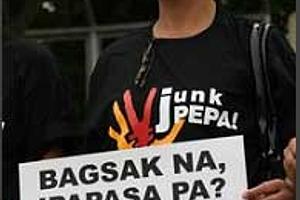
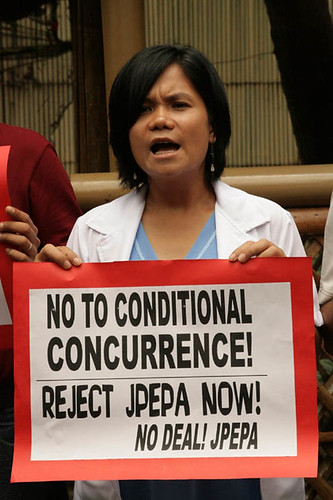
JPEPA was and remains hugely controversial. Filipinos -- and on some issues, Japanese groups -- mobilised to stop the deal for many reasons, including the following:

- the small job market openings for Filipino healthcare workers are very limited (the workers must learn Japanese, undergo equivalency exams, stay for only a restricted time etc) and overlook the real potential for abuse of Filipino workers in Japan;
- concerns that Japan will gain access to and be able to overfish Philippine waters, ruining the livelihoods of small fisherfolk;
- any supposed benefits for increased pineapple and banana exports to Japan would in fact go to corporations like Dole and Del Monte, and their local business partners, who own and run the plantations in the Philippines -- not to small or landless Filipino farmers;
- its unconstitutionality, since JPEPA allows Japanese corporations to own land, operate schools and practice certain professions in the Philippines which the Philippine Constitution does not allow;
- the huge imbalances in the deal, e.g. Japan excluded almost 200 tariff lines from the agreement, the Philippines only six; and
- the fact that JPEPA gives explicit legal ground for Japan to dump toxic wastes in the Philippines.

last update: May 2012
Photo: Karasantos / CC BY-NC-SA 2.0

'SC ruling on JPEPA may lead to one-sided trade deals'
The No Deal! Movement, which has actively campaigned against the Japan-Philippines Economic Partnership Agreement said that the Supreme Court decision to uphold secrecy of Philippine government negotiations over trade deals "will set a dangerous precedent, legitimizing the marginalization of ordinary Filipinos from having access to pertinent information on economic treaties such as JPEPA that will have a deep impact on their interest and livelihood"
SC affirms ‘executive privilege' on JPEPA negotiations
The Philippine Supreme Court has upheld the “executive privilege” invoked by the government in refusing to accede to a request by several lawmakers, and partylist and militant groups for a full disclosure of its negotiations with Japan involving the controversial trade agreement.
Youth group slams crackdown on protesters at G8
Militant Filipino youths scored Tuesday what they called the repression against protesters at the G-8 summit in Hokkaido, Japan, and demanded the release of the arrested protesters. In a letter to Japanese ambassador Makoto Katsura dated July 8, the youths also reiterated their opposition to the Japan Philippines Economic Partnership Agreement (JPEPA).
Japan agrees to amend trade treaty
Japan is willing to sign a side agreement with the Philippines to quiet concerns about provisions in a free-trade treaty deemed inconsistent with or violate the Philippine Constitution, an official said yesterday.
JPEPA: 'Unconstitutional' on 15 counts yet...
The Philippines Senate's ratification of the Japan-Philippines Economic Partnership Agreement (JPEPA) is not likely to push through until, possibly, this August.
Activists brave murky Manila Bay to rail vs JPEPA
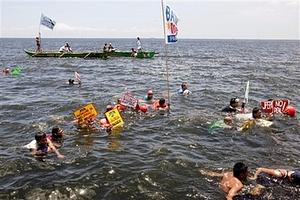
Fourteen activists, most of them fisherfolk, braved the murky waters of Manila Bay Monday morning, swimming 10 kilometers from Bacoor, Cavite to the Senate gates in Pasay City to protest the Japan-Philippines Economic Partnership Agreement (JPEPA) and what was then the proposed "conditional concurrence" of the trade pact.
Santiago defers sponsorship of JPEPA
It's back to the negotiating table for the controversial Japan-Philippines Economic Partnership Agreement (JPEPA) after Philippine Senator Miriam Defensor-Santiago on Monday agreed to defer consideration of the treaty on the request of Foreign Affairs Secretary Alberto Romulo.
Japan Diet pressures RP Senate to ratify Jpepa - group
Anti-Jpepa (Japan-Philippines Economic Partnership Agreement) activists on Tuesday accused the Japanese Diet of pressuring the Philippine Senate to ratify the controversial RP-Japan economic pact.
Senate urged to reject proposed concurrence to Manila-Tokyo trade deal
Sectors from the urban poor, farmers, nurses, fisherfolk, labor and the environment gathered at a press conference on Saturday, calling on the Philippine Senate to reject the conditional concurrence resolution that Senator Miriam Santiago unveiled during her privilege speech at the Senate re-opening early last week.
DFA asks Senate to defer vote on JPEPA
The Philippines Department of Foreign Affairs (DFA) has asked the Senate to defer consideration of the controversial free trade agreement between the Philippines and Japan so that it can comply with the conditions set by the Senate for its ratification.