

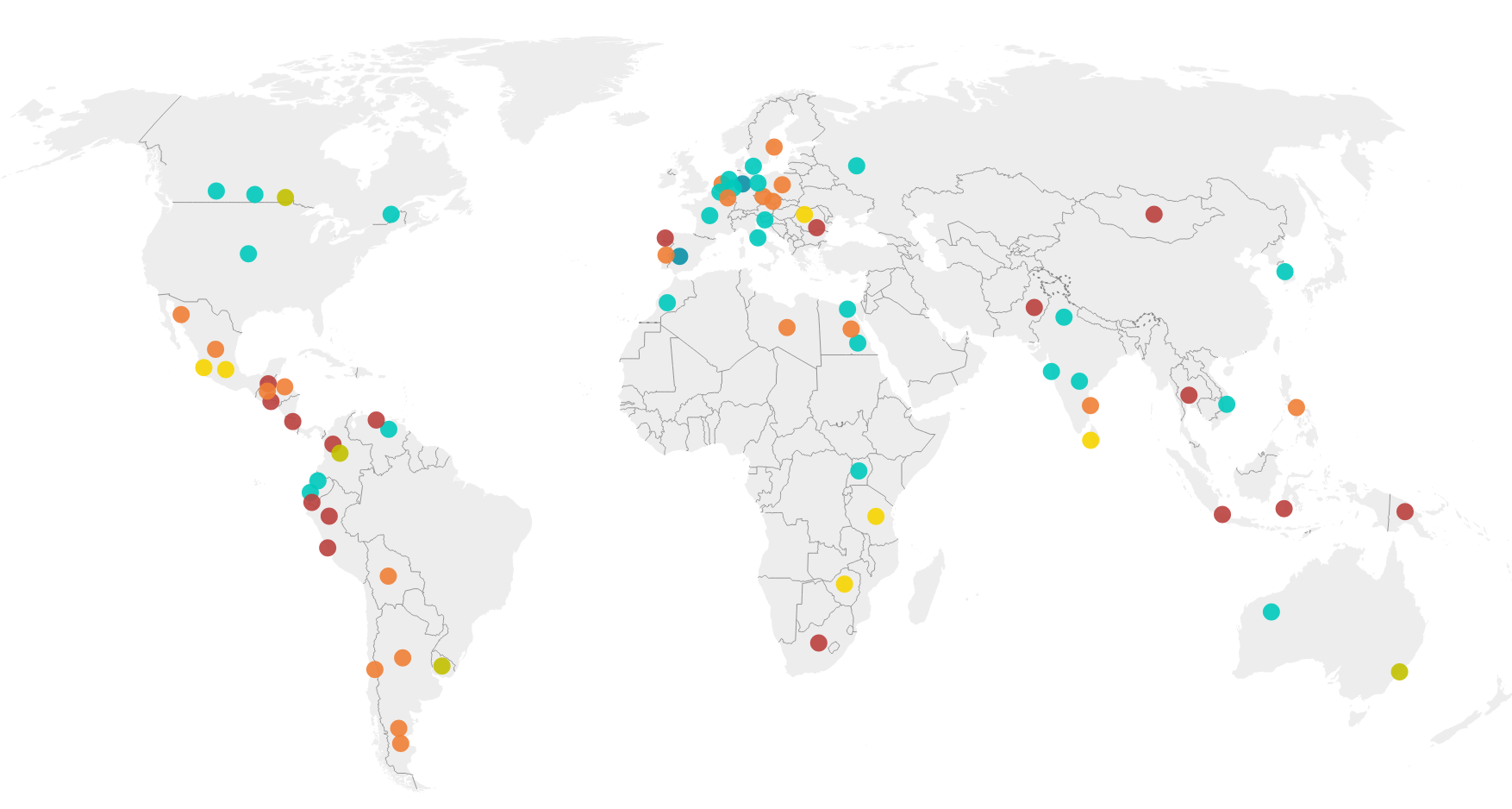
ISDS Case Map


Until recently, Japan focused its bilateral negotiating agenda on a few countries around the Pacific. Major deals have been signed with Singapore (2002), Malaysia (2004), Mexico (2004), Philippines (2006), Indonesia (2007), Chile (2007), Thailand (2007), ASEAN as a whole (2008) and Vietnam (2008).
In mid-2006, Tokyo announced the start of FTA talks with Brunei and these were wrapped up in 2007. Japan’s deals with both Brunei and Indonesia are unique because they guarantee Tokyo access to oil and gas supplies.
In mid-2006, Japan went so far as proposing an overarching East Asian FTA encompassing Japan, ASEAN, India, China, Korea, Australia and New Zealand. ASEAN, among others, gave this idea a cool response.
In 2007, negotiations with India and Australia began, while somewhere down the pipeline, Colombia, China, Korea, Cambodia and Laos are also on the agenda.
Other countries are further targets creeping into Japan’s bilateral trade agenda:
- In early 2005, Japan started exploring possible talks with Switzerland, and the actual negotiations started in 2007.
- In 2006, spurred by concerns about access to energy resources, Japan moved towards kicking off talks for an FTA with Kuwait and other oil and gas-rich Gulf Cooperation Council (GCC) countries.
- There are also growing concerns about trade disadvantages for Japanese firms on a wider international scale, leading to FTA overtures towards Brazil, South Africa, New Zealand and even some wishful talk of a US-Japan deal.
- In late 2011, Japan showed interest in negotiating an FTA with Burma.
- In March 2012, there were indications of upcoming FTA talks with Mongolia and Canada.
The deals put forward by Japan are called "Economic Partnership Agreements" (EPAs), as the government holds that the term "free trade agreement" doesn’t capture the broader integration of economic and social policies that these treaties aim to achieve between the partner countries. But these EPAs are similar in coverage to a typical FTA from the US, New Zealand or the EU, if less ambitious on the content.
Domestic opposition to FTAs has crystallized around the announcement that the Japanese government intends to join the Trans-Pacific Partnership (TPP.) 2011 and 2012 have seen major demonstrations against the agreement were mounted by Japanese farmers, targeting the undermining of food security which agricultural liberalization under the proposed deal could bring about, especially in relation to rice. Zenroren (National Confederation of Trade Unions) also opposes the deal, with concerns about job losses, the opening up of the economy to US capital, and the erosion of living standards and working conditions. Many Japanese opponents view the TPP as being essentially a bilateral FTA with the US.
last update: May 2012
Photo: USDAgov / CC BY 2.0
Anti-FTA campaign page of Consumers Union of Japan
Ministry of Foreign Affairs webpage on Japan's FTAs and EPAs
Japan Business Federation, established in 2002. Website contains several policy papers and position statements on Japan's FTA strategy.
The bilaterals.org team is pleased to announce the launch of an upgraded version of the website and its content management system.
Click here for more information.