

EU-Korea


In May 2007, the European Union and South Korea started negotiating a bilateral free trade agreement. It took effect on 1 July 2011.

This deal is part of the EU’s post-2006 "Global Europe" strategy to boost the competitiveness of EU corporations in the world by securing deeper commitments to neoliberal policies from trading partners, including expanded rights for European transnationals. In Korea, the European Union is trying to win equal, if not better, footing against US firms after the conclusion of the US-Korea FTA. (The EU makes stronger demands than the US on Korea in the areas of intellectual property, services, competition policy and environmental standards.)

Social movements from both sides mobilised against the deal’s potential impacts. One flashpoint of concern is for Korea’s agricultural sector, where pig farmers in particular are expected to suffer from an influx of subsidised EU pork as a result of this deal.

last update: May 2012
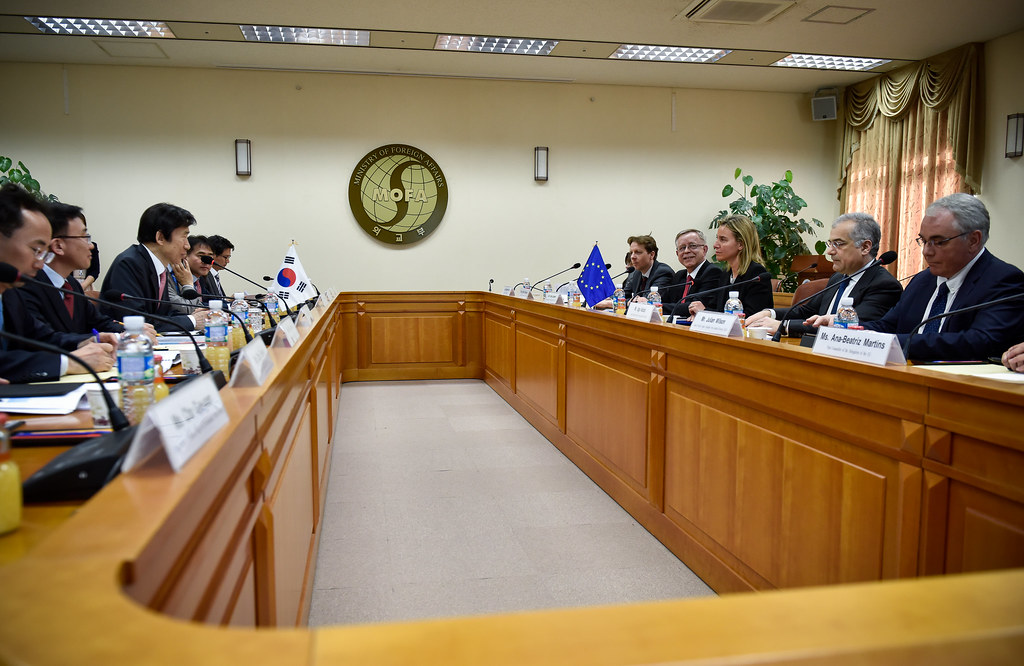
photo: European External Action Service - EEAS/CC BY-NC-ND 2.0


EU demands greater access to South Korean agri market at FTA talks
The EU claims there are considerable gaps between what Seoul is offering Brussels and what was agreed upon with Washington
Korea-EU FTA talks see differences over IPR & cars
Already, the EU has shunned Korea's request to include goods made in the inter-Korean industrial park in North Korea's border city of Kaeseong in their potential FTA and requested Korea to introduce a system in which cafes and restaurants pay royalties to music producers and performers.
Discord among delegations in EU trade negotiations
With the European Union and South Korea starting their talks on a proposed free trade agreement (FTA) in Brussels, Korean negotiators remain divided over how to open the country's market to one of the world's largest economic blocks. The cacophony represents the fact that the government has not put in enough effort to gather consensus before negotiations began and only pushes for the conclusion of the economic deal in a hasty way.
S. Korea, EU have differences over automobiles in free trade talks
South Korea and the European Union are struggling to narrow differences on tariffs and safety regulations on automobile trade as they try to forge an ambitious free trade agreement, a top South Korean negotiator said Tuesday.
EU sets ambitious goals for South Korean free trade deal
'We are setting the bar very high with a 100-per-cent trade liberalization offer,' an EU trade official told Deutsche Presse-Agentur as European and South Korean officials opened a second round of negotiations in Brussels.
Korea removes rice from EU FTA talks
South Korea has sent a draft proposal on free trade talks to the EU, promising to remove or phase out import tariffs on cars over seven years. Seoul has also decided to exclude rice from its list of markets subject to opening, but it may agree to open up its agricultural market, including beef.
Kaeseong goods expected to be problem at EU FTA talks
Korea's chief envoy to free trade talks with the European Union is cautioning against being overly optimistic about having products made at an industrial park in North Korea's Kaeseong included in the bilateral trade deal.
EU FTA to focus on manufacturing sector: official
The ongoing free trade pact talks with the European Union (EU) will be centered on the extent of liberalization of the manufacturing sector, a senior Korean government official said Thursday.
FTAs uncorking big changes in Korea's wine market
The Korean wine industry expects the Korea-EU free trade agreement will cause a third seismic shift in Korea's imported wine market.
S. Korean minister calls on EU firms to consider investment in Kaesong complex
South Korea's commerce minister on Monday called on European companies to consider investing in an inter-Korean industrial complex in North Korea.

Referenced sites

EU-Korea FTA SIA

The EU-Korea FTA Trade Sustainability Impact Assessment (SIA) is intended to produce studies in order to provide a deeper understanding of the sustainability...