


EU-GCC


The European Union and the Gulf Cooperation Council signed an Economic Cooperation Agreement in 1988 which laid the framework for the elaboration of a bilateral free trade agreement between the two regional blocs. Formal negotiations began in 1990 and are still not concluded.

While the EU has powerful economic interests in liberalising investment rules in the Gulf States, so that EU corporations may participate directly in the region's oil, banking, telecoms, port services and other industries, political issues have been publically blamed for blocking agreement. These include demands from the EU with regards to fulfilling standards of democracy and human rights, as well as clauses on cooperation against terrorism and weapons of mass destruction. Human rights groups, such as the International Federation for Human Rights, have urged the EU to insist on respect for freedom of press, women's rights and labour rights of migrant workers in the Gulf countries in return for any trade concessions granted through the FTA.

At the end of 2008, the GCC formally announced it was suspending the trade talks due to the EU's insistence on political demands.

last update: May 2012
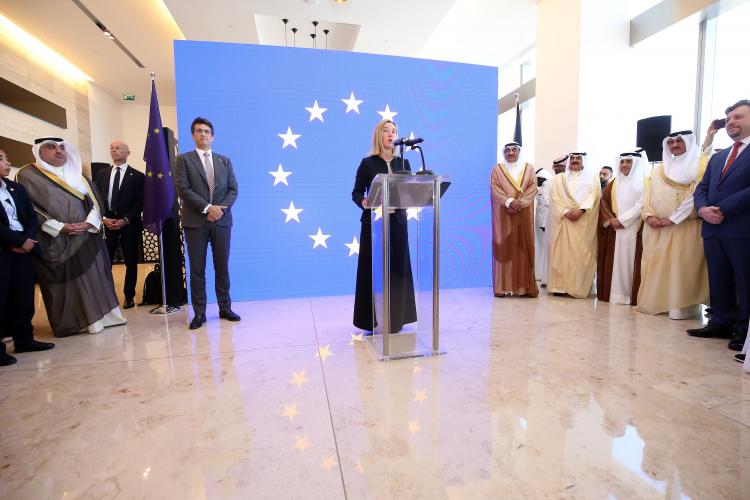
photo: European External Action Service - EEAS/CC BY-NC 2.0


EU urged to sign free trade deal with Gulf states
Gulf oil producers yesterday urged the European Union to stop setting conditions and sign a free trade agreement that has eluded the two sides for nearly two decades because of persistent rifts.
Gulf states, EU to resume negotiations over free-trade agreement
The EU is expected to drop "noneconomic demands" to which the Gulf states object, according to a report from the Emirates Industrial Bank.
EU free trade secondary to Asia pacts: Al Mansouri
The six-nation Gulf Cooperation Council (GCC) is concentrating on trade talks with East Asia after negotiations with the European Union stalled, Sultan Bin Saeed Al Mansouri, Minister of Economy, said.
West accused of ‘hypocrisy' on free trade
A former Qatari minister yesterday lambasted Western “hypocrisy” and “double standards” when it came to free trade agreements (FTAs) with smaller nations. And he maintained that the GCC-US FTA was a thing of the “past”.
GCC-EU FTA hits roadblock again
Free trade talks between the GCC and the European Union have been suspended again after the two sides failed to reach an agreement on human rights and customs duties on GCC exports to Europe.
US should consider trade pact with EU --manufacturers
A proposed trade deal between Canada and the European Union puts pressure on the United States to begin thinking about its own trade pact with Europe, U.S. manufacturers said on Tuesday.
EU-GCC free trade talks to resume after being derailed in December
The European Union and the Gulf Cooperation Council's Joint Council meet today at the Al Bustan Palace Hotel to put on track the Free Trade Agreement talks that were derailed by the GCC last December.
GCC mulls reopening free trade talks aith EU
The Gulf Cooperation Council chief and Saudi and Omani ministers on Sunday discussed how to revive talks on a free trade accord with the European Union that broke down in December
EU responds to demands with more demands
The demands which stood as obstacles to signing an EU-GCC FTA are non-commercial demands, although GCC countries made a great leap in updating and modernising economic and commercial laws in the past years, thinking this would meet EU requirements in this respect.
Massive GCC trade imbalance at heart of failed FTA with EU
Gulf oil producers have accused their main economic partner the European Union (EU) of lacking interest in signing the long-sought free trade deal as it shifts interest to partners in East Europe.