

EU-GCC


The European Union and the Gulf Cooperation Council signed an Economic Cooperation Agreement in 1988 which laid the framework for the elaboration of a bilateral free trade agreement between the two regional blocs. Formal negotiations began in 1990 and are still not concluded.

While the EU has powerful economic interests in liberalising investment rules in the Gulf States, so that EU corporations may participate directly in the region's oil, banking, telecoms, port services and other industries, political issues have been publically blamed for blocking agreement. These include demands from the EU with regards to fulfilling standards of democracy and human rights, as well as clauses on cooperation against terrorism and weapons of mass destruction. Human rights groups, such as the International Federation for Human Rights, have urged the EU to insist on respect for freedom of press, women's rights and labour rights of migrant workers in the Gulf countries in return for any trade concessions granted through the FTA.

At the end of 2008, the GCC formally announced it was suspending the trade talks due to the EU's insistence on political demands.

last update: May 2012
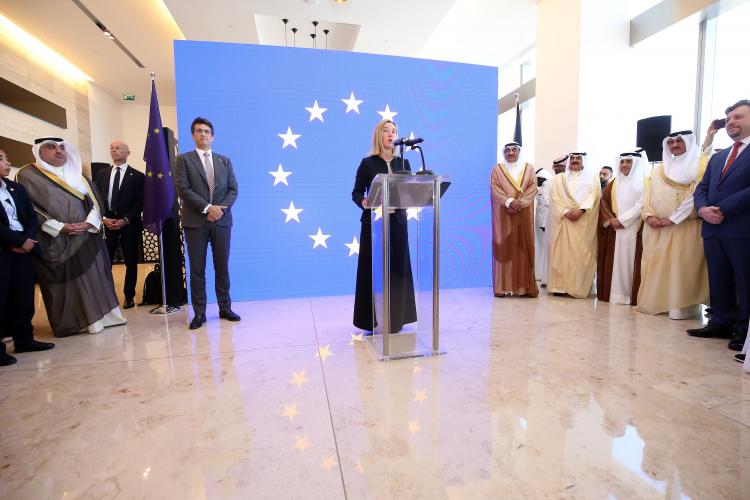
photo: European External Action Service - EEAS/CC BY-NC 2.0


Portugal expects FTA to bolster EU-GCC trade ties
Buoyed by a big surge in exports to Dubai, Portugal said on Thursday that it expects to significantly boost its trade with the GCC after the conclusion of a long-awaited free-trade agreement between the European Union and the GCC.
Sweden eyes stronger relations with UAE, supports EU-GCC FTA agreement
Swedish officials have expressed their country's desire for wider trade and investment relations with the UAE and for a stronger presence in the Gulf country for Swedish businesses seeking to further expand into the whole Gulf region.
Export duty halts signing of agreement with EU
Export duty is one pending issue that needs to be resolved before an EU-GCC free trade agreement is signed, disclosed Tomas Dupla del Moral, Middle East and south Mediterranean External Commissioner with the European Commission in an email exchange with the Kuwait Times this week.
EU-GCC relations enter new phase
The European Union (EU) and the Gulf Cooperation Council (GCC) last week celebrated 22 years of their relationship by launching a three-year Joint Action Programme (JAP) to move forward to stronger cooperation with confidence and optimism.
Difference on duties blocks GCC-EU deal
Despite 98% of the issues of the long-awaited Free Trade Agreement between the GCC and EU having been successfully negotiated, the GCC’s decision to impose customs duties on EU exports remain the only sticking point, an EU source has said.
GCC members suspend free-trade talks with Europe
“Negotiations were suspended because EU countries added a clause depriving GCC countries the right to impose duties on EU exports in the future,” the Director General of the External Economic Relations Department at the Gulf Cooperation Council said.
UAE to push GCC-EU free trade plan
The UAE will push for a long-awaited free trade agreement between the GCC and the European Union during the Emirates presidency of the Gulf states’ bloc next year, said the Foreign Minister.
GCC states may not resume EU FTA talks
GCC states may once again refuse to resume free trade agreement talks with the European Union due to “intransigence” on the European side, a senior official said.
Lobbies trying to stall FTA with EU: Attiyah
Lobbies representing European petrochemicals and aluminum industries are attempting to stall the long overdue free trade agreement between the Gulf Cooperation Council and the European Union because they are concerned about compettion from the GCC
FTA between GCC, EU expected to be sealed next March: Kuwaiti official
The long-awaited negotiations on a Free Trade Agreement between the European Union and the Gulf Cooperation Council is expected to be completed by next March, a Kuwaiti senior official said Tuesday.