

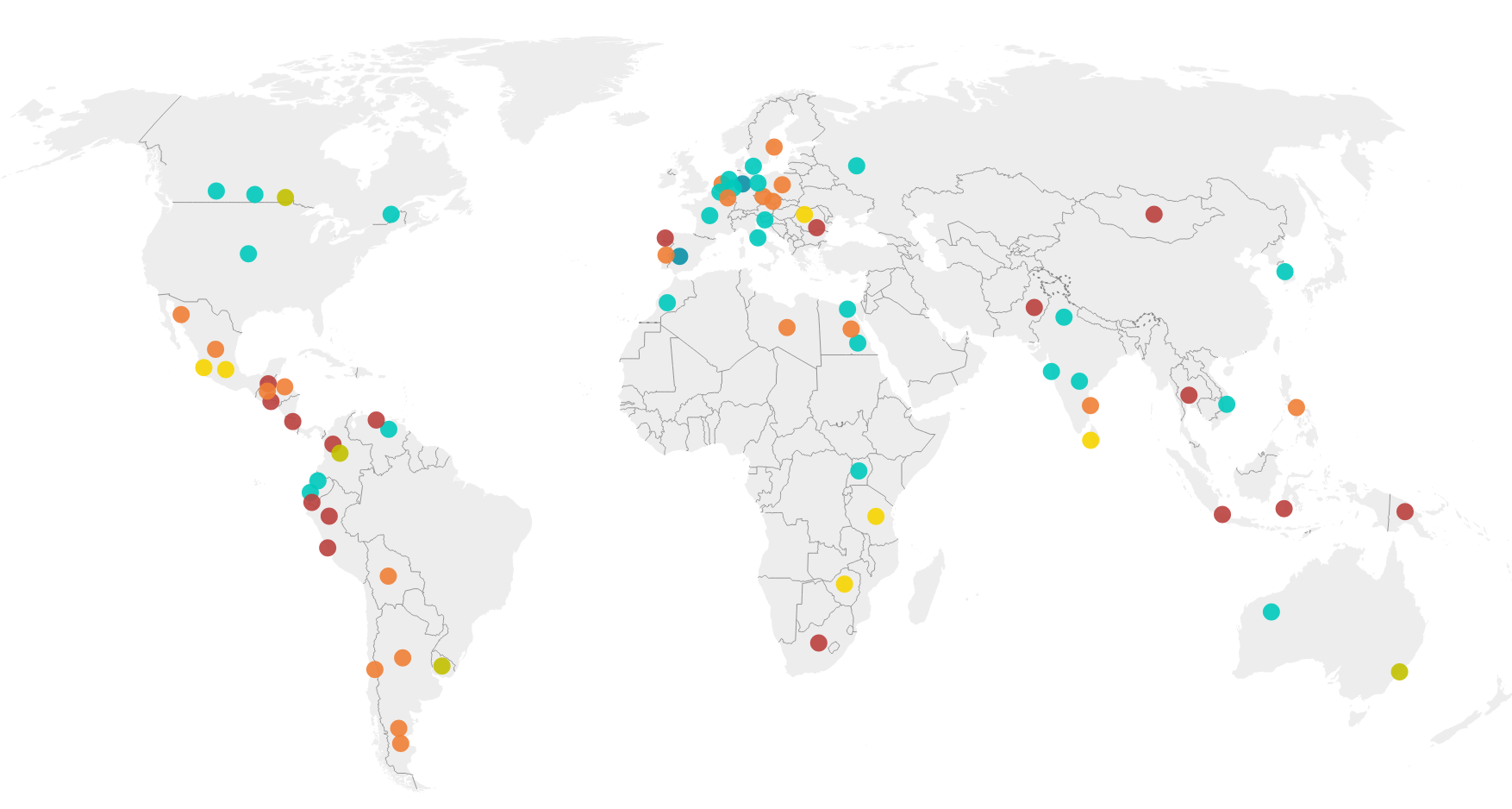
ISDS Case Map

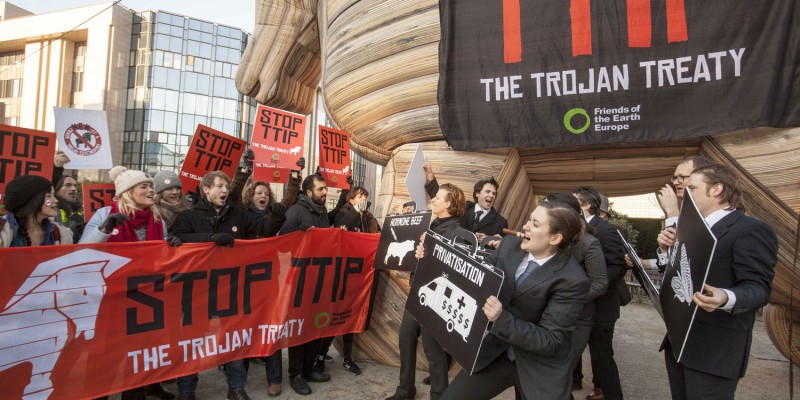
Given that most tariffs between the EU and USA are already at minimal levels, the central focus of the negotiations is the removal of regulatory barriers to trade. This deregulation will contribute 80 per cent of the total corporate gains from TTIP, according to official calculations, yet the ‘barriers’ to be removed include some of the most important rules and standards that safeguard public health, labour rights and the environment. Negotiators are also keen to remove rules that protect local economies and jobs from unfair competition, with potentially devastating consequences. The official assessment undertaken for the European Commission in 2013 calculated that TTIP will lead directly to the loss of at least one million jobs in the EU and USA combined.
Where the negotiations are unable to complete this deregulatory agenda, TTIP seeks to harmonise regulations. Any proposed new regulations in the future could be screened in order to minimise their impact on private sector activity. If national governments do still introduce any new laws or regulations on corporate activity, TTIP will include provisions for an investor-state dispute settlement (ISDS) mechanism to allow foreign investors to sue the host country in their own privileged court system for any resulting loss of future profits.
The EU and USA have seen their global economic importance diminish since the Second World War, so that they now represent around half of world GDP rather than three quarters, as before. In geopolitical terms, TTIP is an attempt to restore the transatlantic alliance in response to the challenge of emerging economies such as Brazil, India and China. Frustrated at no longer being able to impose their will unchallenged in the multilateral forum of the WTO, the EU and USA have identified TTIP as their opportunity to devise together a template for all future trade deals around the world.
The other geopolitical target of TTIP is Russia. The negotiation of increased exports of oil and gas from the USA to Europe is explicitly designed to break the dependence of Central and Eastern European states on energy supplies from Russia, with US negotiators speaking openly of TTIP as the ‘economic NATO’ that will allow Washington to isolate Moscow as it did in the Cold War. Yet TTIP will thereby condemn Europe to decades of dependency on fossil fuels from North America, just when the reality of climate change demands an immediate transition to clean energy sources. Despite its admission that TTIP will lead to millions of tonnes of extra CO2 emissions, the European Commission is still using the negotiations to press for unrestricted access to US energy supplies.
There is now an unprecedented movement of mass opposition against TTIP in Europe. Anti-TTIP platforms have been established in every one of the 28 EU member states, and the self-organised European Citizens’ Initiative against TTIP and CETA raised over 3.3 million signatures in its first year alone. US labour and environmental groups are also raising their voices against TTIP, even if the debate in the USA has been more focused on the Trans-Pacific Partnership (TPP) instead. The EU-US trade negotiations are fast becoming a toxic political issue at national and international levels alike, as citizens recognise that the fight over TTIP is a fight for our very future.
Following strong public outcry and the election of Trump in the US, the talks were put on hold in 2017.
In July 2018, the US President and the EU Commission President agreed to relaunch trade talks on a "TTIP light" deal, after Donald Trump threatened to impose tariffs on European cars. The EU has been mandated to negotiate a limited agreement (on the removal of tariffs on industrial goods, excluding agricultural products, and on conformity assessment) while the US aimed for a larger deal that includes agriculture.
Contributed by John Hilary, War on Want in March 2016; updated in July 2019
Photo: Friends of the Earth Europe







Information sharing and coordination to stop the Transatlantic trade and investment partnership (TTIP), set up by Seattle to Brussels Network
L'alliance D19-20 est une alliance non partisane de citoyen-ennes, d'agriculteurs-trices, de syndicats qui luttent contre les politiques d'austérité. #D1920
Brussels, 13-17 October 2015. Five Days Fighting TTIP : Meetings, Actions, Blockade
European Public Health Alliance news feed on the prospective EU-US Trade Agreement (TTIP) & its potential impact on public health - Subscribe!!
des deutschsprachigen TTIP Mandats für die Geheimverhandlungen zwischen EU und USA
New web page from the European Commission containing fact sheets and proposed legal text for TTIP
Consolidated wiki page on TAFTA
Grupo de Portugal para análise crítica ao Acordo UE-EUA (TTIP)
Web tool set up by AK Europa, ÖGB Europabüro and Friends of the Earth Europet to help people take part in the EU consultation -- until 6 July 2014 -- on inve...
Campaña contra el Tratado Transatlántico de Comercio e Inversiones
Non au Grand Marché Transatlantique – StopTAFTA – Non au TTIP – Non au TCIP
Après des années de négociations discrètes, l’Union européenne et les Etats-Unis préparent officiellement la mise sur pied d’un Marché transatlantique. L’obj...
The bilaterals.org team is pleased to announce the launch of an upgraded version of the website and its content management system.
Click here for more information.