


Resisting the corporate grip on climate action: From Santa Marta to Southeast Asia
On 24-29 April 2026, 57 countries came together for the first conference on transitioning away from fossil fuels in Santa Marta, Colombia, co-organised by Colombia and the Netherlands. TNI researchers participated because of the conference’s specific commitment to energy transition and its recognition of a major barrier to climate action: Investor-State Dispute Settlement (ISDS) as.
The summary of the Academic Dialogue to the Santa Marta Conference made this recognition clear, calling on governments to “realign international legal frameworks to support just transitions… [and] collectively act to neutralise the barrier from ISDS to the transition”. It includes no less than five related recommendations for governments. Yet while civil society and experts’ recommendations were clear, what appeared in the official conference summary was rather weak: “Participants discussed that financial, legal, and investment systems continue to constrain implementation of the transition…such as ISDS, which by some were perceived as creating barriers, while the extent to which these barriers are perceived varies.”
As a part of the transnational trade justice movement, TNI has been advocating against ISDS in trade and investment agreements for over ten years. UNCTAD data has highlighted that 235 fossil fuel related cases and at least 123 ISDS proceedings arose in relation to the renewable energy sector by the end of 2023. TNI and partners’ Global ISDS tracker also highlighted that 129 claims have been filed seeking USD 1 billion or more. What made Santa Marta notable was the growing recognition amongst civil society, academia and progressive governments that legal and financial systems, particularly ISDS, can obstruct meaningful climate action.
Yet the lack of commitment to action from the official conference highlights the gap between civil society and governments, and also the Global South and Global North. While the two host countries are committed to climate action in public, where ISDS is concerned they represent the opposite ends of the spectrum. Last month Colombian President Petro announced the government’s intention to withdraw from the investment protection regime, while on the other hand the Netherlands is a global hub of the ISDS system, with 70 active BITs containing ISDS used in nearly 10 percent of all ISDS cases worldwide.
But why should people care about ISDS?
ISDS provisions, embedded in thousands of trade agreements, allow corporations to sue governments when public policies threaten expected profits. Sold to governments as a means to attract foreign investment, following over thirty years of ISDS in practice there is no evidence to support this claim. ISDS has increasingly been used by fossil fuel and mining companies to challenge people and planet positive initiatives: environmental regulations, coal phase-outs, mining restrictions, and renewable energy policies.
With the demand for minerals like copper, lithium, nickel, rare earth elements and others, indigenous land struggles against extractivism and mining are on the rise, particularly in the Atacama saltpans (known as the ‘Lithium Triangle’, Argentina, Bolivia and Chile), the Amazon Basin (Brazil, Venezuela and Colombia), and in several Southeast Asian countries.
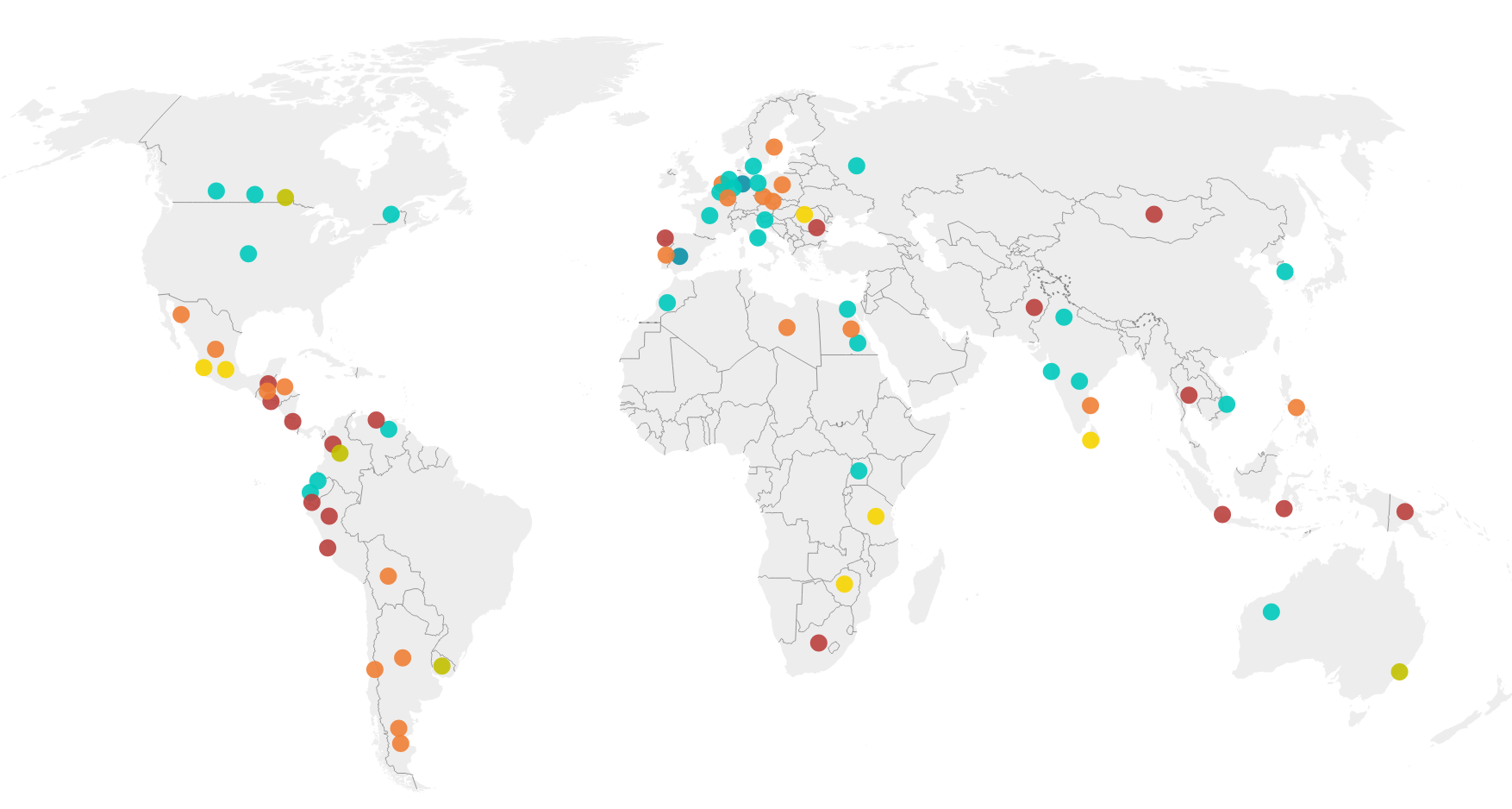
Colombia was co-leading the Santa Marta process, with Brazil, Mexico, Chile, Costa Rica, Guatemala, Panama, Uruguay also in attendance, several of which have had their own fraught experiences with ISDS. By October 2025, 419 ISDS claims had been filed against countries in Latin America and the Caribbean, representing almost a third of all cases, with Venezuela, Argentina, Mexico , Peru, Ecuador, Colombia and Panama being most sued. Lawsuits linked to mining, gas and oil accounted for 23% of total claims.
The US-China rivalry has also impacted the trade and investment landscape as the US, Canada and the EU have looked to ASEAN countries, particularly Indonesia, in the quest to diversify critical raw minerals supply chains away from China. Southeast Asian countries are becoming increasingly exposed to arbitration risks from energy reforms, the restriction of mining activities or shift towards renewables, especially as new trade agreements are being negotiated or revised. As seen in the minimal participation from Asian countries in the Santa Marta conference, more work is needed to highlight ISDS as a barrier to climate justice.
Yet indigenous communities impacted by investments, civil society, and several governments are familiar with the impacts of ISDS. Bolivia was the first country to withdraw from the ISDS system after leaving the ICSID Convention in 2007. Venezuela withdrew from ICSID in 2012 and terminated several investment treaties amid disputes linked to oil-sector nationalisation. Ecuador terminated all of its BITs in 2017 following the recommendations of the audit commission (CAITISA), and Honduras withdrew from ICSID in 2024. Brazil, one of the top recipients of foreign direct investment in Latin America, has never been a member of ICSID.
In Asia, scrutiny of ISDS has also been strong in some countries. India, for example, terminated around 68 BITs in 2016 after adopting a revised BIT model to narrow investor protections and strengthen state regulatory authority. Similarly, Pakistan terminated 23 BITs after facing major ISDS awards including the multibillion Tethyan Copper arbitration case. In 2014, Indonesia also terminated or renegotiated many BITs after facing ISDS claims following the ban of exports of raw materials.
Despite this, over the last few years the pressure to bring back and keep ISDS has increased. In Ecuador, the neoliberal government has been trying to scale back provisions in the constitution, including allowing international arbitration as a means to resolve investment disputes, which the people have rejected in two referendums. In Honduras following the elections in 2025, where there were serious questions of US interference, Honduras rejoined ICSID in January 2026, despite civil society pushback. In Asia, the Regional Comprehensive Economic Partnership, composed of 15 countries, is up for review in 2027 following a successful campaign in 2016 to keep ISDS out of the agreement.
Looking forward
The Santa Marta conference took place as the price of oil surged past USD 100 per barrel following the US-Israeli war on Iran, bringing the question of US intervention and fossil fuel reliance to centre stage.
With inflation and increased energy costs, impacting working people globally, countries are responding by trying to diversify energy supply, domestically or through imports. Amidst this, the investment case for renewable energy is being made as a pathway to diversify countries’ energy mixes to mitigate fiscal strain and reduce pressure on power systems in preparation for future crises. The EU has been cited as an example to show how adding more renewable energy into their mix since the war in Ukraine has mitigated the severity of the shock to the current crisis, linking renewable energy to energy security. Yet as we have seen, the securitisation of energy, and hence trade, pushed the EU to rush for critical raw materials minerals (CRMs) in the peripheries of Europe and beyond. This has also come hand in hand with the greenwashing of CRMs, mostly used for tech and military production.
There is a growing nexus between energy, tech and war, tied together through global trade networks and supply chains, which poses the question of who benefits?
Corporations and billionaires.
According to Oxfam International, the world’s biggest fossil fuel companies (Chevron, Shell, BP, ConocoPhillips, ExxonMobil and TotalEnergies) are projected to earn an additional USD 37 million a day in 2026 compared to 2025. Some of the biggest banks are also seeing their profits grow amidst the war on Iran. Arms companies have record order backlogs with companies such as BAE Systems, Lockheed Martin, Boeing and Northrop Grumman benefiting from more war and genocide. Palantir, among other militarised tech companies, is being increasingly used by governments across the globe for military and civilian data infrastructure, leading to its revenue growth of 19% in the first quarter of 2026 alone.
Struggles over energy and against extraction and investments, will continue from the land to the courts, as war, crises and extractivism continue to make profits for corporations and the rich. Within this system ISDS has repeatedly been used as a tool to punish governments and drain public budgets where they have investments and to impede countries’ attempts to limit the socio-ecological impacts of mining and fossil fuels.
The next conference will be co-hosted by Tuvalu and Ireland in 2027. Tuvalu is a co-host of the pre-COP later this year, a vocal Pacific Island nation at risk from rising sea levels. While ISDS has successfully been put on the agenda, our work now is to shift that recognition into action.