
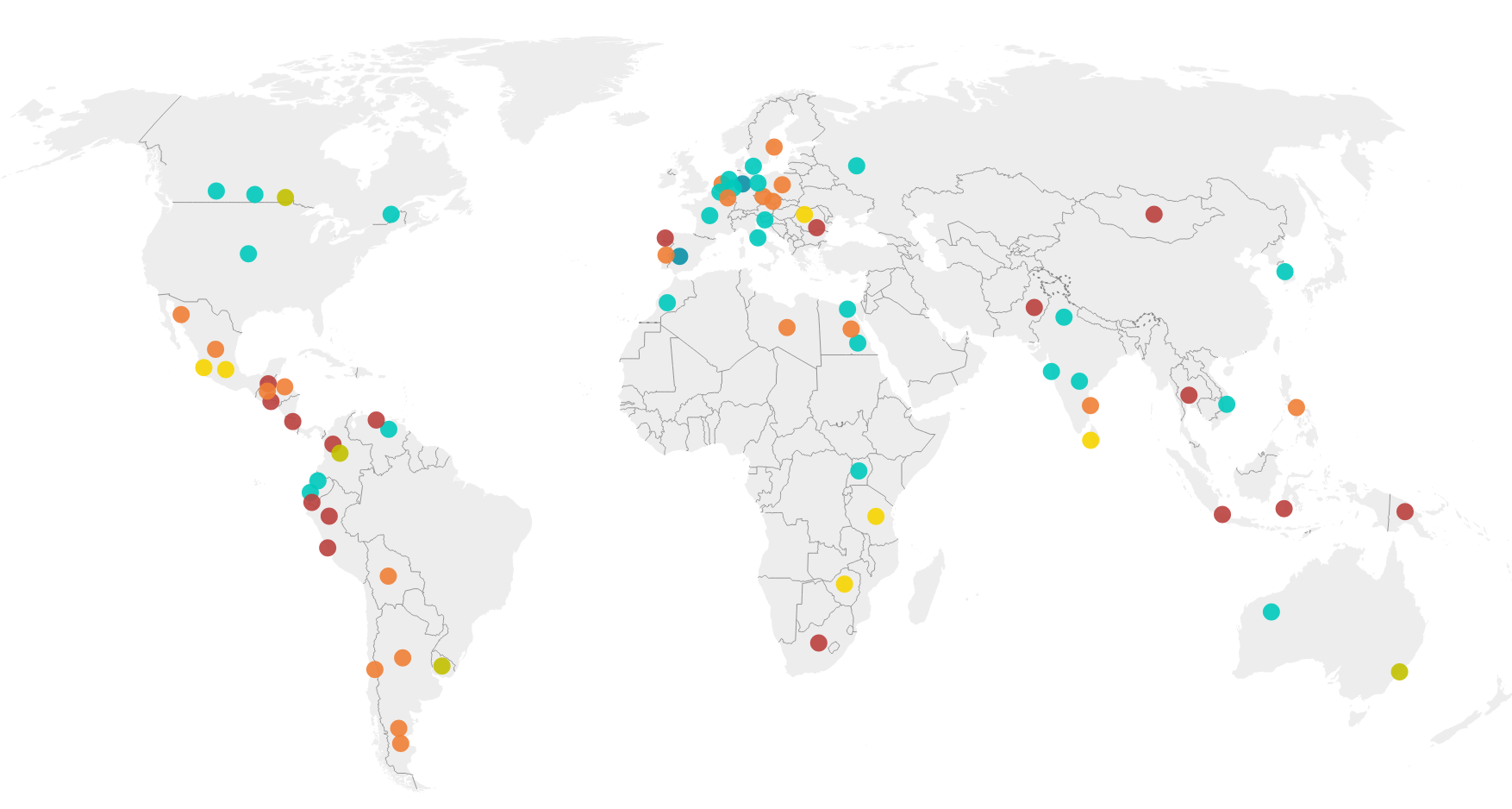
ISDS Case Map

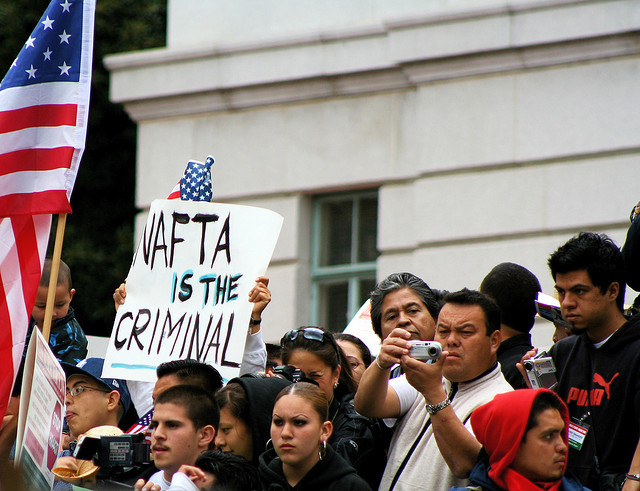
In North America, the North American Free Trade Agreement (NAFTA), which took effect on 1 January 1994, is the most emblematic free trade deal. It became a symbol of the neoliberal world order and served as a blueprint for agreements implemented over the following couple of decades. NAFTA expanded upon the 1989 Canada–US trade agreement and was seen as a landmark in setting new standards in areas such as agriculture, investment, intellectual property and services. However, dubbed a “death sentence” for Mexico’s campesinos and indigenous peoples, NAFTA sparked strong and sustained resistance in Mexico, including the Zapatista uprising. Thirty years of trade liberalisation under NAFTA has had dire consequences for populations. The most severe consequences have been felt in Mexico, where small-scale farming has been put in peril while jobs with low wages and poor working conditions have flourished. NAFTA was renegotiated in 2017 by the first Trump administration. The revamped version, the United States–Mexico–Canada Agreement (USMCA, or CUSMA in Canada), came into force on 1 July 2020.
Latin America is one of the most densely covered regions in the world by trade and investment agreements, it is also one of the regions where resistance is strongest.
Chile has signed over 30 trade agreements and more than 50 bilateral investment treaties (BITs). Peru has over 20 trade agreements and more than 30 BITs. Colombia, for its part, has over 15 trade agreements and more than 15 BITs. These three countries all have a trade deal with the United Statesand the European Union, while Peru and Chile have a trade agreement with China too.. Ecuador has over 10 trade agreements, including one signed with China and the European Union, and others under negotiation with the United States, the United Arab Emirates, and Canada. Ecuador denounced all of its BITs over a decade ago, as did Bolivia. Chile, Peru as well as Mexico are also members of the Comprehensive and Progressive Agreement for Trans-Pacific Partnership, a trade and investment agreement between 12 countries.
At the regional level, the Mercosur bloc (Brazil, Argentina, Paraguay, Uruguay, and Bolivia in the process of accession) has trade agreements with Israel, Egypt, and Palestine, as well as preferential agreements with India, Mexico, and the Southern African Customs Union. In 2025, Mercosur signed a trade agreement with the European Free Trade Association (EFTA), and in January 2026 it signed another with the European Union. The latter has already been ratified by all the bloc's countries and it is expected to enter into force provisionally in May 2026, until the European Union fully ratifies it. Mercosur has also announced negotiations for a trade agreement with Canada.
Faced with this expansion of the trade and investment regime, Latin America also has a long history of resistance. In 2005, one of the most important milestones was the defeat of the Free Trade Area of the Americas (FTAA), an attempt to create a free trade agreement covering the entire American continent, marking its 20th anniversary. This victory was the result of a coalition of social movements, unions, peasant organizations, and governments that questioned the project promoted by the United States. The continental campaign against the FTAA not only managed to halt that agreement but also set a precedent for building regional resistance networks.
Another central focus of these critiques by social movements is the investor-state dispute settlement system (ISDS), present in most BITs and many investment chapters of FTAs. ISDS allows transnational corporations to sue sovereign states before international tribunals. Latin America has been one of the most sued regions in the world under this mechanism, facing multibillion-dollar litigation that affects public finances and conditions decision-making.
In response, several countries have taken action to limit or abandon these mechanisms. Bolivia (2007), Ecuador (2010), Venezuela (2012), and Honduras (2024) withdrew from the International Centre for Settlement of Investment Disputes (ICSID), arguing the need to recover sovereignty. Among these countries, Ecuador returned to ICSID in 2021 and Honduras in 2026. More recently, in April 2026, Colombia has announced a review of its treaty policy and its possible withdrawal from these mechanisms.
The proliferation of these agreements has not solved the structural problems of development but has instead consolidated a model based on dependency, extractivism, and subordination. In response, social movements have proposed alternatives, drawing on the experience of resistance and raising the need for regional integration centered on the people, sovereignty, and social justice.
last update: May 2026
Photo: Jim Winstead / CC BY 2.0
We want trade deals to be democratic, to benefit working people and the environment. We need to revolutionize the trade model and create a new global economy...
The dark secrets of EU-US trade talks
Finnish TTIP-info network
Austrian campaign website
TTIP - No Thanks! A coalition of German NGOs active in the field of agriculture, environment, development and trade policy was launched to critically monitor...
It aims to removing constraints on trade and investment activities in ASEAN, and elevating the importance of the U.S.-ASEAN economic relationship to American...
By the US government
The US Chamber of Commerce's information page on the US-Peru FTA
The US India Business Alliance (USIBA) was incorporated in response to the extraordinary growth of US-India trade and investment, which despite its tremendou...
USJBC has been pushing for a US-Japan FTA
The US-Korea FTA Business Coalition is a group of over 100 leading US companies and trade associations that strongly support the conclusion and passage of a ...
The Office of Bilateral Trade Affairs ensures that the overall foreign policy goals of the U.S. Government are factored into the development of U.S. bilatera...