
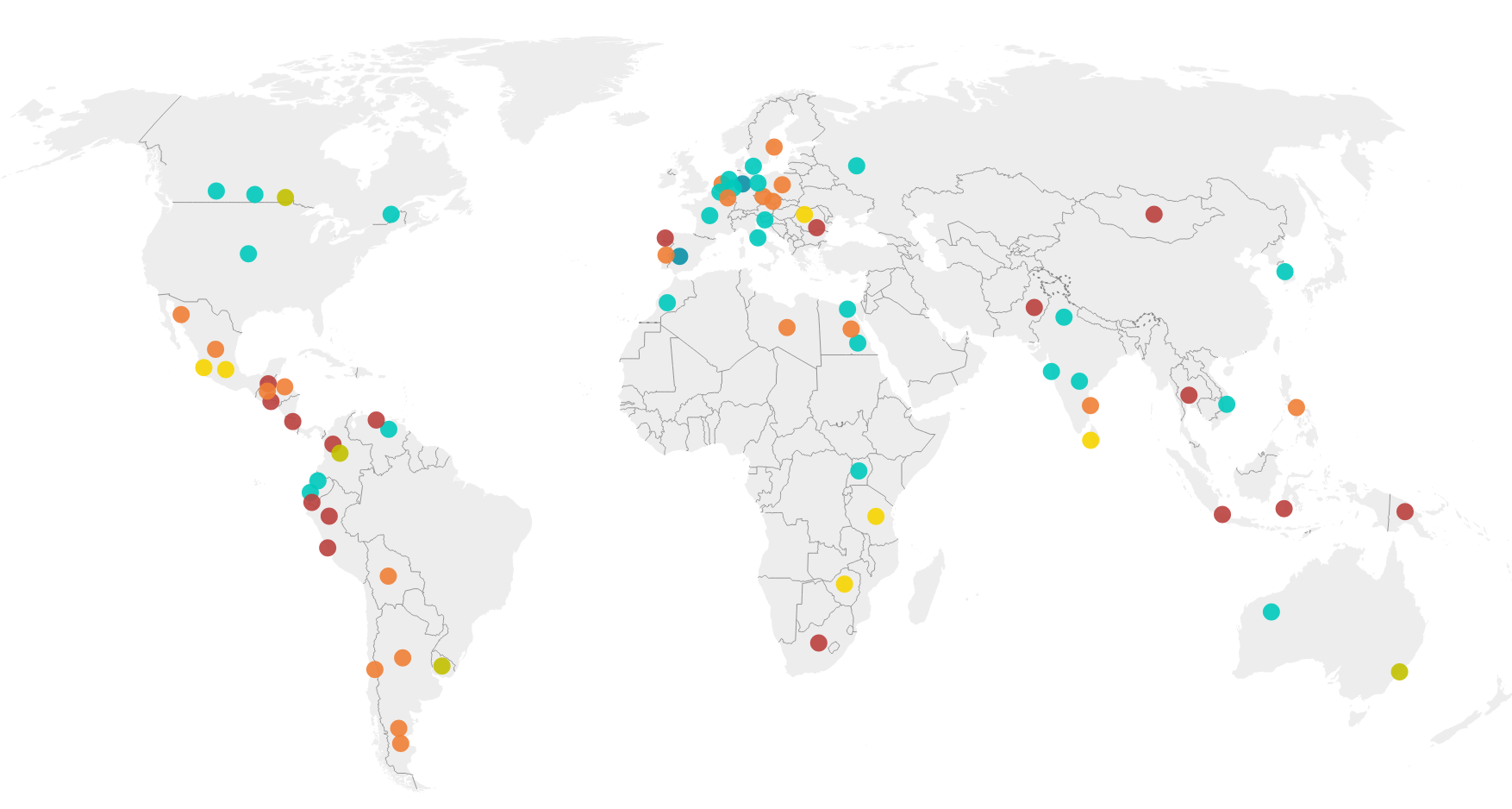
ISDS Case Map

European states have been among the most active in pushing trade and investment agreements with countries around the world. The main players in deal-making are the 27-country bloc of the European Union (EU), the European Free Trade Association (EFTA, comprising Iceland, Liechtenstein, Norway and Switzerland), the Russia-led Eurasian Economic Union (EAEU, also comprising Armenia, Belarus, Kazakhstan and Kyrgyzstan) and the United Kingdom (UK). Many of these agreements have sparked large-scale resistance movements and fostered international coordination among civil society groups worldwide because of the harmful neoliberal policies they impose on people and the environment, which mostly benefit transnational corporations and elites.
The EU has 44 free trade agreements (FTAs) in force with 76 partners. In January 2026, it signed agreements with Mercosur (Argentina, Brazil, Paraguay, Uruguay and soon Bolivia), a move that has attracted much controversy due to its potential impact on farmers, the environment and climate. It also signed an agreement with India. These initiatives are widely seen as a response to the geopolitical turmoil accelerated by Trump. Negotiations on several other agreements are ongoing, including those with Australia, Indonesia, Malaysia, Mexico, the Philippines, Thailand and the United Arab Emirates.
More recently, the EU has initiated new types of narrower deals that complement broader FTAs and are subject to less public scrutiny. It has signed digital trade agreements with South Korea and Singapore. It has also entered into several sustainable investment facilitation agreements, clean trade and investment partnerships, and raw materials partnerships.
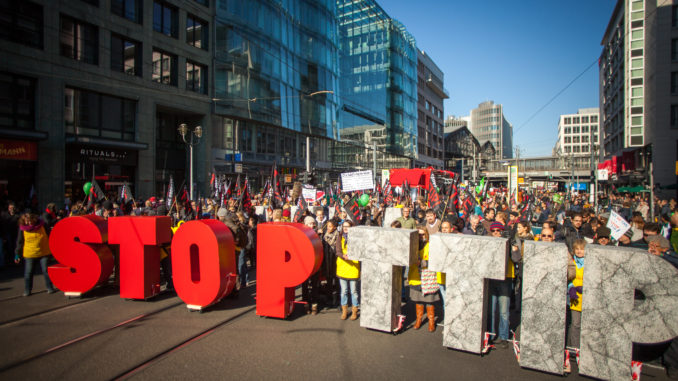
In the mid-2010s, there was an unprecedented movement of mass opposition to free trade agreements with the United States (the Transatlantic Trade and Investment Partnership, TTIP) and Canada (the Comprehensive Economic and Trade Agreement, CETA). Anti-TTIP platforms were established in each EU member state, and a self-organised European Citizens' Initiative against TTIP and CETA gathered over 3.3 million signatures in its first year. Critics were concerned about the potential impact on agriculture and food standards, as well as the inclusion of the investor-state dispute settlement (ISDS) mechanism, which allows foreign investors to sue the host country for any resulting loss of future profits in their own privileged court system. In 2017, the talks with the US were indefinitely put on hold, but CETA entered into force provisionally after its ISDS mechanism was rebranded as the "investment court system," which many activists claimed was largely window-dressing.
EFTA has currently signed 33 free trade agreements with 44 countries and territories outside the EU. These agreements have entered into force with 40 of these countries. The most recent FTAs that the bloc has signed are with India (in force since October 2025), Kosovo, Malaysia, Mercosur, Singapore (digital trade deal) and Thailand. EFTA is also negotiating an agreement with Vietnam.
These deals have been criticised by Swiss groups and a UN Special Rapporteur for pushing provisions that go beyond the requirements of World Trade Organization rules contained in the Agreement on Trade-Related Aspects of Intellectual Property Rights (TRIPS) – known as TRIPS+ – including UPOV91, which sets out rules that prevent farmers from saving seeds. These provisions are hampering farmers’ rights, as well as the rights to food and health. The EFTA-Mercosur agreement has also been slammed for prioritising increased dairy product exports over climate action.
The UK currently has 40 trade agreements in force with 72 partners, including the EU. These include continuity agreements that were rolled over from the time of EU membership and new negotiated deals.
The UK has post-Brexit agreements in force with Australia, New Zealand, as well as Singapore and Ukraine for digital trade only. In 2024, the UK joined the Comprehensive and Progressive Agreement for Trans-Pacific Partnership. It has signed a trade deal with India and is currently negotiating with the Gulf Cooperation Council (GCC), South Korea (an upgraded FTA), Switzerland, Thailand, Türkiye and the US.
Civil society groups have criticised the GCC deal for ignoring human rights and climate issues, and the India deal for endangering the South Asian country's ability to protect health, data and livelihoods. British groups have also condemned UK trade and investment deals for including the ISDS mechanism.
The EAEU has also been very active in negotiating trade deals. The union was historically set up to challenge the economic influence of the US and the EU, and to counter the two superpowers’ attempts to isolate Russia. Although its FTAs tend to be narrower in scope than those of its counterparts, the EAEU is known to push for provisions requiring countries to join UPOV.
The EAEU currently has trade agreements in force with China, Iran, Serbia and Vietnam. It has signed FTAs with Indonesia, Mongolia, Singapore and the United Arab Emirates. The union has been discussing trade deals with Cambodia, Chile, Egypt, India, Israel, Korea and Peru. Potential negotiations with ASEAN, Bangladesh, the Gulf Cooperation Council, Mauritius, Mercosur, Mexico, Morocco, New Zealand, Pakistan, Thailand and Tunisia could also emerge further down the line.
In 2012, the EAEU established a free trade area with Moldova, Tajikistan, Ukraine and Uzbekistan, as part of the Commonwealth of Independent States Free Trade Area. On 1 January 2016, Russia suspended the agreement with Ukraine, following the provisional application of the European Union-Ukraine trade deal.
Last update: May 2026
Photo credit: ARC2020
des deutschsprachigen TTIP Mandats für die Geheimverhandlungen zwischen EU und USA
The European Services Forum (ESF) is a network of representatives from the European services sector. We are committed to actively promoting the interests of ...
Wesbite of the European business lobby in ASEAN
Joint lobby platform of corporations from Japan and the EU, contains position papers and meeting reports
The EU-Korea FTA Trade Sustainability Impact Assessment (SIA) is intended to produce studies in order to provide a deeper understanding of the sustainability...
EU overview of EMFTA process and goals
New web page from the European Commission containing fact sheets and proposed legal text for TTIP
EurActiv articles on the Economic Partnership Agreeements
Eurochambres, a European business lobby group, webpage on FTAs
Friends of the Earth Europe's special web section on trade deals