

Alert to the Malagasy population concerning the Economic Partnership Agreement (EPA) with the European Union, to be signed on Wednesday 10 June on the island of Mauritius
translated by bilaterals.org
The Economic Partnership Agreement (EPA) between the European Union and the four Indian Ocean islands of Comoros, Mauritius, Seychelles and Madagascar is to be signed on Wednesday, 10 June on the island of Mauritius, according to the Facebook page of the European Union delegation to Madagascar.
To our knowledge, no representatives of peasant organisations or Malagasy civil society have participated in the negotiations for this agreement since 2022 (1).
However, there are important issues and problems that need to be discussed and resolved together. For example, the populations of the countries that have signed the EPA, including us, will be affected if the new measures proposed by the European Union are implemented. This would have a negative and potentially devastating impact on populations' right to food, as well as on peasant producers' right to use, select, protect and exchange seeds of their choice. Such actions would be prohibited under the "intellectual property rights" regime claimed by companies and required by this agreement. These concerns lie at the heart of the mobilisation of non-governmental organisations (NGOs), which are organising a significant event: the European Forum on Food Justice in Brussels on 9 June 2026.
What changes does the European Union plan to bring?
For decades, large companies and various financial powers have been pressuring States worldwide to implement strict laws and regulations that prohibit peasants from reproducing commercial seeds. The objective is to make their investments profitable. However, the result has been the criminalisation of peasants who sow, conserve, exchange and protect seeds from their farms, as they have always done (2).
In short, companies are seeking to privatise seeds through intellectual property rights, which would force peasants to pay every time they use them.
Intellectual property rights over seeds will increase agricultural production costs for peasants. This will result in worsening food insecurity and weakening food sovereignty.
Organisations such as UPOV (the International Union for the Protection of New Varieties of Plants), which is an intergovernmental organisation, promote the privatisation of seeds through patents. Peasant and citizen movements in several countries around the world oppose UPOV's approach (3).
For the right of Malagasy producers to freely use their seeds and for the right of the entire population to accessible food
We Malagasy people are not alone in our struggle to protect peasant and traditional seeds. However, we must strengthen the protection of seed-related rights here in Madagascar, in solidarity with farmers and populations in other countries.
We therefore ask the following:
- that the Malagasy authorities publish the contents of the Economic Partnership Agreement (EPA) prior to signing;
- that representatives of Madagascar refrain from signing any provisions concerning seeds, food or intellectual property rights without consulting peasant organisations and civil society in advance;
- that local seeds remain common property and are not transformed into the private property of individuals or companies;
- that farmers retain the right to freely choose the seeds they wish to use, in accordance with various international declarations and treaties that protect their rights;
- farmers should be able to continue their practices and develop their traditional knowledge regarding seeds without being forced to buy industrial seeds;
- the majority of the Malagasy population is vulnerable, so it is the responsibility of the government, decision-makers and international partners to preserve the right of the Malagasy people to food and food sovereignty by rejecting the new measures that the European Union plans to adopt.
This declaration and these demands are based on currently available information. They may evolve according to new information that might be made public regarding the actual content of the Economic Partnership Agreement (EPA).
These demands will remain valid regardless of the partner that wishes to conclude an agreement with Madagascar.
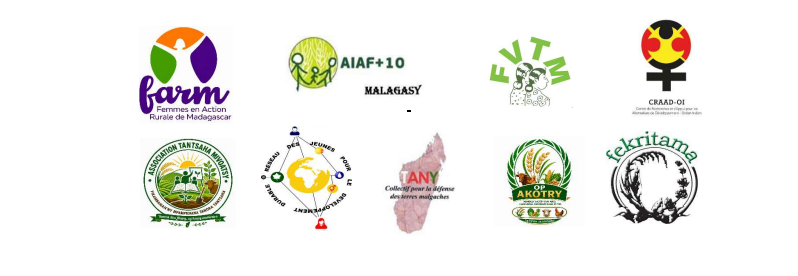
Signatories:
• Centre de Recherches et d’Appui pour les Alternatives de Développement – CRAAD-OI
• CNAF – Comité National pour l’Agriculture Familiale
• Collectif pour la défense des terres malgaches – TANY
• FARM – Femme en Action Rurale de Madagascar
• FEKRITAMA - Confédération des Agriculteurs Malgaches
• FVTM – Fivondronan’ny Vehivavy Tantsaha eto Madagasikara
• Organisation Paysanne AKOTRY
• RJDD – Réseau des Jeunes pour le Développement Durable
• Tantsaha Mivoatsy
References:
(1) https://terresmalgaches.info/collectif-tany-souverainete-alimentaire-madagascar-accords-partenariat-economique/
(2) GRAIN, UPOV 91 and other seed laws: short guide on the methods of seed companies to try to control and monopolize seeds
(3) https://www.apbrebes.org/news/open-letter-no-upov-eu-esa-epa
(4) The International Covenant on Economic, Social and Cultural Rights (ICESCR), the International Treaty on Plant Genetic Resources for Food and Agriculture (ITPGRFA) and the United Nations Declaration on the Rights of Peasants and Other People Living in Rural Areas (UNDROP)
(5) Geneva Graduate Institute, State of Farmers’ Rights to Seeds in the World, A systematic review of national regulations in Kenya, Rwanda, Madagascar and Colombia